
Automated issue reproduction is the process of automatically generating executable tests that replicate reported software bugs, a technique formally known as Bug Reproduction Test (BRT) generation. A BRT must fail on buggy code and pass on fixed code, giving developers and automated repair systems a concrete signal that a fix actually works. Modern approaches use Large Language Models (LLMs), Search-Based Software Testing (SBST), and agent-based multi-stage pipelines to generate these tests from bug reports alone. For software developers and product managers, understanding what automated issue reproduction means in practice is the difference between a reactive debugging culture and a systematic one.
What is automated issue reproduction and why does it matter?
Automated issue reproduction is defined as the programmatic generation of test cases that recreate a reported defect without manual developer intervention. The industry term for the output is a Bug Reproduction Test, or BRT. A valid BRT has one defining property: it fails when run against the buggy version of the code and passes after the fix is applied.
The gap this fills is significant. Only 4% of bug reports in the Defects4J benchmark dataset include reproduction tests. That means the vast majority of bug reports arrive as plain text descriptions, screenshots, or user complaints with no executable evidence attached. Developers must manually interpret the report, locate the relevant code, and write a test before they can even begin fixing the problem.

Automated defect reproduction closes that gap. It converts a natural language bug report into an executable test case, which then guides both human developers and Automated Program Repair (APR) systems toward the correct fix. The practical result is faster root cause analysis, higher confidence in patches, and a shorter cycle from report to resolution.
What technologies and methods power automated bug reproduction?
Large Language Models for test generation
LLMs like GPT-4 and similar code-generation models are the most common starting point for automated bug reproduction. They read a bug report, retrieve relevant source code, and generate a test case in the target language. The strength of LLMs is their ability to reason about natural language descriptions and map them to code structures. The weakness is hallucination: LLMs frequently generate fake imports, call non-existent methods, or produce syntactically invalid code.
Pure LLM methods require static analysis or search-based validation to catch these errors before the generated test reaches a developer. Without that layer, a significant portion of generated tests will fail to compile, let alone reproduce the bug.
Search-Based Software Testing as a complement
SBST uses optimization algorithms, such as genetic algorithms and evolutionary search, to generate test inputs that trigger specific code paths. SBST does not hallucinate. It operates on the actual codebase and produces syntactically valid tests by construction. The limitation is context: SBST struggles to interpret the semantic meaning of a bug report written in natural language.
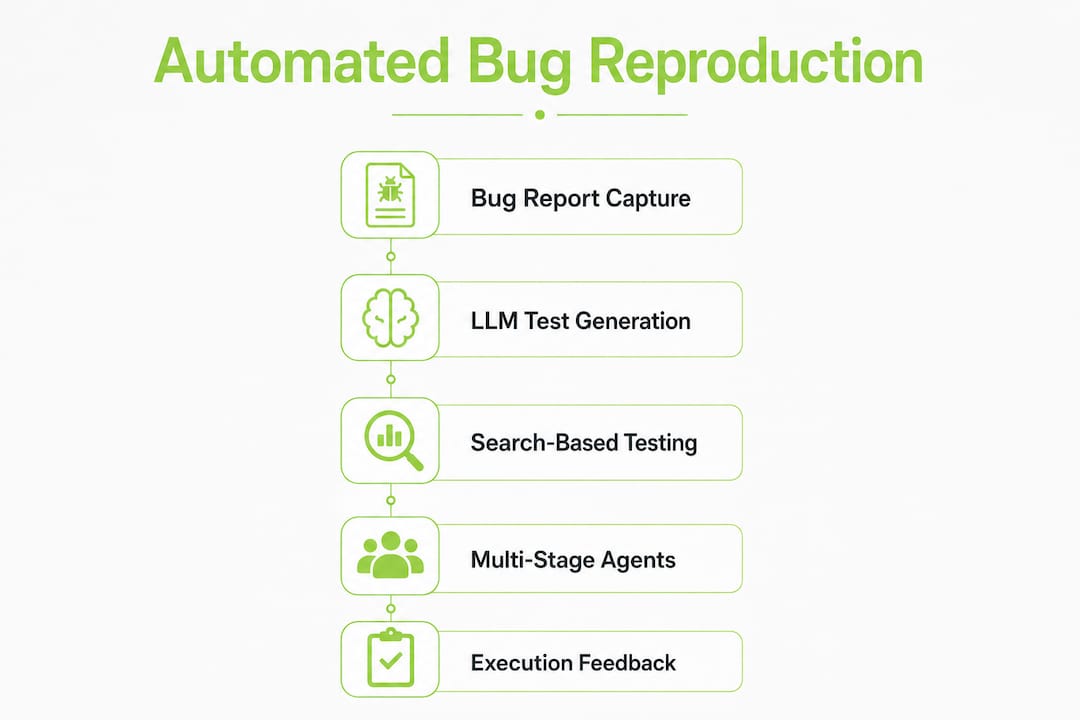
Hybrid approaches combine both methods. BLAST, a tool that merges LLM-based generation with SBST optimization, achieves a 35.4% success rate generating issue-reproducing tests, outperforming either method used alone. That improvement comes from letting the LLM handle semantic interpretation while SBST handles syntactic correctness and test validity.
Agent-based multi-stage pipelines
The most advanced automated issue reproduction pipeline architectures use multi-stage agents that interact with code repositories iteratively. Rather than generating a test in a single prompt, these agents retrieve relevant code graphs, refine their queries, execute candidate tests, and use execution feedback to improve subsequent attempts. Agent-based frameworks reduce syntactic errors compared to single-shot LLM prompting because each stage catches and corrects errors before they propagate.
The Echo agent, for example, uses graph-enhanced retrieval combined with execution feedback. High-performance systems perform code retrieval and analysis before generating any test, which reduces hallucinations and improves the relevance of the output.
Pro Tip: Before adopting any automated bug reproduction tool, check whether it performs code retrieval before generation. Tools that skip this step produce far more invalid tests, which adds noise rather than reducing it.
How effective is automated issue reproduction today?
The state of the art has advanced quickly. Echo, a graph-enhanced retrieval agent, achieved a 66.28% success rate on the SWT-Bench Verified dataset as of march 2026. That benchmark uses verified, real-world GitHub issues and measures whether the generated test correctly fails on the buggy commit and passes after the fix.
To put that number in context: earlier pure LLM methods scored well below 50% on the same class of benchmarks. The jump to 66.28% reflects the impact of retrieval augmentation, execution feedback loops, and graph-based code understanding.
Industrial results are equally telling. At Google, automated BRT generation improved Automated Program Repair success rates by 30%. That improvement comes directly from giving the APR system a concrete, executable reproduction test to work against rather than a plain text description.
The Ensemble Pass Rate (EPR) metric quantifies this further. EPR uses generated BRTs to rank candidate fixes from multiple automated repair attempts. EPR ranks fixes with approximately 70% accuracy when selecting the best plausible fix from twenty candidates. That accuracy rate makes automated reproduction tests a practical filter for APR output, not just a debugging aid.
| Method | Success rate | Key advantage |
|---|---|---|
| Pure LLM (single-shot) | Below 50% on verified benchmarks | Fast generation, low setup cost |
| BLAST (LLM + SBST hybrid) | 35.4% on issue-reproducing test benchmarks | Syntactically valid output |
| Echo (graph retrieval + feedback) | 66.28% on SWT-Bench Verified | High accuracy via iterative retrieval |
What challenges do practitioners face with automated defect reproduction?
Vague bug reports are the first obstacle
The quality of a generated BRT depends directly on the quality of the bug report. Reports that lack stack traces, environment details, or clear reproduction steps give the LLM too little signal to work with. The result is a test that reproduces a surface symptom rather than the actual defect, or no valid test at all.
This is not a theoretical problem. The 4% figure from Defects4J shows that most real-world bug reports arrive without any reproduction test. Teams that want to benefit from automated reproduction need to improve their bug capture process upstream, collecting session data, stack traces, and user actions at the point of failure.
Single-shot prompting produces unreliable results
Sending a bug report to an LLM in a single prompt and expecting a valid test back is the least reliable approach. Multi-stage agent frameworks with retrieval and validation consistently outperform single-shot methods in industrial settings. The reason is simple: a single prompt gives the model no opportunity to check its own output against the actual codebase.
Practitioners who adopt single-shot approaches often find that a large share of generated tests fail to compile or import correctly. That failure rate negates the time savings the automation was supposed to provide.
- Insufficient bug report detail produces tests that target the wrong code path.
- Missing codebase context causes LLMs to reference methods or classes that do not exist.
- No execution validation means syntactically broken tests reach developers unfiltered.
- Proprietary codebases require fine-tuned models or integrated tooling to handle idiosyncratic APIs.
Pro Tip: Pair your automated reproduction pipeline with a structured bug capture tool that collects session replays and stack traces automatically. The richer the input, the higher the BRT success rate. Coevy's session replay and AI-generated reproduction steps are built exactly for this upstream capture problem.
Integration with development infrastructure
Automated reproduction does not work in isolation. Practical BRT generation requires fine-tuned LLMs and integrated testing tools that understand the target codebase. A generic model with no access to the actual source code will produce generic tests. Teams need to connect their reproduction pipeline to their version control system, test runner, and CI environment for the output to be useful. For a deeper look at how AI reads codebases to generate accurate tests, see codebase-aware debugging.
How does automated issue reproduction integrate into development workflows?
Automated bug reproduction delivers the most value when it is embedded directly into the development cycle rather than treated as a standalone tool. The following workflow shows how BRTs move from report to resolution.
- Bug report arrives. A user or monitoring system files a report with a description, stack trace, and session data. The richer this input, the better the generated test will be.
- Retrieval and context building. The pipeline queries the codebase, identifies relevant files and methods, and builds a context graph. This step is what separates high-performing systems from single-shot approaches.
- Test generation. The LLM generates a candidate BRT using the retrieved context. Hybrid systems apply SBST optimization at this stage to correct syntactic errors.
- Execution and validation. The candidate test runs against the buggy commit. If it fails as expected, it is a valid BRT. If it passes or errors out, the pipeline iterates.
- BRT delivered to developer or APR system. A confirmed BRT guides the developer directly to the failing behavior. For APR systems, the BRT serves as the fitness function for patch generation.
- Fix validation. After a patch is applied, the BRT must pass. This fail-to-pass criterion is the final confirmation that the fix addresses the reported bug.
Automated error reporting tools that capture session context at the point of failure feed directly into step one, making the entire pipeline more reliable. Some teams deploy GitHub bots that propose BRTs as pull request comments, giving reviewers an executable test alongside the proposed fix. That pattern makes code review faster and more objective because the test either passes or it does not.
For product managers, the business case is straightforward. Shorter time to reproduce means shorter time to repair. BRTs guide developers and APR systems in fixing bugs accurately, which reduces the back-and-forth between support, QA, and engineering. Teams that integrate automated reproduction into their CI pipeline report fewer regression bugs because every fix ships with a test that proves it works.
Key Takeaways
Automated issue reproduction reduces debugging time and increases fix confidence by converting bug reports into executable tests that fail on buggy code and pass on fixed code.
| Point | Details |
|---|---|
| BRT definition | A Bug Reproduction Test fails on buggy code and passes after the fix, confirming the patch works. |
| Hybrid methods win | Combining LLMs with SBST, as in BLAST, outperforms either method used alone for test generation. |
| State-of-the-art accuracy | Echo achieved 66.28% success on SWT-Bench Verified, the current benchmark for automated reproduction. |
| Bug report quality matters | Only 4% of real-world bug reports include reproduction tests, making upstream data capture critical. |
| Agent pipelines beat single-shot | Multi-stage agents with retrieval and execution feedback produce fewer invalid tests than one-prompt approaches. |
Why I think most teams are adopting this in the wrong order
Most development teams I have seen approach automated issue reproduction by evaluating generation tools first and fixing their bug capture process last. That is backward. The most sophisticated LLM agent in the world cannot generate a useful BRT from a bug report that says "the app crashed on checkout." The upstream data, session context, stack traces, and user actions, is what makes the generation step work.
The shift toward hybrid LLM-SBST approaches is real and the results are compelling. A 66.28% success rate on verified benchmarks is not a research curiosity. It is production-ready accuracy for many bug categories. But teams that skip the retrieval and validation layers and go straight to single-shot prompting will see failure rates that make the whole exercise feel pointless.
Agent-based multi-stage pipelines are where this field is heading, and the integration with AI-driven bug triage is the next logical step. When a system can capture a bug, classify it, generate a reproduction test, and rank candidate fixes automatically, the developer's job shifts from firefighting to reviewing. That is a meaningful change in how engineering time gets spent.
My advice: start by improving what you capture at the point of failure. Then build or adopt a reproduction pipeline that performs retrieval before generation. The AI-generated reproduction steps space is moving fast, and teams that get the data layer right will see compounding returns as the generation models improve.
— Dizzy
How Coevy fits into your reproduction workflow
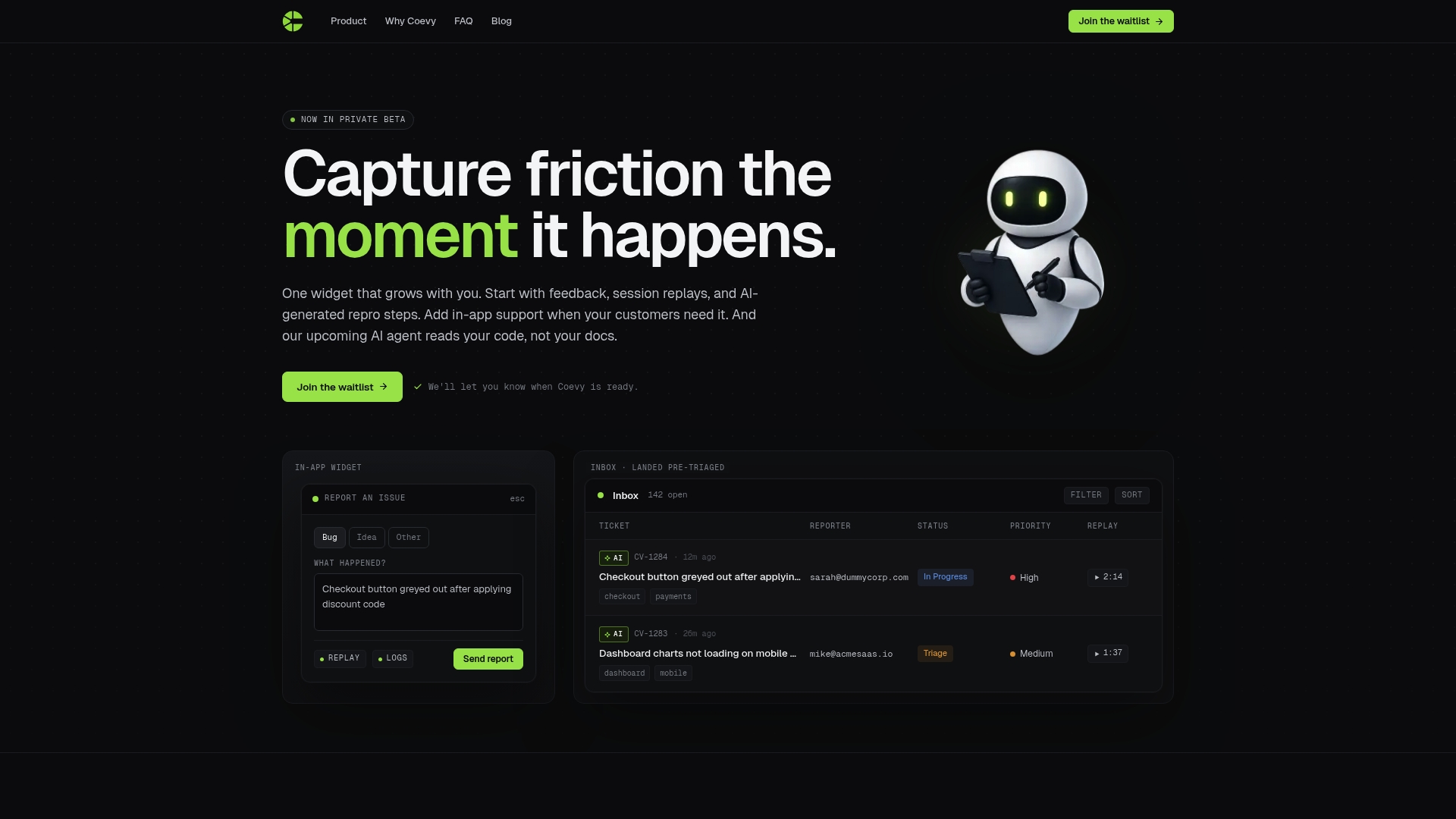
The hardest part of automated issue reproduction is not the generation step. It is capturing enough context at the moment a bug occurs to make generation possible. Coevy addresses that directly. The platform embeds a widget into your web app that collects session replays, stack traces, and user actions automatically when an issue is reported. That data feeds directly into the reproduction pipeline, giving your LLM or hybrid system the rich input it needs to generate a valid BRT. Coevy also provides AI-generated reproduction steps and auto-tagging out of the box, so your team spends less time triaging and more time fixing. See how Coevy works and connect it to your existing QA workflow.
FAQ
What is a Bug Reproduction Test (BRT)?
A Bug Reproduction Test is an executable test case that fails when run against buggy code and passes after the fix is applied. It serves as both a debugging guide and a fix validation tool.
How does automated issue reproduction differ from standard test automation?
Standard test automation verifies expected behavior. Automated issue reproduction specifically generates tests that replicate a reported defect, targeting the exact failure condition described in a bug report.
What success rates do current automated reproduction tools achieve?
The Echo agent achieved 66.28% on the SWT-Bench Verified benchmark as of march 2026, representing the current state of the art for automated issue-reproducing test generation.
Why do LLM-only approaches fail in practice?
LLMs generate hallucinated code, including fake imports and non-existent methods, without access to the actual codebase. Static analysis and SBST are required to validate and correct generated tests before they reach developers.
How does automated bug reproduction help product managers?
Automated reproduction shortens the time between a user report and a confirmed fix by giving engineering teams an executable test immediately. At Google, automated BRT generation improved repair success rates by 30%, directly reducing the cost and duration of bug resolution cycles.