The role of AI in product support strategy is to transform support from a reactive ticket queue into an embedded, intelligent product capability that resolves most routine issues autonomously while augmenting human agents for complex cases. Well-implemented AI handles 60–70% of Tier-1 support volume without human intervention. That figure, drawn from Gartner's 2025 Customer Service Technology Report, means the majority of your support load can be deflected before it ever reaches a human agent. Tools like Zendesk AI, Intercom Fin, and Fivetran's support AI application are already operating at this level. For product support strategists, the question is no longer whether to adopt AI. It is how to embed it correctly so it generates measurable business value.
How does AI embed into the product experience to shift support capabilities?
Embedding AI into the product shifts support from an external function to a product capability, enabling real-time, context-aware resolution within the user workflow. This is the central paradigm shift in artificial intelligence product strategy for 2026. Traditional support AI sits outside the product, waiting for a user to open a chat widget or submit a ticket. Embedded AI operates at the exact point where an issue occurs, reading the user's current state, configuration, and session context to deliver a precise answer or take a corrective action immediately.

The practical difference is significant. A user hitting a permission error in a SaaS dashboard no longer needs to describe the problem to a chatbot. Embedded AI already knows the user's role, the page they are on, and the specific configuration causing the failure. It can surface a fix, update a setting with the user's consent, or escalate with full context attached.
Key capabilities that define embedded, in-product AI support include:
- Context ingestion: Reading session state, user configuration, and product telemetry in real time
- Governed actions: Taking product-level actions via APIs within defined permission boundaries
- Proactive triggers: Detecting failure patterns before a user submits a ticket
- Handoff packaging: Passing structured context to a human agent when escalation is required
The governance layer is non-negotiable. IBM's agentic AI architecture uses policy enforcement and guarded API calls to allow AI to orchestrate actions without compromising security or compliance. Without this layer, in-product AI actions create liability and erode user trust.
Pro Tip: Design your AI's permission model before you configure its capabilities. Define exactly which product actions it can take autonomously, which require user confirmation, and which are off-limits entirely. This prevents scope creep and protects your customers.
What operational strategies ensure successful AI integration in product support?
Successful AI integration in product support follows a structured rollout sequence, not a big-bang deployment. The 2026 playbooks from leading practitioners converge on the same foundational steps.
Start in human-in-the-loop mode. Target 60% autonomous resolution before scaling AI autonomy. Run AI suggestions alongside human agents, measure accuracy, and only expand AI authority once the resolution rate is validated. This prevents the most common rollout failure: deploying AI that confidently gives wrong answers.
Design escalation rules before configuring AI. Escalation triggers must be explicit design artifacts covering sentiment thresholds, retry limits, customer-requested handoffs, and sensitive topic categories. Writing these rules first forces clarity about what AI should never handle alone.
Align your knowledge base and data plumbing. Without clean, integrated data, AI support risks hallucination and poor resolution quality. Fivetran's own implementation showed that unified data ingestion and transformation is the top strategic priority before scaling AI. A fragmented knowledge base produces a fragmented AI.
Run synthetic replay testing. Use historical tickets to simulate AI behavior before going live. This surfaces edge cases, identifies gaps in the knowledge base, and validates that escalation rules fire correctly. Effective AI drafting for technical support requires synthetic replay testing with historical tickets as a quality gate.
Use AI assist tools inside your help desk. Tools that surface real-time knowledge, draft responses, and tone cues augment agents on complex cases while the autonomous layer handles routine ones. This hybrid model captures value at both ends of the ticket spectrum.
"Pilot workflows should use one system of record per process to attribute ROI clearly and prevent untestable agent behavior." — AI Agents for Startups: Routine Tasks Best Practices
This principle matters because multi-system pilots obscure causality. If your AI pilot touches three different data sources and two help desks simultaneously, you cannot determine which change drove the improvement. Isolate variables to measure what actually works.
Which metrics and KPIs demonstrate AI's impact on product support?
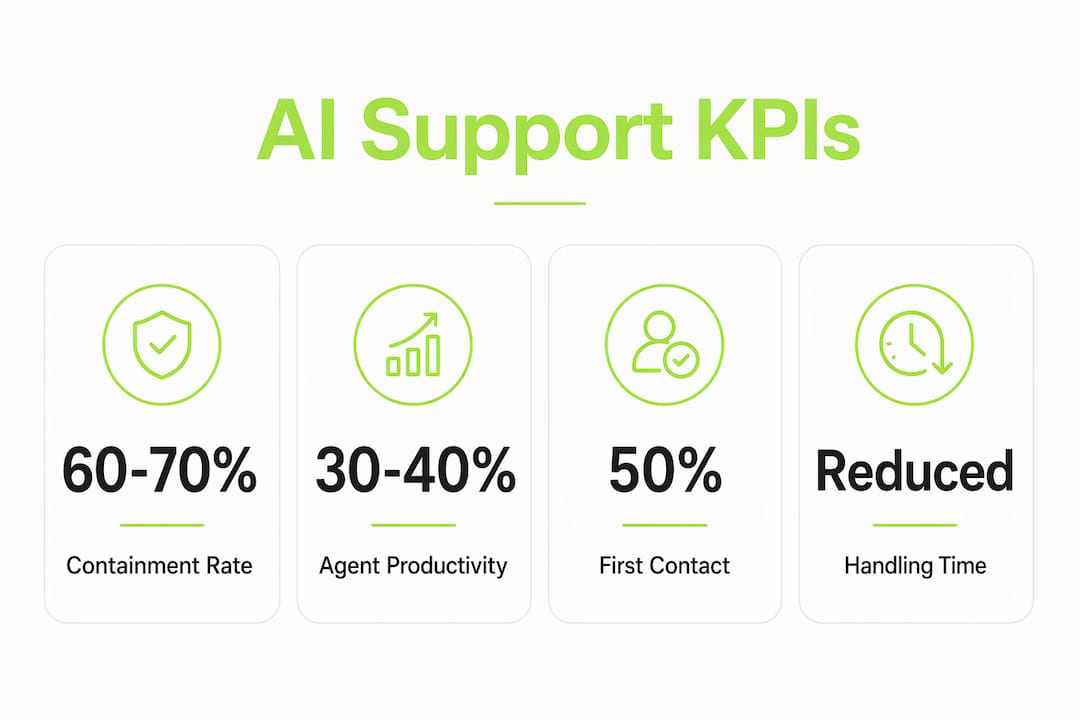
The impact of AI on product support is measurable, and the numbers from 2026 deployments are concrete. The Quant and IBM deployment of AI agent Ava produced results that set a clear benchmark: 84% of calls resolved by AI, first call resolution improved from 71% to 86%, and average handling time dropped from 11 minutes 30 seconds to 8 minutes 30 seconds. These are not projections. They are published outcomes from a May 2026 deployment.
| Metric | Benchmark | What it signals |
|---|---|---|
| AI containment rate | 60–70% of Tier-1 volume | Routine ticket deflection freeing human capacity |
| First contact resolution | 71% → 86% (Quant/IBM) | Fewer repeat contacts and faster closure |
| Average handling time | 11m30s → 8m30s (Quant/IBM) | Faster resolution per ticket across the team |
| Agent productivity gain | 30–40% improvement | Real-time AI assist reducing research and drafting time |
AI assist tools increase agent productivity by 30–40%, according to Forrester's 2025 Contact Center AI Report. That gain comes from real-time knowledge retrieval, tone analysis, and draft response generation, not from replacing agents but from removing the friction in their workflow.
The metric shift that SAP's executive leadership advocates is equally important. KPIs for AI support should move beyond speed metrics toward value generation measures like customer health scores and predictive problem prevention rates. Speed metrics tell you how fast your support runs. Value metrics tell you whether your support is preventing churn and driving retention. Both matter, but the second set is where AI creates a genuine competitive advantage.
How do AI-driven support tools reshape human agent roles?
Human agents in an AI-augmented support model are no longer ticket processors. They are escalation experts, edge-case specialists, and AI collaborators. This role shift is one of the most significant structural changes that AI tools for customer service produce, and it requires deliberate change management to execute well.
The division of labor is clear. AI handles routine, high-volume, pattern-matching cases. Humans handle ambiguous, emotionally charged, high-stakes, and technically novel cases. The result is that every human interaction carries more weight and requires more skill. Agents who previously spent 70% of their time on password resets and billing questions now spend that time on cases that genuinely require judgment.
Fivetran's AI-powered support tool demonstrates what augmentation looks like in practice. The platform generates structured AI summaries during handoffs inside Zendesk, giving agents full context on a case without requiring them to read through a long ticket thread. This reduces the cognitive load of context-switching and shortens the time to productive engagement on complex cases.
Key shifts in team structure and workflow include:
- Training focus moves from product knowledge to judgment and empathy. AI surfaces the facts. Agents apply them.
- Quality assurance shifts toward AI output review. Teams need processes to audit AI responses and catch systematic errors before they scale.
- Escalation becomes a skill, not a fallback. Knowing when and how to take over from AI is a trained competency, not an instinct.
Pro Tip: When redesigning agent workflows around AI, map the cases AI cannot handle before you map the ones it can. The edge cases define where human skill is irreplaceable, and that mapping should drive your training program.
The evolution from ticket processors to governance experts is a structural shift that forward-looking support teams are already building into their hiring and onboarding programs.
What are the emerging trends shaping AI's future in product support?
The next phase of AI in customer support moves from resolution to anticipation. Several trends are already visible in 2026 deployments and will define the strategic agenda for the next two years.
- Predictive and anticipatory support: AI systems that analyze real-time product telemetry and usage patterns to detect failure conditions before users encounter them. AI predictive diagnostics are already improving proactive customer support by identifying issues at the data layer before they surface as tickets.
- AI-powered root cause analysis: Automated identification of the underlying cause of recurring issues, feeding directly into product development backlogs. This closes the loop between support and engineering without requiring manual ticket tagging or analysis.
- Integration with product feedback loops: AI support data becomes a structured input to product roadmap decisions. Patterns in support tickets, session replays, and user friction signals inform feature prioritization in ways that manual analysis cannot match at scale.
- Support as a product differentiator: The shift from cost center to value driver is accelerating. SAP's executive leadership frames AI-enabled support as improving decision-making across large datasets, not just reducing headcount costs. Companies that treat support quality as a product feature will retain customers that competitors lose.
- Continuous data governance: As AI support systems grow more autonomous, the quality and freshness of underlying data becomes a permanent operational discipline, not a one-time setup task.
For teams building scalable AI support, the architecture decisions made today determine the ceiling on what AI can do in 18 months. Invest in data infrastructure and governance now, or rebuild it under pressure later.
Key takeaways
The role of AI in product support strategy is defined by embedding intelligent, autonomous resolution directly within the product experience, measured through containment rates, resolution speed, and customer health outcomes rather than cost reduction alone.
| Point | Details |
|---|---|
| Embed AI in the product | In-product AI resolves issues at the point of occurrence, reducing friction and ticket volume. |
| Design escalation rules first | Explicit escalation triggers prevent looping failures and protect customer experience during AI rollout. |
| Target 60% resolution before scaling | Validate autonomous resolution rates in human-in-the-loop mode before expanding AI authority. |
| Shift KPIs toward value metrics | Measure customer health and predictive prevention rates alongside speed and containment metrics. |
| Invest in data quality continuously | Clean, integrated data is the foundation of accurate AI support. Without it, AI performance degrades. |
Why I think most teams are implementing AI support backwards
Most product support teams I see approach AI implementation by asking: "What can we automate?" That is the wrong starting question. It optimizes for cost reduction and produces AI that handles easy cases while leaving the hard ones exactly as hard as before.
The better question is: "Where does our product create friction that AI can resolve before it becomes a support event?" That question leads you to embedded, proactive AI rather than a smarter chatbot sitting outside your product.
The teams getting the most value from AI support in 2026 are the ones who treated escalation design as a product design problem, not an operations problem. They wrote escalation rules the same way they write acceptance criteria for features. They tested AI behavior with synthetic replays the same way they run regression tests on code. They measured customer health outcomes the same way they measure activation and retention.
The teams struggling are the ones who bought an AI platform, pointed it at their knowledge base, and called it done. The knowledge base was stale. The escalation rules were implicit. The data was fragmented. The AI performed poorly, agents lost confidence in it, and adoption stalled.
An AI-first support approach is not a technology decision. It is a product and organizational design decision that happens to involve technology. Get the design right first, and the technology performs. Get it backwards, and no amount of model sophistication will save you.
— Dizzy
Capture friction before it becomes a ticket with Coevy
Product support teams that want to put these principles into practice need tools built for the moment issues occur, not after users have already given up.
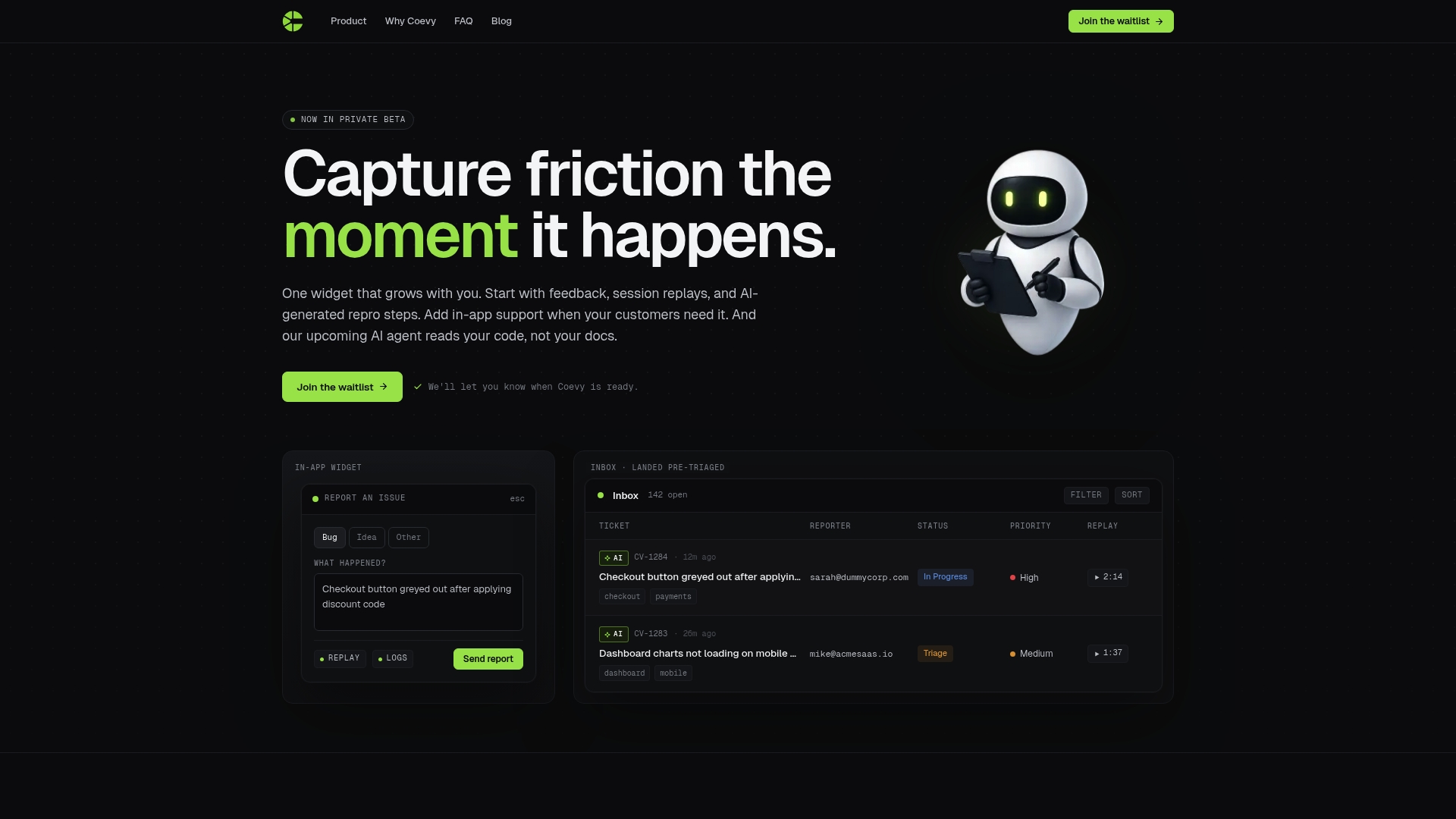
Coevy is a SaaS platform that embeds AI-powered support directly inside your web application. It captures session replays, generates AI reproduction steps for bugs, and attaches contextual data to every issue automatically. Its upcoming codebase-aware AI agent reads your actual source code to deliver precise answers, not generic documentation responses. Auto-tagging, prioritization, and in-product feedback collection give your team the signal quality needed to act before customers churn. If you are building a support strategy that scales with your product, start with Coevy and capture friction the moment it happens.
FAQ
What is the role of AI in product support strategy?
AI in product support strategy defines the shift from reactive ticket handling to embedded, autonomous problem resolution within the product experience. Well-implemented AI handles 60–70% of Tier-1 support volume, freeing human agents for complex and high-stakes cases.
How should teams start an AI support rollout?
Start in human-in-the-loop mode and target 60% autonomous resolution before scaling AI authority. Define explicit escalation triggers covering sentiment thresholds, retry limits, and sensitive categories before configuring any AI behavior.
Which KPIs measure AI's impact on product support?
The primary KPIs are AI containment rate, first contact resolution, and average handling time. The Quant and IBM deployment of AI agent Ava raised first call resolution from 71% to 86% and cut average handling time from 11 minutes 30 seconds to 8 minutes 30 seconds.
How does AI change the role of human support agents?
Human agents shift from processing routine tickets to handling escalations, edge cases, and emotionally complex interactions. AI assist tools increase agent productivity by 30–40% by surfacing real-time knowledge, drafting responses, and flagging sentiment cues.
What is the biggest risk in scaling AI for customer support?
The biggest risk is poor data quality. Without clean, unified, and continuously updated data, AI support systems hallucinate, produce inaccurate resolutions, and erode user trust faster than manual support ever could.