Solo app user retention strategies are the targeted methods SaaS founders and product teams use to keep single users engaged, returning, and finding value in their app long after the install. The industry term for this discipline is user retention engineering, and it combines behavioral design, notification science, and re-engagement sequencing. The stakes are high: median Day 1 retention sits at just 24% globally, meaning most apps lose three out of four users before the second day. Getting onboarding, habit loops, and re-engagement right is not a nice-to-have. It is the difference between a product that grows and one that leaks.
1. Solo app user retention strategies start with frictionless onboarding
The fastest path to retention is getting your user to a core value moment before they have a reason to leave. Reducing time to first value to under 60 seconds improves Day 1 retention by 15–25 percentage points. That is the single highest-leverage action a solo app team can take.

Most onboarding flows fail because they front-load friction. Account creation, permission requests, and tutorial carousels all delay the moment a user feels the product working for them. The fix is to defer those steps until after the user has experienced something real.
Practical tactics that cut onboarding friction:
- Replace tutorial carousels with contextual tooltips. Show guidance only when the user reaches the relevant screen, not all at once.
- Design empty states as discovery surfaces. Curated starter content in empty states gives users a guided first win instead of a blank page.
- Defer account creation. Apple's App Store guidelines require apps to allow access to core features without registration. Premature login requests cause massive drop-off.
- Define one activation milestone. Examples include "created first playlist" or "logged first workout." Build the entire first session around reaching that milestone.
Pro Tip: Run a funnel analysis on your onboarding flow and identify the single step with the highest exit rate. Fix that one step before touching anything else.
2. Building habit loops that bring users back between Day 1 and Day 7
The steepest retention drop happens between Day 1 and Day 7. Behavioral design is the most reliable way to close that gap. Nir Eyal's Hook Model breaks habit formation into four phases: Trigger, Action, Reward, and Investment. Each phase builds on the last to make your app part of a user's daily routine.
The Trigger phase is where most solo apps underinvest. External triggers like push notifications work early, but the goal is to internalize the trigger so the user thinks of the app without being prompted. That happens only after the Reward and Investment phases have delivered enough value.
"Retention is a long-term architectural challenge requiring habitual triggers and early churn interception, not just marketing campaigns."
Tactics that build durable habit loops:
- Use variable rewards. Predictable rewards lose their pull quickly. Varying the reward, whether a new insight, a streak milestone, or fresh content, sustains engagement over weeks.
- Add investment mechanics. Personal investment during onboarding, such as setting goals or preferences, locks in long-term value. Users who invest in a product are significantly more active over time.
- Anchor a habitual cadence. Features like daily content refresh or streaks give users a reason to return at a predictable time.
- Minimize cognitive load. The Action phase must require as little effort as possible. Reduce taps, eliminate decision points, and pre-fill where you can.
Pro Tip: Map your app's Hook Model on paper before building any new feature. If you cannot identify a clear Trigger and Reward for the feature, users will not return to use it.
3. Smart push notification strategies that boost engagement without driving uninstalls
Push notifications are the most direct channel you have to a solo user. They are also the fastest way to lose them. Sending generic, frequent notifications accelerates uninstalls. One precise, well-timed message outperforms a blast of generic ones every time.
The timing of your permission request matters as much as the notification itself. Delaying the push permission request until after the user experiences their first core value moment can double opt-in rates and improve long-term retention by 30–50%. Asking before that moment produces opt-in rates near zero.
Best practices for notification strategy:
- Use behavior-triggered notifications. Behavior-based triggers improve user reaction rates by up to 400% compared to generic scheduled messages.
- Segment by notification type. Separate transactional, promotional, and social notifications. Apply different frequency caps to each.
- Offer granular opt-out controls. Letting users silence one notification type without turning off all notifications preserves the channel and builds trust.
- Use soft prompts first. Show an in-app prompt explaining the value of notifications before triggering the system permission dialog. This pre-qualifies users and increases acceptance.
Pro Tip: A/B test notification copy at the sentence level, not just the subject line. The specific verb you use ("See your results" vs. "Check your progress") changes open rates measurably.
4. Multi-channel re-engagement campaigns to win back lapsed users
No retention system catches every user. A structured re-engagement sequence recovers the ones who slip through. Multi-channel re-engagement sequences can recover 14–29% of users who would otherwise churn permanently. That is a meaningful number for any solo app team.
The key is segmentation. Treating all lapsed users the same wastes budget and erodes trust. Segment lapsed users into four tiers based on inactivity duration: At-Risk, Cooling Off, Lapsed, and Dormant. Each tier requires a different channel, tone, and message.
A proven multi-channel re-engagement sequence:
- Day 3 push notification. Soft reminder. Reference the last action the user took. Keep it short and value-focused.
- Day 7 push notification. Escalate the value proposition. Highlight a feature or update the user has not seen.
- Day 10 email. Shift to email for deeper lapses. Use a personal tone. Include a specific reason to return, such as new content or a completed goal summary.
- Day 14 email. Final value escalation. Offer something concrete: a tip, a result, or a milestone the user is close to reaching.
- Day 30 retargeting ad. For Dormant users, paid retargeting on social or display channels re-introduces the brand without relying on a channel the user has already ignored.
A multi-step, multi-channel sequence with escalating value propositions consistently outperforms single-channel campaigns. The tone across every touchpoint should be zero-pressure and value-first. Never guilt a lapsed user. Show them what they are missing.
5. Matching retention tactics to your app's engagement dimensions
User retention depends on category-specific engagement dimensions: frequency, depth, and stickiness. Productivity apps benefit most from frequency and stickiness. Content apps need depth. Choosing the wrong dimension to optimize is one of the most common retention mistakes solo teams make.
The table below maps common retention tactics to the engagement dimension they serve best.
| Tactic | Primary dimension | Best for | Trade-off |
|---|---|---|---|
| Onboarding activation milestone | Depth | All app categories | Requires clear value definition upfront |
| Streaks and daily cadence | Frequency | Productivity, habit apps | Can feel punishing if missed |
| Variable reward loops | Stickiness | Games, content, social | Requires ongoing content investment |
| Behavior-triggered push | Frequency | All categories | Needs behavioral event tracking |
| Multi-channel re-engagement | Stickiness | Apps with email lists | Higher cost and setup complexity |
| Personal investment mechanics | Depth | Tools, productivity | Requires thoughtful preference design |
Optimizing the wrong engagement dimension is a frequent mistake. Define your app's primary engagement dimension first, then select tactics that serve it. A meditation app optimizing for depth needs different mechanics than a fitness tracker optimizing for daily frequency.
Key Takeaways
The most effective solo app user retention strategies combine fast onboarding activation, behavioral habit loops, precisely timed notifications, and segmented re-engagement sequences to reduce churn at every stage of the user lifecycle.
| Point | Details |
|---|---|
| Speed to first value | Reach the core activation milestone in under 60 seconds to maximize Day 1 retention. |
| Habit loop investment | Users who set preferences or goals during onboarding are significantly more active long-term. |
| Notification timing | Delay push permission requests until after first value delivery to double opt-in rates. |
| Segmented re-engagement | Divide lapsed users into At-Risk, Cooling Off, Lapsed, and Dormant tiers for targeted recovery. |
| Dimension-first tactics | Identify your app's primary engagement dimension (frequency, depth, or stickiness) before choosing tactics. |
Retention is an architecture problem, not a messaging problem
I have worked with enough solo app teams to know that most retention failures are not caused by bad marketing. They are caused by a product that never built the conditions for a habit to form. The onboarding flow delivered information instead of a win. The notifications fired on a schedule instead of a signal. The re-engagement email said "we miss you" instead of "here is what you almost achieved."
The teams that get retention right treat it as a design constraint from day one, not a growth lever they bolt on after launch. They define their activation milestone before they write a line of onboarding copy. They map their Hook Model before they build their notification system. They segment their lapsed users before they write a single re-engagement email.
AI-driven personalization is changing what is possible for lean solo teams. AI in SaaS retention now makes it practical to automate habit triggers and personalize re-engagement content at a scale that previously required a full growth team. That is a genuine shift, and solo founders who ignore it will find themselves outpaced by apps with smaller feature sets but smarter behavioral systems.
The uncomfortable truth is that most retention problems are visible in your data before users churn. Session replays, friction events, and drop-off points in your onboarding funnel all signal trouble weeks before a user goes dormant. The teams that intercept churn early, before a user has mentally moved on, consistently outperform those who rely on win-back campaigns. Build the system that catches the signal early. The win-back campaign is a last resort, not a strategy.
— Dizzy
How Coevy helps you catch retention leaks before they compound
Friction in your app is invisible until you have a tool that surfaces it in real time. Coevy captures user friction at the exact moment it happens, attaching session replays and contextual data to every issue without requiring engineering resources to set up.
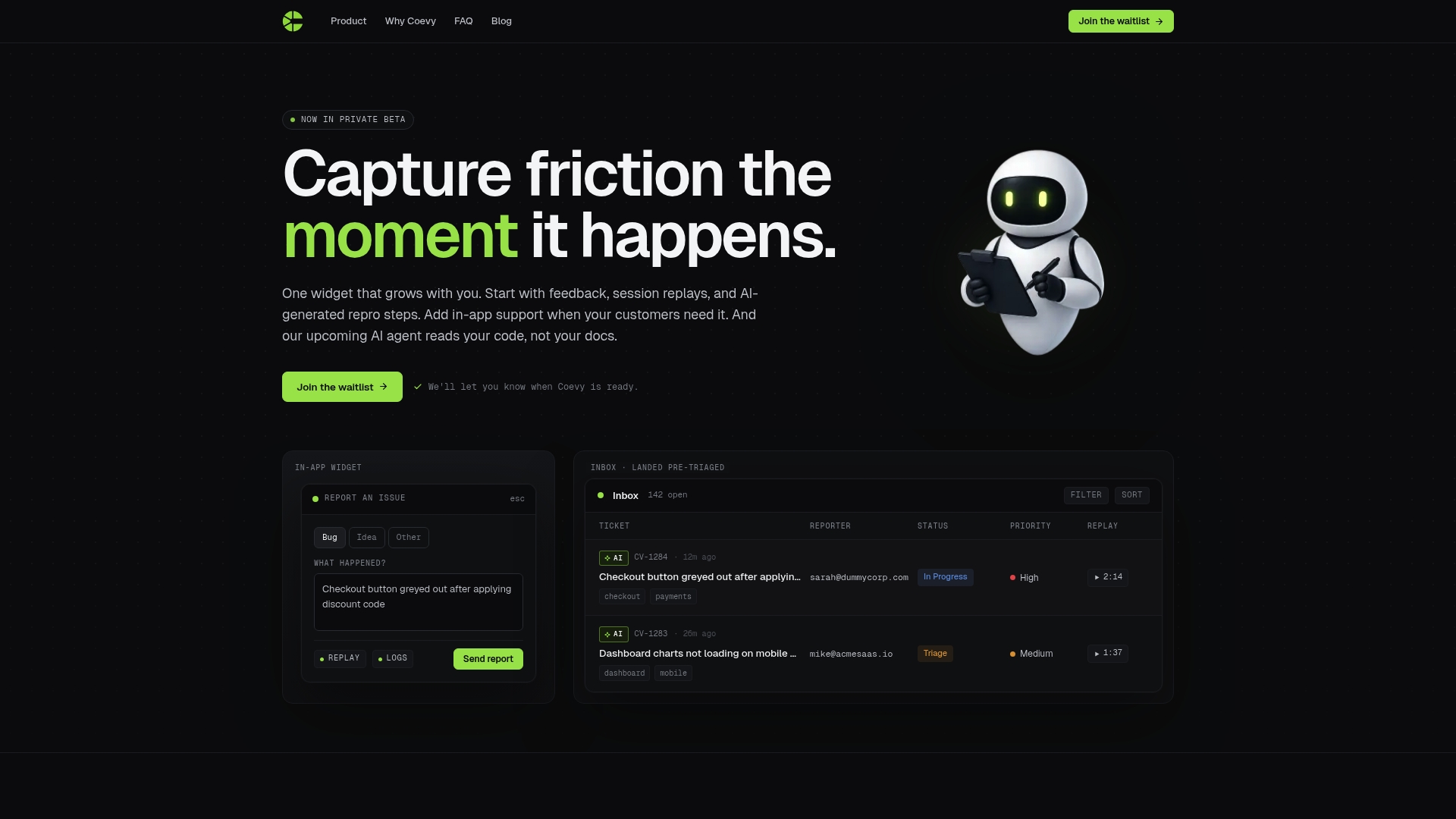
For solo founders and small product teams, Coevy's embedded widget means you see where users stall, what they click before they leave, and which onboarding steps generate the most confusion. That data feeds directly into the retention decisions covered in this article: fixing the highest-friction onboarding step, triggering the right notification at the right moment, and intercepting churn before it becomes permanent. Coevy also collects in-app feedback that tells you why users are leaving, not just when. Visit coevy.com to see how it fits your product workflow.
FAQ
What is the average Day 1 retention rate for mobile apps?
Median Day 1 retention sits at 24% globally. Most solo apps lose more than 75% of new users before the second day, making the first session the highest-priority retention window.
How long should onboarding take to maximize retention?
Onboarding should deliver the core value moment in under 60 seconds. Apps that reach a clear activation milestone in the first session see Day 1 retention improve by 15–25 percentage points.
When should I ask for push notification permission?
Ask after the user has experienced their first core value moment, not at launch. Delaying the request to that point can double opt-in rates compared to asking immediately on install.
How do I re-engage users who have gone dormant?
Segment lapsed users by inactivity duration and use a multi-channel sequence: push notifications on Days 3 and 7, emails on Days 10 and 14, and retargeting ads by Day 30. This approach recovers 14–29% of users who would otherwise churn permanently.
What is the Hook Model and why does it matter for solo apps?
The Hook Model, developed by Nir Eyal, describes four phases of habit formation: Trigger, Action, Reward, and Investment. Solo app teams use it to design features and notification systems that build returning behavior without relying on paid re-engagement.