Picking the wrong in-app feedback tool doesn't just slow your team down. It corrupts your product roadmap with noise, buries real user pain in support queues, and leaves engineers fixing the wrong things. The in-app feedback tools comparison challenge is real: there are dozens of options, each promising to surface what users actually want, but most SaaS teams pick based on a demo or a G2 review rather than a structured evaluation. This article cuts through that. You'll find a criteria-based framework, a tool-by-tool breakdown, a side-by-side comparison table, and a clear decision guide for growing SaaS teams.
Table of Contents
- Key criteria for evaluating in-app feedback tools
- Top in-app feedback tools for growing SaaS teams
- Comparison table: features, pricing, and core strengths
- When to use a dedicated feedback platform versus a help desk system
- Best practices and insider tips for maximizing feedback tool efficiency
- Why many SaaS teams overlook the critical distinction between feedback and support
- Discover Coevy: Capture friction the moment it happens
- Frequently asked questions
Key Takeaways
| Point | Details |
|---|---|
| Separate feedback from support | Use dedicated feedback platforms to avoid losing valuable product insights hidden in support tickets. |
| Evaluate key criteria | Focus on user engagement, prioritization features, integration, and security when choosing tools. |
| Match tool to use case | Select tools based on your product's maturity and feedback goals, not just features. |
| Balance platforms | Use feedback tools for long-term product strategy and help desks for immediate issue resolution. |
| Leverage voting wisely | User voting surfaces demand patterns but requires strategic product team judgment for prioritization. |
Key criteria for evaluating in-app feedback tools
Before you start comparing tools, you need to know what you're comparing them on. The biggest mistake teams make is treating all feedback tools as interchangeable. They're not. Some are built for product discovery. Others are built for support. Using the wrong one for the wrong job is like using a bug tracker as a CRM.
Feedback platforms must handle collecting, organizing, and prioritizing product feedback explicitly, or valuable insights disappear inside closed support tickets. That distinction matters more than any individual feature.
Here are the criteria that actually move the needle for SaaS product teams:
- Product feedback capabilities vs. support features. Does the tool help you capture and organize ideas, or does it route tickets? Know which you need before you evaluate anything. A good feedback software evaluation starts with this question.
- User engagement mechanisms. Voting, commenting, and status updates keep users invested. Without them, a feedback board becomes a black hole.
- Prioritization and roadmap communication. Can you score, rank, and surface feedback to your product team? Can you close the loop with users when their request ships?
- Integration depth. Does it connect with your issue tracker, project management tool, or CRM? Isolated feedback is rarely acted on.
- Security and privacy. For SaaS teams handling user data, GDPR compliance, field masking, and IP anonymization aren't optional extras. They're table stakes. Understanding the customer service vs experience distinction also helps clarify what data you actually need to collect.
- Scalability and moderation. A feedback board with 50 entries is manageable. One with 5,000 is not, unless the tool has filtering, tagging, and duplicate detection built in.
Pro Tip: Before demoing any tool, write down your top three feedback goals. If a tool doesn't directly address at least two of them in the first 10 minutes, move on.
Top in-app feedback tools for growing SaaS teams
With criteria in hand, here's a breakdown of the tools most commonly used by SaaS product teams in 2026, including what they're genuinely good at and where they fall short.

Instabug is the go-to for mobile app teams. Instabug is best for mobile app teams needing bug reporting with automatic diagnostics, including device specs, network logs, and repro steps attached to every report. If your product is mobile-first and your engineers are drowning in "it just crashed" reports, Instabug solves a real problem. It's less useful for web apps or for teams that need feature voting and roadmap features.
Canny focuses on the product discovery side. Canny offers feature voting, public roadmaps, and changelogs to support product prioritization. It's excellent at aggregating demand and closing the loop with users. The tradeoff is that it's not built for real-time bug reporting or contextual session data. Think of it as a structured conversation with your user base, not a diagnostic tool.
Survicate covers multi-channel surveys, including in-app, email, and web. It's strong on targeting logic, letting you trigger surveys based on user behavior or lifecycle stage. If your primary goal is quantitative feedback at scale, Survicate is worth evaluating. It's less suited for teams that need visual bug reporting.
Usersnap brings visual feedback to the table. Users can annotate screenshots directly, which dramatically reduces the ambiguity in bug reports. Designers and QA teams tend to love it. It integrates with most project management tools and is a natural fit for web app teams running regular release cycles.
Qualaroo specializes in micro-surveys, short, non-intrusive prompts triggered by user behavior. Its behavioral targeting is sophisticated, and it's particularly effective for measuring sentiment at key moments in the user journey. It's not a bug reporting tool, and it won't give you a feature voting board.
A useful feedback tools overview can help you map these options to your current product stage before committing to a trial.
Pro Tip: Most of these tools offer free trials. Run two or three simultaneously with a small internal test group before rolling out to users. Real usage reveals friction that demos never show.
Comparison table: features, pricing, and core strengths
Summary comparison tables assist teams in evaluating use case fit, pricing, and core feedback mechanisms at a glance. Here's how the major tools stack up:
| Tool | Best use case | Starting price | Free trial | Core feedback type |
|---|---|---|---|---|
| Instabug | Mobile bug reporting | ~$149/month | Yes | Bug reports with diagnostics |
| Canny | Feature voting and roadmaps | Free tier available | Yes | Feature requests and voting |
| Survicate | Multi-channel surveys | ~$99/month | Yes | Quantitative surveys |
| Usersnap | Visual bug and UX feedback | ~$69/month | Yes | Annotated screenshots |
| Qualaroo | Behavioral micro-surveys | ~$69/month | Yes | Targeted sentiment surveys |
| Coevy | Unified feedback, bug reporting, and AI support | Contact for pricing | Yes | Session replay, AI bug reproduction, feedback widget |
A few things worth noting about this table. First, "starting price" rarely reflects what a growing SaaS team actually pays once you factor in seat counts and feature tiers. Always check the pricing page directly. Second, the "core feedback type" column is the most important column here. If it doesn't match your primary goal, the tool is the wrong fit regardless of price.
When to use a dedicated feedback platform versus a help desk system
This is where a lot of SaaS teams go wrong. They route feature requests through their help desk because it's already there. Then they wonder why their roadmap feels reactive and their product team is always playing catch-up.
Feedback platforms collect and prioritize product feedback, while help desks resolve immediate customer issues. Using support tickets for product prioritization leads to lost insights, because tickets close, conversations end, and the signal disappears.
Here's how to think about the split:
- Use a feedback platform when you need to aggregate ideas across your user base, identify patterns, communicate roadmap decisions, and close the loop with users who submitted requests.
- Use a help desk when a user has an urgent problem that needs a human response, an SLA, or a private conversation.
- Never use a feedback board as a substitute for urgent support. Users in crisis don't want to vote on their own problem.
The risks of mixing these workflows are real. Support reps get overwhelmed with product ideas they can't act on. Product teams get incomplete data because most feedback never makes it out of closed tickets. Users feel ignored because nobody follows up.
The best-run SaaS teams treat feedback and support as two distinct operational functions with separate tools, separate owners, and separate success metrics. The data flows between them, but the workflows don't.
Understanding the service versus experience differences at a strategic level makes this separation much easier to implement and defend internally.
Best practices and insider tips for maximizing feedback tool efficiency
Choosing a tool is only half the work. Here's how to actually get value from it once it's in place.
- Start with your primary feedback goal. Are you trying to reduce bug report ambiguity, prioritize your roadmap, or measure user sentiment? Your answer should eliminate at least half the tools on your shortlist immediately.
- Integrate with your existing workflows. A feedback tool that sits in isolation will be ignored within a month. Connect it to your issue tracker, your product management tool, and your support system so feedback flows where decisions get made.
- Keep urgent issues out of feedback boards. If a user is blocked, they need a support channel, not a voting button. Make this distinction clear in your in-app UI so users route themselves correctly.
- Apply judgment to voting data. High vote counts show demand, but they don't show feasibility, strategic fit, or implementation cost. Use votes as one input, not the only input.
- Schedule regular review sessions. The strongest SaaS teams select feedback tools aligned with product maturity and run structured review cycles to align collected feedback with roadmap decisions. Monthly is a reasonable cadence for most teams.
Pro Tip: Assign a named owner for your feedback tool, someone who reviews new submissions weekly, merges duplicates, and closes the loop with users when their request ships. Without ownership, feedback boards decay fast.
Explore feedback tool best practices across different product stages to refine your approach as your team scales.
Why many SaaS teams overlook the critical distinction between feedback and support
Here's an uncomfortable truth: most SaaS teams don't have a feedback problem. They have a categorization problem. They're collecting feedback, but they're storing it in the wrong place, routing it through the wrong people, and measuring it with the wrong metrics.
Using support workflows to prioritize product features causes valuable feedback to disappear in closed tickets, leading to fragmented communication and reactive development. The result is a product team that's always responding to the loudest voice rather than the most common need.
What makes this hard to fix is that it feels efficient in the short term. Your support team already has a system. Why add another tool? The answer is that support systems are optimized for resolution speed, not pattern recognition. They close tickets. They don't surface trends.
Dedicated feedback platforms do the opposite. They keep ideas visible, aggregate similar requests, and give product teams a live view of what users actually want over time. That's a fundamentally different function, and conflating it with support creates bottlenecks that compound as your user base grows.
The teams that get this right separate the two functions early, before the feedback volume gets unmanageable. They also invest in connecting the service-experience distinction to their tool choices, so every team member understands why the separation matters operationally, not just philosophically.
Discover Coevy: Capture friction the moment it happens
If your team is still routing bug reports through email threads or losing feature requests in support queues, there's a better way. Coevy is built specifically for SaaS teams that need feedback, bug reporting, and AI-powered support in one embedded widget. Users can report issues with session replay and AI-generated reproduction steps attached automatically, so your engineers get context instead of guesswork.
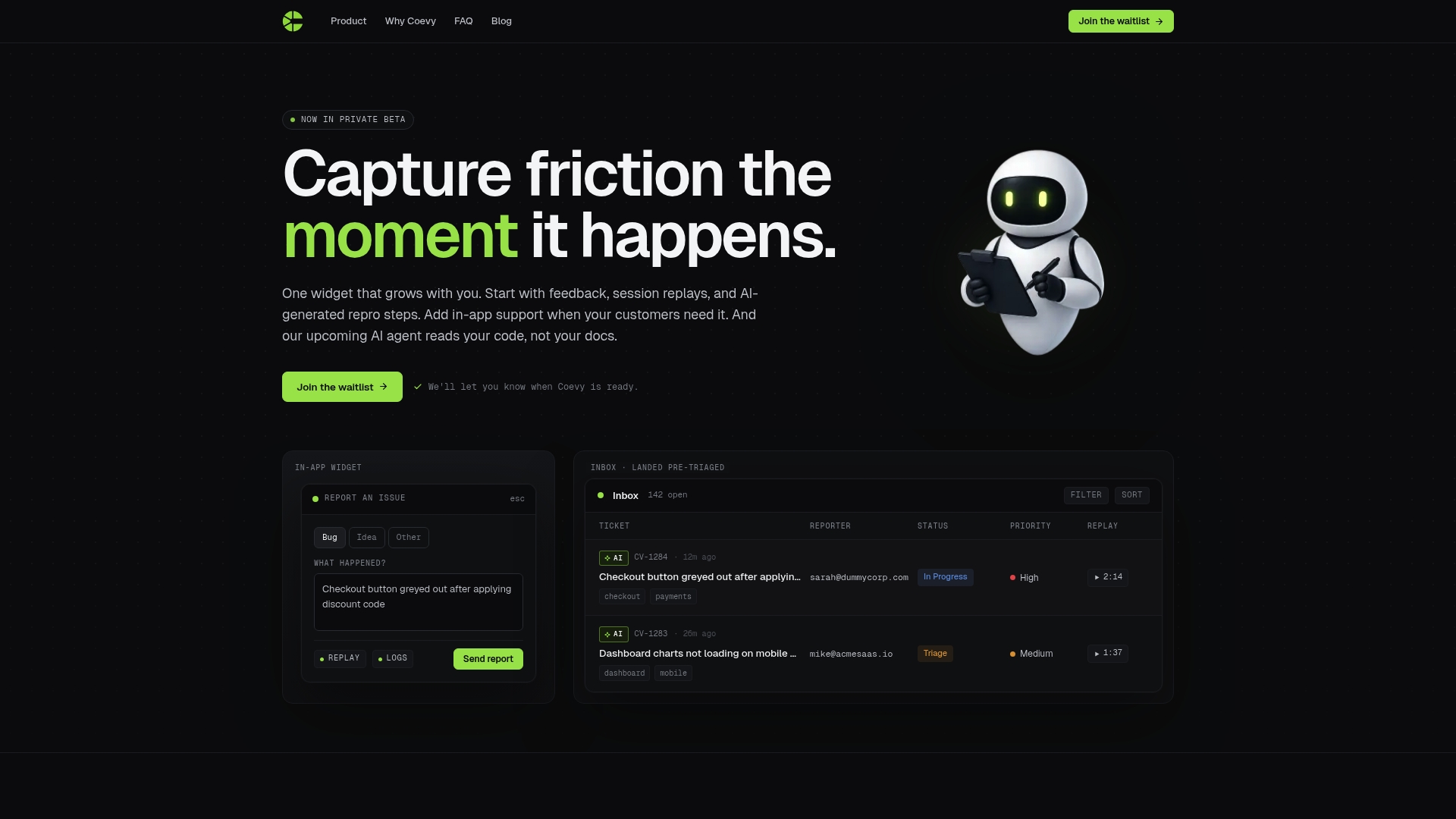
Coevy's AI reads your actual codebase, not just documentation, so the support answers it generates are accurate and specific to your product. It's GDPR-compliant, handles field masking and IP anonymization out of the box, and scales with your team from early-stage to enterprise. If you want to see how it fits into a broader feedback strategy, the customer feedback software guide is a solid place to start.
Frequently asked questions
What is the main difference between feedback tools and help desk systems?
Feedback platforms collect and prioritize product improvement ideas, while help desk systems handle immediate customer support issues and ticket resolution. They serve different functions and work best when used together rather than interchangeably.
Which in-app feedback tool is best for mobile app bug reporting?
Instabug is best for mobile app teams needing intuitive bug reporting with automatic device diagnostics, including network logs and environment data attached to every report without manual effort.
Can I use a feedback platform as my only customer support tool?
No. Feedback systems are not optimized for time-sensitive problems, making a help desk necessary for urgent support. Feedback boards are for product discovery, not immediate issue resolution.
How do voting features help in product feedback platforms?
Voting and aggregation help identify high-impact requests and prevent product teams from relying solely on the loudest customer. It gives quieter but equally valid users a voice in shaping the roadmap.
What should SaaS teams consider when selecting an in-app feedback tool?
Start with your primary goal and filter by budget, team size, and integration needs. Also consider whether you need mobile or web focus, and whether the tool supports your current product maturity stage.