Founder burnout is defined as chronic exhaustion caused by sustained high-decision volume, administrative overload, and the absence of mental recovery time. Understanding how AI support reduces founder burnout starts with one fact: 62% of employees, including leaders, report reduced stress after adopting AI tools. That number reflects a real shift in how founders manage cognitive load, not just productivity. AI support for entrepreneurs works by removing the low-judgment tasks that drain mental energy, freeing founders to focus on the work only they can do. The catch is that AI also introduces new cognitive risks, including what BCG calls "brain fry," that founders must actively manage.
How AI support reduces founder burnout through task delegation
The fastest path to reducing burnout with AI is identifying which tasks consume time without requiring your judgment. Scheduling, investor update drafts, meeting coordination, follow-up sequences, and basic market research summaries all qualify. These tasks are necessary but not strategic. They sit on your mental plate all day, creating low-grade anxiety even when you are not actively working on them.
Founders who delegate these workflows to AI personal assistants reclaim 12–15 hours weekly, turning lost time into capacity for product decisions, team leadership, and fundraising conversations. That is nearly two full workdays returned each week. The ROI compounds quickly when you consider that a founder's highest-value hours are spent on judgment calls, not inbox management.

The cost barrier is lower than most founders expect. Entry-level AI research and writing assistants cost between $0 and $100 per month and compress multi-hour tasks into minutes. A founder spending three hours weekly on investor update drafts can reduce that to 30 minutes with a well-prompted AI writing assistant.
The key tasks worth delegating first:
- Scheduling and calendar management: AI scheduling tools handle back-and-forth coordination without founder involvement.
- Investor and stakeholder updates: AI drafts structured updates from your notes, ready for light editing.
- Meeting follow-ups: AI agents send follow-up emails and log action items automatically.
- Market research summaries: AI compresses hours of reading into structured briefs.
- First-draft content: Blog posts, job descriptions, and pitch deck sections all benefit from AI drafting.
Pro Tip: Start with one task category, not five. Founders who try to delegate everything at once create more cognitive overhead than they remove. Pick scheduling or follow-ups first, build trust in the system, then expand.
What is "brain fry" and how does it differ from burnout?
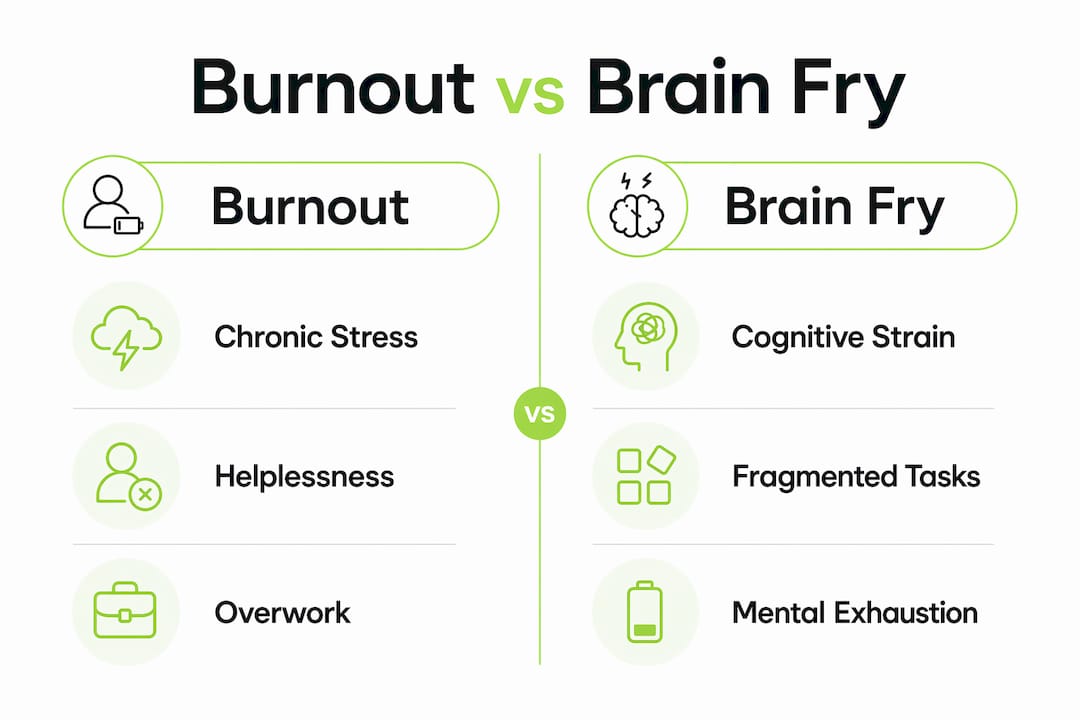
Burnout and brain fry are related but distinct problems. Burnout is the result of chronic stress and helplessness over time. Brain fry is a specific cognitive strain that comes from managing multiple AI systems simultaneously while still making high-stakes decisions.
BCG identifies brain fry as a separate challenge from burnout, one that requires a different response. Burnout calls for rest and workload reduction. Brain fry calls for better AI workflow design. A founder running five disconnected AI tools, each requiring different prompts, logins, and mental models, is adding cognitive load rather than removing it.
The solution is moving from individual AI use to collective, embedded AI workflows. When AI is woven into your existing processes rather than bolted on as separate apps, the mental overhead drops significantly.
| Challenge | Cause | Fix |
|---|---|---|
| Burnout | Chronic stress, helplessness, overwork | Reduce workload, rest, delegate tasks |
| Brain fry | Managing fragmented AI tools and high-decision volume | Embed AI into existing workflows, reduce app switching |
| Cognitive overload | Too many simultaneous inputs and decisions | Prioritize quality AI use over quantity of tools |
Embedding AI into workflows rather than treating each tool as a standalone app is the structural fix. A founder who uses one AI agent to handle scheduling, follow-ups, and daily briefs inside a single system carries far less mental weight than one juggling three separate tools for the same tasks.
AI should be framed as ongoing experimentation, not a performance mandate. When founders feel pressure to use AI perfectly or maximize every feature, the tool becomes another source of anxiety. Treating AI as a flexible experiment lowers that fear and builds genuine agency over time.
What are the social and mental risks of AI for founder well-being?
AI efficiency creates a hidden cost: reduced human connection. Workday's 2026 research found that over-relying on AI deepens a workplace "connection deficit", cutting the small talk and spontaneous trust-building that holds teams together. For early-stage founders, this is a serious risk. Your team's loyalty and your investors' confidence both depend on human relationships that AI cannot replicate.
"Leaders must intentionally design how AI complements rather than replaces human feedback and mentoring systems." — Workday Global Research, 2026
The shift in human agency is equally important to understand. AI changes your role from task executor to director. You no longer write the first draft. You direct the AI, review the output, and apply judgment. That shift is powerful, but it requires founders to stay deliberate about where their judgment actually lives.
Founders who use AI to restore "pathways thinking" report stronger agency and lower helplessness. Pathways thinking means seeing multiple routes to a goal rather than feeling trapped by one blocked path. AI provides those alternative routes, which directly counters the helplessness that drives burnout.
Practical ways to protect human connection while using AI:
- Schedule unstructured team time. Protect at least one weekly touchpoint that has no agenda and no AI summary.
- Keep mentorship human. AI can prepare you for a mentor conversation, but the conversation itself must stay human.
- Use AI to prepare, not replace. Let AI draft the investor update, then deliver it with your voice and presence.
- Watch for emotional reliance. If you find yourself processing decisions with AI before talking to your co-founder, that is a signal to recalibrate.
How can founders build AI workflows that actually reduce fatigue?
The biggest mistake founders make is adding AI tools without changing their operational architecture. Adding a new AI app to an already overloaded system creates more friction, not less. Founders benefit most from delegating entire repetitive workflows to AI agents, not just individual tasks.
A practical integration framework looks like this:
- Start with a morning brief. Set up an AI agent to deliver a daily summary of your top priorities, pending follow-ups, and calendar conflicts before you open your inbox. This replaces reactive morning scrolling with a structured start.
- Delegate one full workflow. Choose one complete process, such as investor update preparation, and hand the entire pipeline to an AI agent. Do not just use AI for one step. Let it handle research, drafting, and formatting.
- Build in an end-of-day capture. Spend 5–10 minutes summarizing your day's progress to your AI agent. This end-of-day capture ritual signals cognitive closure, helping your brain disengage from work overnight. Founders who practice this report sleeping better and arriving at work less depleted.
- Trust AI reminders over your memory. Stop carrying follow-up tasks in your head. Log them to your AI agent immediately and let the system surface them at the right time. This converts diffuse anxiety into a managed list.
- Expand one workflow at a time. After two weeks with one delegated workflow running reliably, add a second. Gradual expansion builds trust in the system without creating new cognitive overhead.
Pro Tip: The AI tools for founder wellness that deliver the most relief are not the most feature-rich. They are the ones you actually use consistently. Simplicity and reliability beat capability every time.
The goal is not to use more AI. The goal is to carry less in your head. Every task your AI agent reliably handles is one fewer item competing for mental space during a board meeting or a product decision.
Key Takeaways
AI support reduces founder burnout most effectively when it replaces entire workflows, not just individual tasks, freeing mental capacity for the judgment work that only founders can do.
| Point | Details |
|---|---|
| Delegate full workflows | Hand entire repetitive pipelines to AI agents, not just single tasks, to remove sustained cognitive load. |
| Separate burnout from brain fry | Burnout needs rest; brain fry needs better workflow design with fewer, embedded AI tools. |
| Protect human connection | Intentionally schedule unstructured team time to counter the connection deficit AI efficiency creates. |
| Practice end-of-day capture | Spend 5–10 minutes summarizing progress to an AI agent to achieve cognitive closure and protect sleep. |
| Expand AI use gradually | Add one workflow at a time to build system trust without creating new mental overhead. |
The uncomfortable truth about AI and founder resilience
Founders are sold AI as a productivity tool. The real value is psychological. When your AI agent reliably handles follow-ups and your morning brief arrives before you open your inbox, you stop carrying the weight of "what am I forgetting?" That shift is not about efficiency. It is about mental freedom.
The founders I see struggle most with AI are the ones who treat it as a collection of apps rather than a redesigned way of working. They add five tools, use each one inconsistently, and end up with more cognitive overhead than before. Brain fry is real, and fragmented AI use is its primary cause.
The founders who genuinely reduce their burnout with AI do one thing differently: they commit to trusting the system. They log the follow-up immediately instead of holding it in their head. They let the AI draft the investor update instead of starting from scratch at 11 PM. That trust is built slowly, one reliable interaction at a time.
My honest view is that AI does not reduce burnout by doing more. It reduces burnout by letting you carry less. The distinction matters because it changes how you adopt AI. You are not looking for the most powerful tool. You are looking for the most reliable one. Build that reliability first, then expand.
— Dizzy
How Coevy helps founders reduce operational friction
Founders dealing with support ticket volume and user feedback loops face a specific kind of fatigue: the constant back-and-forth of bug reports, feature requests, and follow-up questions that never fully resolve.
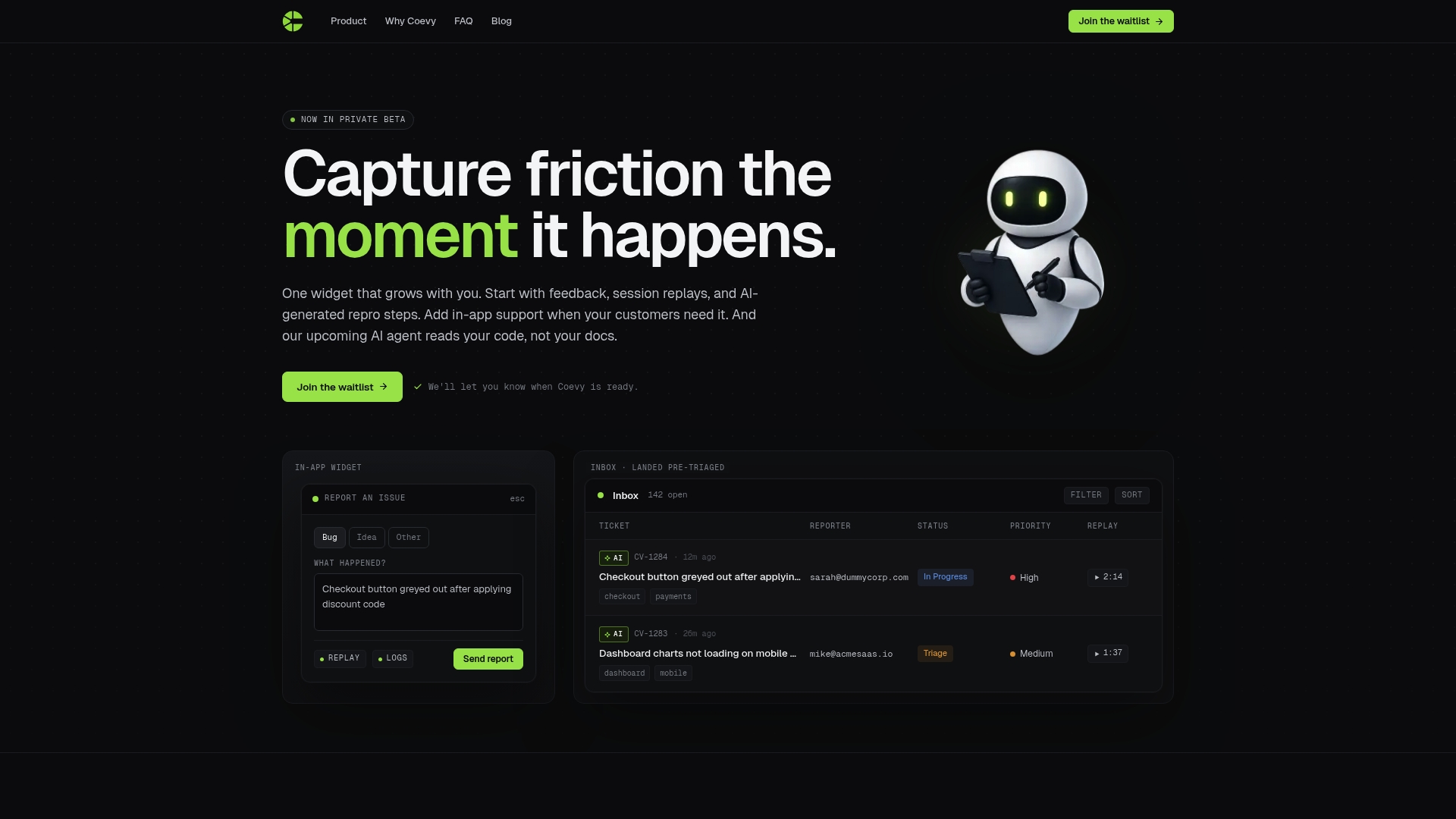
Coevy is built to remove that friction at the source. Its AI-powered widget captures user feedback, attaches session context automatically, and generates reproduction steps for bugs without requiring manual follow-up from your team. Founders using Coevy spend less time chasing issue details and more time making product decisions. The platform's AI support for lean teams grows with your product, from early feedback collection through full support ticket management, so you are not rebuilding your support workflow every six months.
FAQ
What tasks should founders delegate to AI first?
Scheduling, investor update drafts, and meeting follow-ups deliver the fastest relief. Founders who start with these reclaim 12–15 hours weekly without disrupting strategic work.
What is the difference between burnout and brain fry?
Burnout comes from chronic stress and overwork over time. Brain fry is cognitive strain from managing multiple fragmented AI tools simultaneously. BCG identifies these as separate problems requiring different solutions.
Can AI use make founder burnout worse?
Yes, if adopted poorly. Adding disconnected AI tools without redesigning workflows increases cognitive load. Increased AI expectations without guidance directly contribute to employee and founder burnout.
How does the end-of-day capture ritual work?
Founders spend 5–10 minutes summarizing daily progress to an AI agent before closing work. This practice signals cognitive closure and helps the brain disengage, reducing overnight rumination and next-day fatigue.
Does AI reduce the need for human connection at work?
AI efficiency can reduce spontaneous trust-building and small talk, creating a connection deficit. Founders must intentionally design human interactions alongside AI use to maintain team cohesion.