AI support reduces developer interruptions by delivering context-aware, actionable answers directly inside developer workflows, cutting the repetitive queries that pull engineers out of deep work. The industry term for this capability is AI-assisted developer support, and it covers everything from ticket deflection to codebase-aware debugging assistance. Tools like Harness AI, GitHub Copilot, and Atlassian Rovo Dev each attack a different layer of the interruption problem. Harness AI deflects 95% of platform support tickets by traversing job history, logs, and config changes to produce specific fixes rather than generic error messages. Understanding how ai support reduces developer interruptions, and where it falls short, is the difference between a team that ships faster and one that just adds another tool to its stack.
How AI support reduces developer interruptions
Developer interruptions fall into four distinct categories, and each one carries a cost beyond the minutes lost.
Repetitive support tickets are the most visible drain. Engineers field the same platform questions dozens of times per sprint. Every ticket answered manually is a context switch that costs the responder, not just the requester.

Code search and documentation hunting pulls developers out of their editor to scan wikis, Confluence pages, or Slack threads. Most developer friction lies in assembling context, not in writing code itself. AI that surfaces the right answer inside the IDE removes that hunt entirely.
Context switching between tools fragments attention. A developer debugging a pipeline failure who must jump to a ticketing system, then a log viewer, then a chat thread loses the mental model they built. Recovery from a single context switch takes far longer than the switch itself.
Meeting and escalation interruptions are the hardest to quantify. A five-minute "quick question" in Slack can derail 30 minutes of focused work once you account for re-entry time. Measuring interruption cost requires tracking fragmentation and recovery time, not just the duration of the escalation itself.
The common thread across all four categories is cognitive load. When AI absorbs the repetitive, searchable, and automatable work, engineers reclaim the mental bandwidth that deep work demands.
What do tools like Harness, GitHub Copilot, and Rovo Dev actually do?
The mechanisms these tools use are distinct, and that distinction matters for choosing the right fit.
Harness AI uses a knowledge graph that connects job history, configuration changes, and logs. When a pipeline fails, the AI traverses that graph and returns a specific fix, such as a YAML correction, rather than pointing the developer to a documentation page. That specificity is what drives the 95% ticket deflection rate. Generic answers still interrupt engineers because they require interpretation and follow-up.
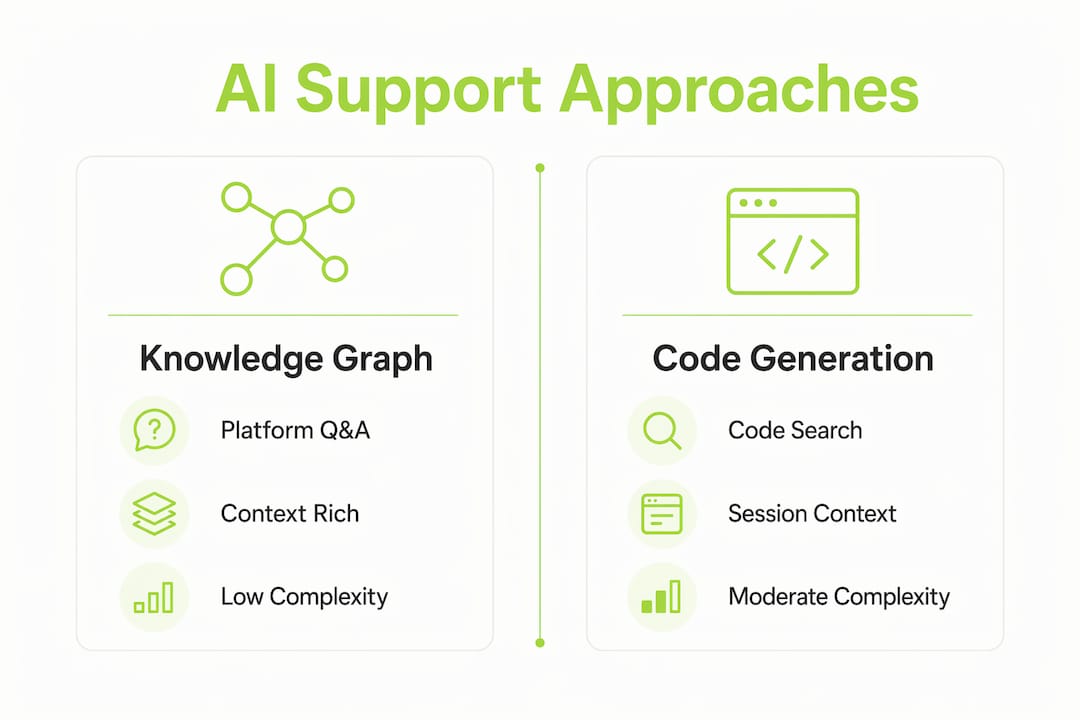
GitHub Copilot attacks a different layer. Its recent improvements focus on session context management, using prompt caching and efficient model routing so developers do not have to re-explain their intent across interactions. Session-aware tooling reduces the cognitive overhead of back-and-forth exchanges that would otherwise interrupt flow.
Atlassian Rovo Dev targets the software development lifecycle more broadly. Teams using AI-native SDLC tools save 2–3 hours per week and see 19% more merged pull requests per repository. That time comes primarily from coding and review tasks, representing roughly 10% of a typical developer's weekly coding time.
Pro Tip: Before deploying any of these tools, map where your team's interruptions actually originate. Ticket deflection tools solve a different problem than code generation tools. Deploying the wrong one adds overhead without reducing the interruptions that matter most.
Controlled studies on LLM assistants for software development confirm that the biggest gains come from minimizing code search and automating trivial tasks, not from raw code generation speed. The implication is clear: AI earns its place by removing the friction around coding, not just by writing more of it.
Why AI sometimes increases fragmentation instead of reducing it
The counterintuitive finding from 2026 research is that AI can make fragmentation worse, not better.
A JetBrains study found that AI users show more IDE activations, suggesting AI shifts context switching rather than eliminates it. Developers perceived themselves as being in flow, but telemetry told a different story. More tool interactions, not fewer, appeared in the data.
"Developers perceive AI assistance as helpful for flow, but telemetry reveals increased fragmentation; measurement beyond subjective feeling is crucial." — JetBrains Research, 2026
Three patterns explain why this happens:
- Verification overhead. Every AI suggestion requires a developer to read, evaluate, and confirm or reject it. That verification step is itself an interruption, especially when the suggestion is partially correct.
- Hallucinated fixes. An AI that confidently produces a wrong answer sends the developer down a debugging path that did not exist before the AI got involved. Calibrated confidence models and verification feedback gates exist specifically to prevent this class of interruption.
- Session discontinuity. When an AI tool loses the thread of a developer's intent between interactions, the developer must re-explain context. Continuity of intent is the factor that separates agentic tools that reduce interruptions from those that just add a new kind of them.
The lesson is not that AI fails. The lesson is that AI without proper context management trades one type of interruption for another.
Best practices for teams that want AI to actually minimize interruptions
The teams that get the most from AI support share a set of habits that have nothing to do with which tool they chose.
- Invest in clean, findable documentation first. Teams that self-serve information with AI are 4.9x more effective and 4.4x more productive than those that do not. AI amplifies the quality of your existing knowledge base. It cannot compensate for a documentation gap.
- Maintain connected intent across AI sessions. Use tools that preserve the thread of a developer's current task. When an AI assistant forgets context between turns, the developer pays the re-orientation cost. Agentic tools that maintain workflow threads eliminate that cost.
- Track fragmentation metrics, not just time to answer. Speed of response is a shallow metric. The real measure is whether the AI interaction required the developer to context-switch and how long recovery took. Teams that measure total interruption impact catch fragmentation problems that pure ticket-volume metrics miss.
- Build verification gates into AI-assisted debugging. Require AI tools to express confidence levels and flag uncertain suggestions. This prevents hallucinated fixes from generating new interruption chains.
- Iterate with your team, not just your tooling. The best AI configuration for reducing interruptions is the one your team actually trusts and uses consistently. Adoption gaps create shadow workflows that reintroduce the interruptions AI was supposed to eliminate.
Pro Tip: Run a two-week fragmentation audit before and after deploying an AI tool. Count IDE activations, tool switches, and Slack interruptions. The numbers will tell you whether the tool is reducing friction or just moving it.
Improving coding efficiency with AI requires treating documentation quality, session continuity, and measurement discipline as prerequisites, not afterthoughts. The benefits of AI code reading tools compound only when the surrounding process supports them.
AI support approaches compared: which method reduces which interruptions?
Different AI architectures solve different interruption problems. Choosing the wrong architecture for your team's dominant interruption type is the most common deployment mistake.
| AI approach | Primary interruption reduced | Implementation complexity |
|---|---|---|
| Knowledge graph traversal (Harness AI) | Repetitive platform support tickets | Medium: requires indexed logs and config history |
| Code generation and review (GitHub Copilot, Rovo Dev) | Code search, review bottlenecks | Low: IDE plugin or CI integration |
| Agentic assistants with session continuity | Context switching, re-explanation overhead | High: requires workflow thread management |
| Codebase-aware support (Coevy) | Bug reproduction, escalation back-and-forth | Medium: requires source code access and widget integration |
Knowledge graph traversal works best when your interruptions come from platform operations questions. Engineers ask the same pipeline failure questions repeatedly, and a graph that connects logs to known fixes deflects those tickets before they reach a human.
Code generation tools like GitHub Copilot and Rovo Dev work best when interruptions come from search and review friction. They reduce the time spent hunting for syntax, patterns, or reviewer availability. The source code integrated AI assistants category extends this by reading actual application code rather than relying on documentation alone.
Agentic assistants are the most powerful and the most demanding to implement. They require tools that maintain a connected thread of developer intent across multiple interactions. When they work, they eliminate the re-orientation cost entirely. When they fail, they add a new category of interruption.
Key takeaways
AI support reduces developer interruptions most effectively when it delivers specific, context-rich answers that remove the need for follow-up, rather than generic responses that create new context-switching cycles.
| Point | Details |
|---|---|
| Specificity beats speed | AI that returns a precise fix deflects tickets; AI that returns generic guidance just moves the interruption downstream. |
| Fragmentation is a real risk | JetBrains telemetry shows AI can increase IDE activations, so measure fragmentation before and after deployment. |
| Documentation quality multiplies AI gains | Teams with clean, findable docs are 4.9x more effective when using AI self-serve support. |
| Session continuity is non-negotiable | AI tools that lose context between turns force developers to re-explain, creating a new interruption type. |
| Match the tool to the interruption type | Knowledge graphs, code generation, and agentic assistants each solve a different category of developer friction. |
The uncomfortable truth about AI and developer focus
The dominant narrative around AI in developer productivity is that more AI equals fewer interruptions. The JetBrains telemetry data from 2026 complicates that story in a way most vendors are not eager to discuss.
Developers feel more productive with AI. Their telemetry shows more tool switches. Both things are true at the same time. What that tells me is that AI changes the texture of interruptions more than it eliminates them. The interruptions become shorter and more frequent rather than fewer and longer. Whether that trade is worth it depends entirely on the type of work your team does.
For teams doing deep architectural work, frequent short interruptions from AI verification cycles may be more damaging than the occasional long escalation. For teams doing high-volume operational support, deflecting 95% of tickets with Harness AI is a genuine win regardless of fragmentation patterns.
The practical advice I would give any engineering lead is this: do not deploy AI support tools and assume the problem is solved. Instrument your workflows. Measure fragmentation. Talk to your engineers about whether the AI interactions feel like help or noise. The teams that get lasting productivity gains from AI are the ones that treat it as a process change, not a product purchase.
Coevy's approach of reading actual source code rather than relying on documentation is the right direction for reducing escalation back-and-forth. But even the best tool needs a team that measures outcomes honestly.
— Dizzy
Coevy captures friction before it becomes an interruption
Engineering teams spend significant time chasing down bug reports that lack context, reproducing issues that users describe vaguely, and answering support questions that could have been resolved without a developer ever getting involved.
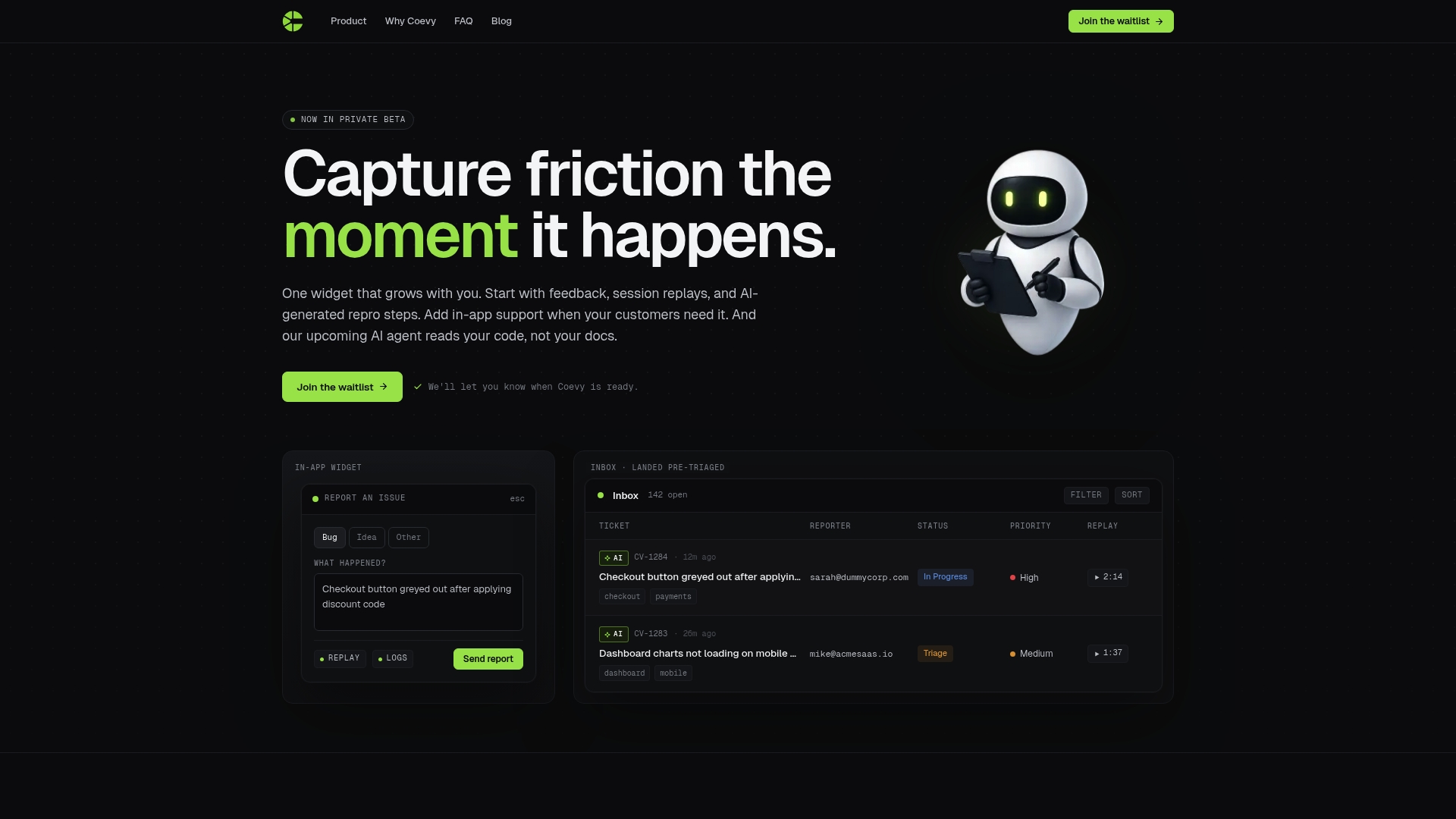
Coevy embeds directly into your web app and captures session replays, AI-generated reproduction steps, and contextual data at the moment a user hits friction. Its upcoming AI agent reads your actual codebase, not just your documentation, so the answers it returns are grounded in how your application actually works. That specificity is what prevents vague bug reports from becoming developer interruptions. Teams looking to reduce escalations and keep engineers in flow can explore Coevy's platform and see how friction capture changes the support workflow from the ground up.
FAQ
How does AI support reduce developer interruptions?
AI support reduces developer interruptions by deflecting repetitive queries with specific, context-aware answers and automating code search and review tasks. Tools like Harness AI use knowledge graphs to return precise fixes, removing the need for developer involvement in routine support.
Can AI tools increase context switching instead of reducing it?
Yes. A JetBrains 2026 study found that AI users show more IDE activations, indicating that AI can shift rather than eliminate context switching. Effective implementation requires session continuity and fragmentation monitoring to avoid this outcome.
What metrics should teams track to measure AI's impact on interruptions?
Teams should track fragmentation patterns and context recovery time, not just ticket volume or time to answer. Total interruption impact includes the time developers spend re-orienting after an AI interaction, which standard metrics miss.
What is the difference between knowledge graph AI and agentic AI for developers?
Knowledge graph AI, like Harness AI, traverses logs and config history to answer specific platform questions. Agentic AI maintains a connected thread of developer intent across multiple interactions, reducing the re-explanation overhead that causes context switching.
How does documentation quality affect AI interruption reduction?
Clean, findable documentation amplifies AI's ability to deflect interruptions. Atlassian research shows teams that self-serve information with AI are 4.9x more effective than those that do not, making documentation investment a prerequisite for AI support success.