AI reduces support ticket volume by intercepting high-frequency, repetitive inquiries before they ever reach a human agent. This process, formally called ticket deflection, combines automated self-service, autonomous resolution, and intelligent routing to cut the raw number of tickets your team handles each day. IBM notes that AI categorizes and routes requests automatically, preventing the misdirection delays that inflate agent queues. For customer support leaders in tech companies, understanding how AI reduces support ticket volume is the difference between a team that scales and one that burns out.
How AI reduces support ticket volume: the core mechanisms
AI deflects tickets through three distinct layers. The first is customer-facing self-service, where an AI agent answers common questions like password resets, billing lookups, and account status checks without creating a ticket at all. The second is autonomous resolution, where the AI takes a direct action inside a connected system, such as issuing a refund or updating a subscription. The third is intelligent routing, where tickets that do reach the queue are sent to the right team immediately, cutting resolution time and preventing repeat contacts.
SAP confirmed that its AI autonomously resolves 20% of internal support tickets and assists in 100% of cases, producing a 12% productivity gain. That productivity gain means existing agents handle more volume without additional headcount. These are not theoretical projections. SAP's CEO disclosed these figures in Q1 2026 earnings, making them among the most credible benchmarks available for enterprise AI support deployments.
The foundational insight is simple: tickets you prevent cost nothing to resolve. Every Tier-1 request deflected by self-service is a ticket that never enters your queue, never consumes agent time, and never risks a slow resolution that damages customer satisfaction.

What are the primary AI techniques used to deflect tickets?
Four techniques power most AI deflection systems in production today.
- Intent parsing. The AI reads the customer's message and identifies the underlying request, such as "cancel my account" or "where is my order," regardless of how the customer phrases it. Accurate intent parsing is the foundation of every downstream decision.
- Retrieval-Augmented Generation (RAG). Once intent is clear, the AI searches a knowledge base for the most relevant answer and generates a response grounded in that content. RAG reduces hallucination risk compared to pure language model responses.
- Confidence scoring. The AI assigns a confidence level to its proposed answer. High-confidence responses trigger auto-resolution. Low-confidence responses escalate to an agent. This gate is what separates genuine deflection from false deflection that creates re-contact loops.
- CRM and system integration. When the AI connects to billing, order management, or CRM platforms, it can take account-specific actions rather than just providing information. This is where deflection rates climb significantly.
Pure knowledge retrieval plateaus at roughly 35–40% deflection. Deep system integrations push that figure to 60–90%. The gap between those two numbers represents the difference between a chatbot that answers FAQs and an AI agent that actually resolves problems.
Pro Tip: Start your AI deployment on the five to ten ticket intents that appear most frequently in your queue. Mature knowledge base coverage for those intents before expanding scope. This approach produces faster deflection gains and cleaner confidence scoring from day one.
How does AI augment agent workflows to reduce ticket volume?
AI's impact on agent workflows is often underestimated. The direct deflection number gets the headlines, but agent-focused AI features like draft response generation and structured summaries deliver larger throughput gains than customer-facing bots alone. Higher agent throughput means each ticket is resolved faster, which reduces the backlog that causes customers to submit duplicate tickets.
Here is how AI augments agent work in practice:
- Draft response generation. The AI reads the ticket, pulls from prior ticket history and internal documentation, and writes a suggested reply. The agent reviews and sends. Fivetran's AI-first Zendesk integration does exactly this, cutting the time agents spend composing replies from scratch.
- Structured ticket summaries. When a ticket escalates from AI to a human, the AI attaches a summary of what was already tried, what the customer said, and what system data is relevant. Engineers avoid re-investigating context they already have.
- Automated categorization and routing. IBM highlights that AI routing reduces bottlenecks by sending tickets to the right specialist immediately. Misrouted tickets generate internal handoffs, which add time and often prompt customers to submit a second ticket asking for an update.
- Repetitive task elimination. Tagging, priority assignment, and SLA flagging happen automatically. Agents spend their time on judgment calls, not administrative work.
Pro Tip: Track your first-contact resolution rate before and after deploying agent assist features. A rising first-contact resolution rate is the clearest signal that AI is reducing the repeat tickets that inflate your queue without appearing in standard deflection metrics.
What metrics actually measure AI-driven ticket volume reduction?
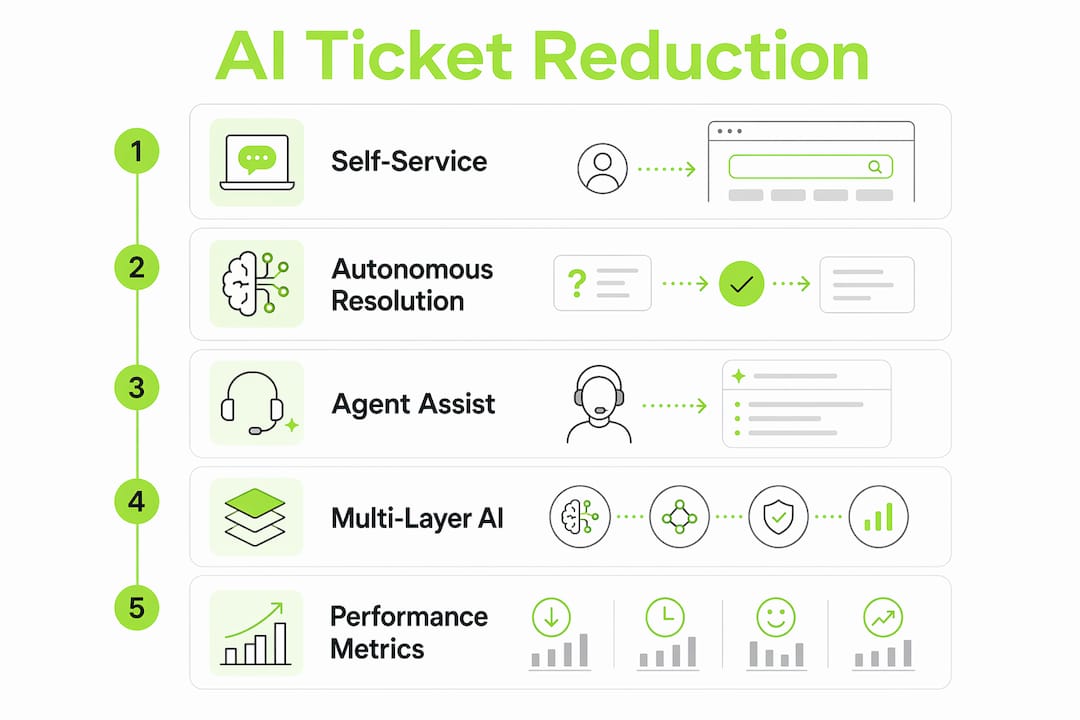
Deflection rate is the metric most vendors lead with. It is also the easiest to game. A bot that closes conversations without resolving them produces a high deflection rate and a spike in re-contacts within 48 hours. Confidence gating and escalation paths are the critical success factors that separate real volume reduction from inflated dashboard numbers.
The metrics that matter are:
- Resolution rate. Did the customer's problem actually get solved? Measure this through post-interaction surveys or by tracking whether the customer contacts support again within 48 hours on the same issue.
- Re-contact rate within 48 hours. A rising re-contact rate after AI deployment signals false deflection. The AI is closing tickets, not resolving them.
- CSAT on AI-handled interactions. Customer satisfaction scores on AI-resolved tickets tell you whether the experience is acceptable, not just whether the ticket closed.
- Escalation accuracy. Are escalated tickets landing with the right team on the first transfer? Poor escalation accuracy creates internal handoffs that generate repeat customer contacts.
| Metric | What it measures | Warning sign |
|---|---|---|
| Resolution rate | True problem resolution | Falling rate after AI launch |
| Re-contact within 48 hours | False deflection | Rate rises post-deployment |
| CSAT on AI tickets | Customer experience quality | Score below human-handled baseline |
| Escalation accuracy | Routing quality | High internal transfer rate |
Iterative review of escalated cases is the operational habit that separates teams that improve from teams that plateau. Every escalated ticket is a data point showing where the AI's knowledge base or confidence thresholds need adjustment. Improving knowledge base quality boosts autonomous AI resolution effectiveness by up to 25%. That is not a one-time gain. It compounds as the knowledge base matures.
How do multi-layer AI approaches increase deflection rates?
The highest deflection rates come from systems built in layers, not from a single AI tool. A layered pipeline works like this: the customer's query enters, intent parsing identifies the request, RAG retrieves relevant knowledge, confidence scoring decides the next step, and the system either resolves autonomously, assists the agent, or escalates with full context attached.
The contrast between retrieval-only and fully integrated systems is stark. Non-integrated AI agents plateau around 35–40% deflection. Systems that connect to CRM, billing, and order management platforms reach 60–90% deflection because they can act, not just answer.
Account-aware actions are the key differentiator. An AI that can look up an order status, process a refund, or change a subscription tier resolves the ticket completely. An AI that can only describe how to do those things creates a ticket. The difference is integration depth, not AI sophistication.
Context-carrying escalations also reduce ticket volume indirectly. When a customer escalates from AI to a human agent, the agent receives the full conversation history, the actions already attempted, and the relevant account data. The customer does not need to repeat themselves. That reduces frustration-driven duplicate tickets and cuts average handle time on escalated cases.
AI-driven volume reduction is maximized when the focus is on improving agent throughput alongside autonomous replies. The two layers reinforce each other. Better deflection reduces agent queue pressure. Better agent tools reduce resolution time. Both effects shrink the total ticket volume your team carries at any given moment. For teams exploring AI-powered ticket management, the pipeline architecture matters as much as the AI model itself.
Key Takeaways
AI reduces support ticket volume most effectively when deflection, autonomous resolution, and agent augmentation work together as a layered system rather than independent tools.
| Point | Details |
|---|---|
| Deflection beats documentation | AI that takes account-aware actions resolves tickets; AI that only answers FAQs deflects them temporarily. |
| Integration depth drives results | Retrieval-only systems plateau at 35–40% deflection; CRM-integrated systems reach 60–90%. |
| Agent assist multiplies gains | Draft responses and structured summaries raise first-contact resolution and cut repeat tickets. |
| Measure re-contact, not just deflection | A rising re-contact rate within 48 hours signals false deflection, not real volume reduction. |
| Knowledge base quality compounds | Improving documentation boosts autonomous resolution effectiveness by up to 25% over time. |
The metric most support leaders ignore
Most support leaders I talk to are chasing deflection rate. I understand why. It is the number vendors put on the slide, and it moves fast after deployment. But deflection rate without re-contact rate is a vanity metric. I have seen teams celebrate a 45% deflection rate while their re-contact volume climbed 30% in the same quarter. The AI was closing conversations. It was not solving problems.
The teams that get real, durable ticket volume reduction do two things differently. First, they treat the knowledge base as a product, not a project. They assign ownership, set review cadences, and track which AI failures trace back to missing or outdated documentation. Second, they keep humans in the loop as governors, not just escalation targets. Humans remain governors and escalators in AI-augmented support, while AI handles drafting, summarization, and routine resolutions. That division of labor is not a limitation. It is the architecture that makes the whole system trustworthy.
My honest advice: start with your top ten ticket intents, build deep knowledge coverage for those intents, and measure re-contact rate from week one. You will learn more from that narrow focus in 90 days than from a broad deployment that produces impressive deflection numbers and confused customers.
— Dizzy
What Coevy brings to AI-driven ticket reduction
Support leaders who want to put these strategies into practice need tools built for the complexity of real SaaS products, not generic chatbot platforms.
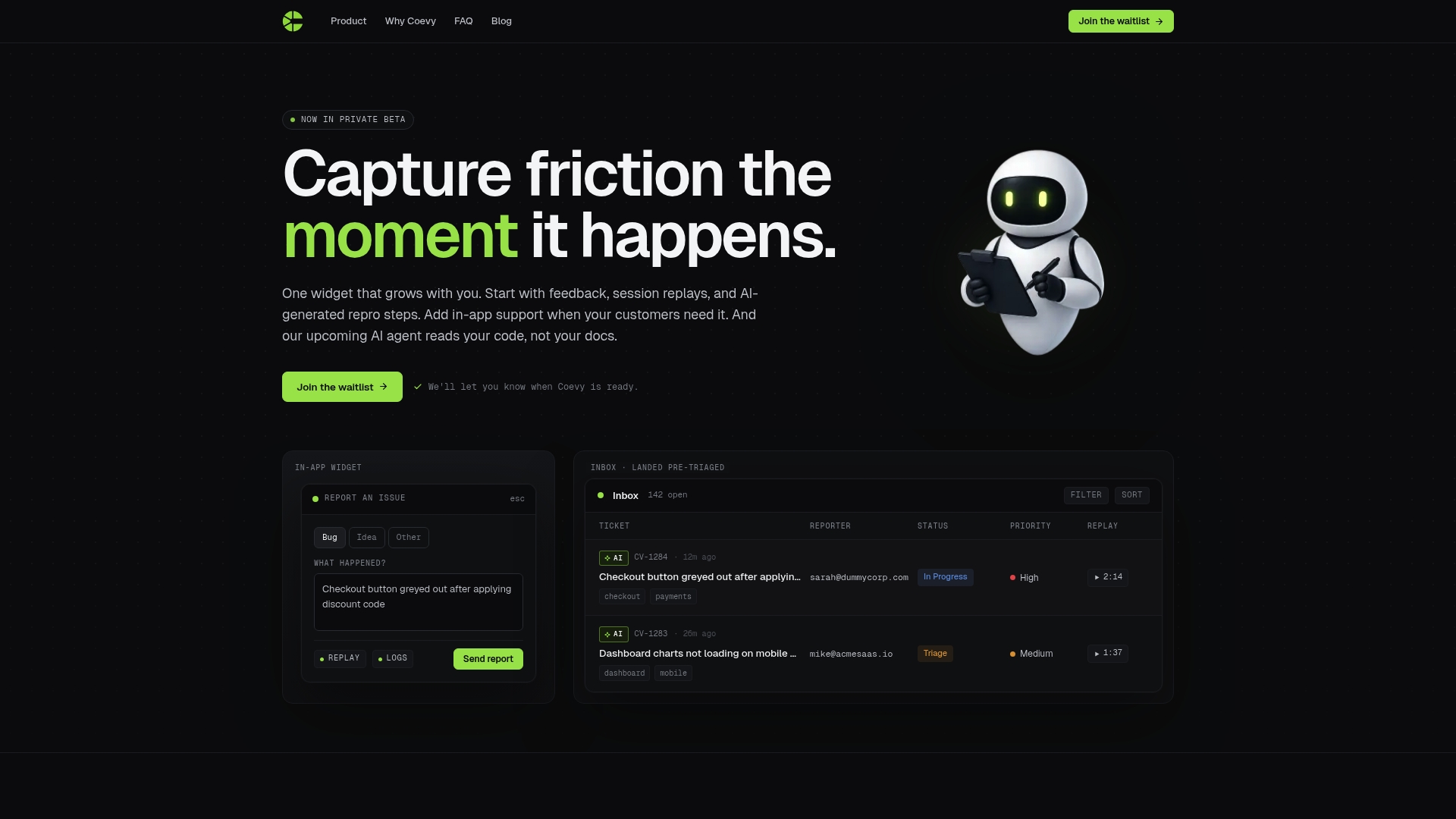
Coevy is built specifically for software teams that need AI support to grow with their product. Its AI-powered features include auto-tagging, ticket prioritization, and a codebase-aware AI agent that reads actual source code rather than relying on static documentation. That means answers tied to how your application actually works, not how someone described it months ago. For teams focused on reducing repetitive support queries and freeing agents for complex work, Coevy offers a unified widget that handles feedback collection, session replays, and AI-generated bug reproduction steps in one place. Explore Coevy's platform to see how it fits your support workflow.
FAQ
How does AI reduce support ticket volume?
AI reduces ticket volume by deflecting high-frequency requests through self-service, autonomously resolving certain tickets via system integrations, and routing remaining tickets accurately to cut repeat contacts. Each layer removes tickets before or after they enter the agent queue.
What deflection rate can AI realistically achieve?
Retrieval-only AI systems typically plateau at 35–40% deflection. Systems integrated with CRM, billing, and order management platforms reach 60–90% deflection by taking direct account-aware actions rather than just providing information.
What is the biggest mistake teams make when deploying AI for ticket reduction?
Optimizing for deflection rate without tracking re-contact rate within 48 hours. A high deflection rate paired with rising re-contacts means the AI is closing tickets without resolving them, which inflates volume rather than reducing it.
How does improving the knowledge base affect AI ticket resolution?
Improving knowledge base quality boosts autonomous AI resolution effectiveness by up to 25%. The knowledge base is the primary input for retrieval-based AI, so documentation gaps directly limit how many tickets the AI can resolve without human involvement.
How does AI help agents reduce ticket volume indirectly?
AI draft responses, structured escalation summaries, and automated categorization raise agent throughput and first-contact resolution rates. Higher first-contact resolution means fewer customers submit follow-up tickets, which reduces total queue volume over time.