Embedding in-app feedback and AI-powered support directly into web and eCommerce platforms often leads to slow resolutions, messy handoffs, and missing session context for engineers. Most existing tools either require multiple widgets, lack automation for order flows, or demand custom quotes instead of simple pricing, which creates friction and budgeting blind spots for SaaS and commerce teams. This comparison details feature sets, automation levels, and integration scope for five feedback and support platforms so you can choose one that improves ticket triage, reduces manual work, and fits your workflow without procurement headaches.
Table of Contents
- Coevy
- Konvo AI Customer Platform
- Hoola
- Konversation
- Consio AI
- Comparative Analysis: Choosing the Best Fit for Your Needs
Coevy
At a Glance
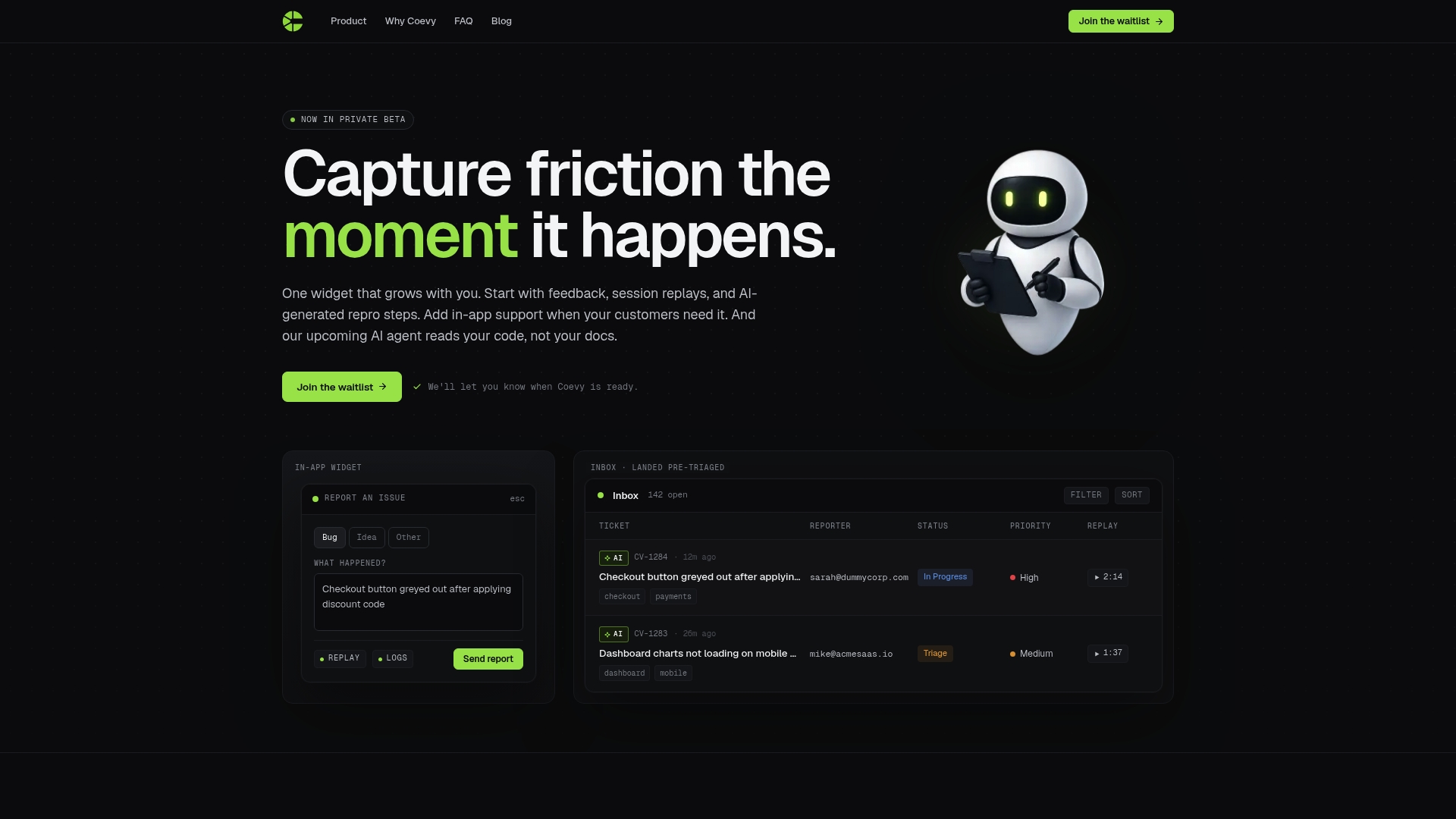
Currently in private beta, Coevy plans an AI agent that reads your actual codebase rather than relying on documentation to answer support and debugging questions. The vendor advertises GDPR-compliant handling and an in-app widget that captures feedback, session replay, logs, and AI-generated reproduction steps.
Core Features
- Feedback widget for bug reports, feature requests, and NPS collection directly inside your web app.
- AI-generated reproduction steps produced from combined session replays and contextual logs to speed engineer handoffs.
- Session replay that records console logs, network requests, and environment metadata for each report.
- Pre-triaged inbox where tickets arrive with attached session data and AI tags for faster routing.
- A planned codebase-aware AI that cites exact source locations when it answers support queries.
Key Differentiator
Coevy attaches rich session context to tickets at capture time and layers automated reproduction steps on top of that context. That single-widget approach keeps the exact replay, logs, and AI tags bound to the ticket so engineers see reproduction paths and environment details without chasing users or digging through separate tools.
Pros
- Saves investigation time by bundling session replay, console logs, and network traces with every report. Engineers get the context they need without extra emails.
- The pre-triaged inbox reduces manual triage. Tickets arrive with AI tags and repro steps so routing and prioritization start automatically.
- Capturing NPS and feature requests in the same widget keeps qualitative feedback tied to the same session context as bugs, improving product decisions.
- The road map includes a code-reading AI that points to exact source locations, which changes the nature of developer support from guesswork to code-referenced guidance.
- Designed to grow with your app: initial feedback capture scales toward support automation and deeper debugging workflows as your team adopts more features.
Cons
- Currently in private beta, so full feature stability and availability are limited while the product matures.
Who It's For
Product managers, support leads, and engineering teams at growing SaaS companies that need tighter context around web app incidents. Teams that want to reduce back-and-forth between support and engineering will find Coevy useful during early scaling.
Unique Value Proposition
The widget-first design means session data and AI repro steps are captured at the moment of user feedback and travel with the ticket. That reduces manual context transfer and lowers time spent reproducing issues, letting small teams turn reports into fixes faster without adding multiple point solutions.
Real World Use Case
A midstage SaaS team embeds Coevy into their app. A user files a bug, the widget attaches a session playback, console output, and an AI-written reproduction checklist. Support creates a ticket that already contains the repro steps and environment, so an engineer reproduces and fixes the issue in a single sprint.
Pricing
Pricing is not yet published. The product is in private beta and the vendor has not published final pricing tiers, so budget planning requires direct contact with the team.
Website: https://coevy.com
Konvo AI Customer Platform
At a Glance
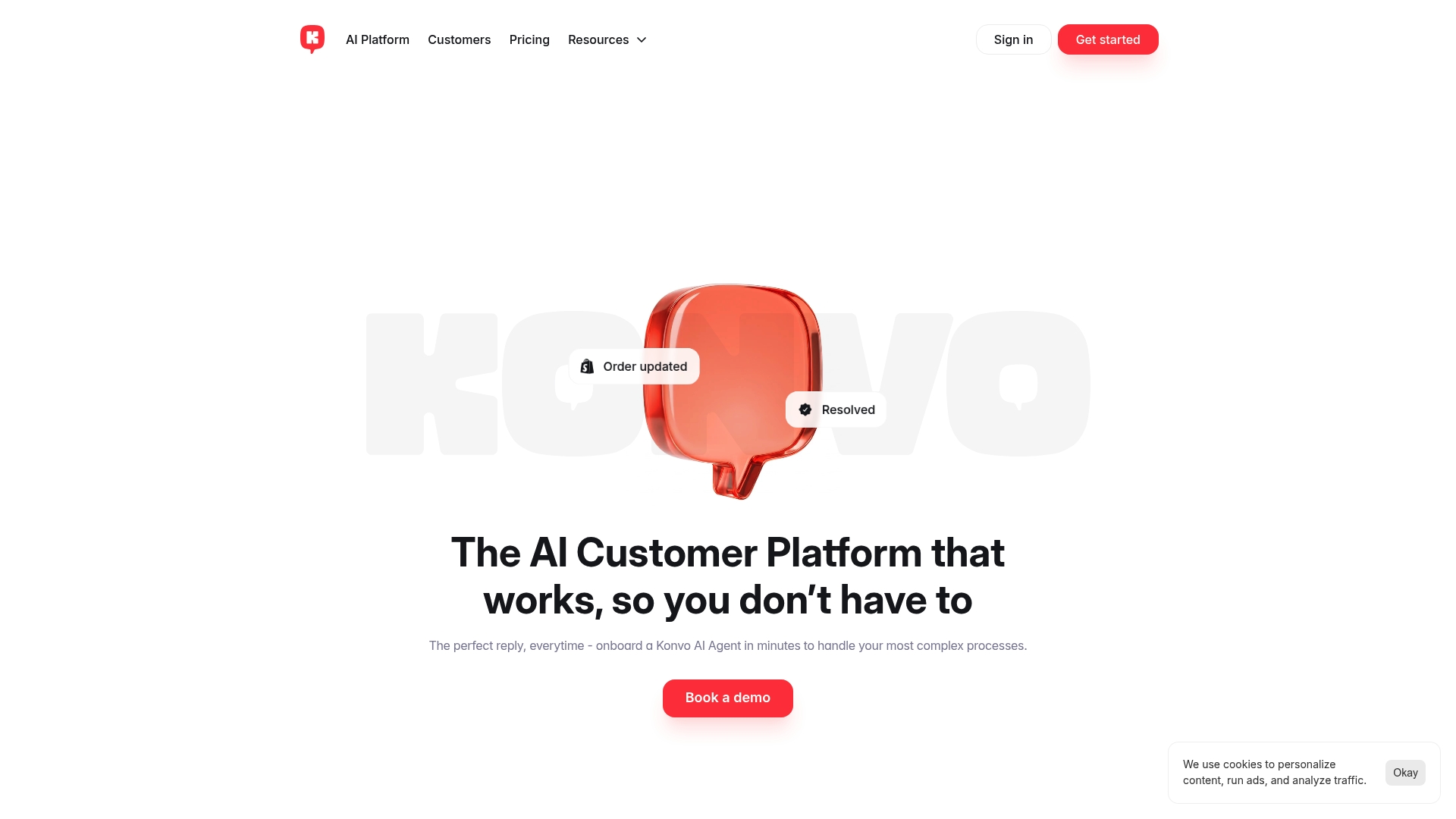
The vendor advertises automating up to 76% of customer interactions, a striking efficiency claim aimed at eCommerce peaks and sale events. Konvo focuses on fast AI agent rollout and works alongside helpdesks like Zendesk and Gorgias while connecting to major shop systems.
Core Features
Build and deploy AI customer support agents in minutes that learn from your product catalog and past conversations.
Connect a single agent to WhatsApp, live chat, email, and social media so agents work across channels without tool switching.
Automate order management, refunds, subscription handling, escalations, and test AI responses before production while collecting feedback and analytics.
Key Differentiator
Konvo’s standout claim is that it learns from your catalog, conversations, and processes to resolve multi step tasks autonomously. That design aims to reduce handoffs by letting the agent act on order status and subscription flows while integrating into existing helpdesk workflows.
Pros
Fast onboarding. Teams report agents can be configured and deployed quickly, which reduces time to value during busy seasons.
Cross channel coverage removes the need to flip between systems for basic queries, lowering response latency across WhatsApp, chat, email, and social.
Compatibility with existing helpdesks lets you keep Zendesk or Gorgias in place while layering AI on top of current workflows.
Continuous learning and analytics provide iterative improvement, and that 76% figure gives a concrete target for automation rates.
Automates complex ops like refunds and subscriptions rather than just answering FAQ style questions.
Cons
Heavy dependence on integration quality and data. Initial setup and mapping catalog logic take engineering time to reach reliable accuracy.
Effectiveness varies with catalog complexity and process clarity; messy product data will reduce agent performance.
Pricing is customized and not listed publicly, which complicates budgeting for teams that need fixed figures up front.
When It May Not Fit
If you lack engineering bandwidth to integrate systems or to tune agent behavior, Konvo will demand ongoing ops work. Small stores with very simple catalogs may get limited upside. Teams needing transparent per seat or per interaction pricing may find tailored quotes a procurement hurdle.
Notable Integrations
- Shopify
- WooCommerce
- Mintsoft
- Sendcloud
- Amphora
Konvo also advertises interoperability with helpdesks such as Zendesk and Gorgias to preserve existing ticketing workflows.
Who It's For
eCommerce brands and support teams that want to automate order and subscription flows across channels while retaining their helpdesk. Best for teams willing to invest in integration and continuous tuning to maximize AI accuracy.
Real World Use Case
According to the vendor, Café San Jorge used Konvo to double revenue while handling peak seasons without adding staff. In practice the platform routed orders and managed refunds across chat and email, freeing agents to handle exceptions.
Pricing
Konvo offers customized pricing based on business needs and requires contacting the vendor for a tailored plan. That model fits buyers who prefer bespoke quotes but frustrates teams that need transparent, list pricing.
Website: https://konvoai.com
Hoola
At a Glance
Hoola's marketing claims it can automate up to 80% of support tickets for eCommerce teams. That 80% claim frames the product as an automation-first solution that links shop systems, helpdesks, and multichannel messaging.
Core Features
- Build and deploy AI customer support agents in minutes that can handle order lookups and process changes.
- Connectors to shop systems, 3PLs, and major helpdesks to automate cancellations, refunds, and order updates.
- Multichannel support across WhatsApp, live chat, email, Instagram, and voice for consistent customer interactions.
- Conversation simulation and instant feedback loops to improve agent performance over time.
Key Differentiator
Hoola positions its AI agents to not only reply but to act and follow multi-step processes while keeping brand tone. Where Coevy focuses on an embedded widget with code-aware assistance inside apps, Hoola narrows on eCommerce flows and helpdesk augmentation for order operations and refunds.
Pros
- Rapid onboarding and deployment reduce time to value for merchants integrating AI into existing workflows.
- Multichannel support lets teams manage WhatsApp, chat, email, and social from a single agent model.
- Agents are designed to execute complex actions like order changes, which lowers manual work for support staff.
- Provides AI-driven insights tied to conversation patterns to help refine responses and policies.
- Built-in escalation paths hand off to humans when necessary, preserving coverage for edge cases.
Cons
- User sentiment is highly polarized: some reviews praise automation, while others report billing and reliability problems.
- Several reports mention complex onboarding when vendor support is limited, which can delay rollout.
- Customer support quality appears inconsistent across accounts, creating risk for teams that need predictable SLAs.
- Allegations of unauthorized billing and double charging appear in public feedback and warrant caution.
When It May Not Fit
If your organization requires strict, auditable billing and an ironclad support SLA, Hoola could be a poor match given the mixed reliability reports. Also avoid Hoola if you need an out-of-the-box compliance certification guarantee tied to vendor materials.
Notable Integrations
Hoola lists native connections to common eCommerce and support platforms:
- Gorgias
- Zendesk
- Front
- FreshDesk
- Shopify
- WooCommerce
Who It's For
eCommerce brands that want to automate high-volume transactional support and already use or plan to use helpdesks like Gorgias or Zendesk. Best for teams that can accept some vendor-led onboarding and are focused on reducing order-handling toil.
Real World Use Case
The vendor’s example references Konvo AI claiming 70–80% automation of inquiries for a premium fashion brand. That case frames Hoola as suitable for brands that prioritize faster responses and conversational personalization at scale, while accepting variation in outcomes.
Pricing
Not applicable. The product listing is informational only, and the vendor does not publish standard public pricing here; contact Hoola for commercial terms and implementation estimates.
Website: https://hoola.so
Konversation
At a Glance
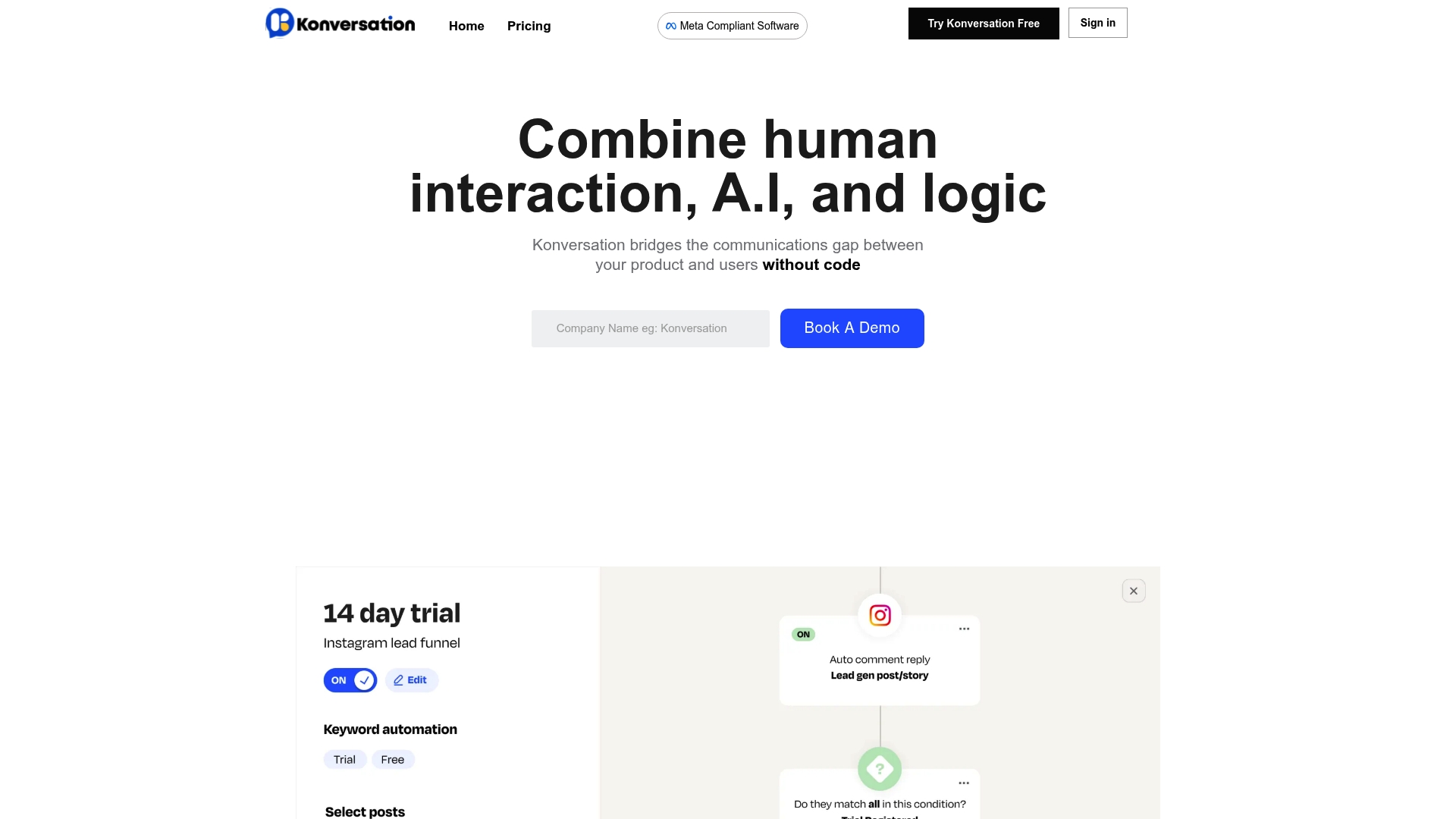
Konversation's marketing materials state it supports more than 100 companies, positioning itself as a lightweight multi-channel engine for SaaS teams. The platform advertises a 14-day free trial and tiered plans that scale by active contacts, which makes trialing low friction.
Core Features
Konversation bundles multi-channel automation across 15 plus messaging channels, an omni-channel inbox, and AI-driven in-app support. It also offers API sync, dynamic API documentation, and a flow builder for no code automations. Built-in OpenAI ChatGPT support and GitBook chatbot integration help keep documentation and support aligned.
Key Differentiator
What sets Konversation apart is the combination of no code multi-channel flows and direct documentation sync tailored for SaaS teams. That pairing lets product teams route onboarding, knowledge, and conversational support from the same automation surface without writing integration middleware.
Pros
- Easy to get started. The no code flow builder and preconfigured channel templates let nondevelopers set up cross channel journeys quickly, lowering dependency on engineering.
- Centralized conversation view. The omni-channel inbox collects web, email, and social messages so support reps do not toggle between tools during a single ticket.
- Docs plus chat. The GitBook chatbot integration and API sync help the support layer reference live documentation, reducing outdated answer risk.
- Pricing model aimed at growth. Tiered plans based on active contacts and add ons like done for you setup provide predictable scaling for inbound engagement.
- AI first. Built-in OpenAI ChatGPT support powers quick bot responses and drafts for reps, which speeds resolution in common workflows.
Cons
- Limited public validation. There are few substantive third party reviews, so real world strengths and edge case failures are not well documented.
- Porting friction. The vendor notes potential limitations moving flows from platforms like Manychat, which could require rebuilding flows for parity.
- Unclear enterprise pedigree. The materials emphasize SaaS fit but do not detail large scale security, compliance, or SLA commitments publicly.
Who It's For
SaaS product and support teams that want a no code way to automate onboarding and unify messages across channels. Best for small to mid sized teams that prioritize shipping conversational journeys quickly and keeping docs and chat synchronized.
Real World Use Case
A startup used Konversation to automate onboarding emails, in app prompts, and social responses during a new feature rollout. The team synced their GitBook docs so the chatbot answered documentation questions and routed complex queries to the omni-channel inbox, reducing repetitive agent replies.
Pricing
Plans start at $49 per month for the Starter tier with charges for higher user capacity at $7 per 1,000 users. Tiered Growth and Scale plans exist along with Premium custom plans and add ons such as VIP support and done for you setup. A 14-day free trial is available.
Website: https://konversation.io
Consio AI
At a Glance
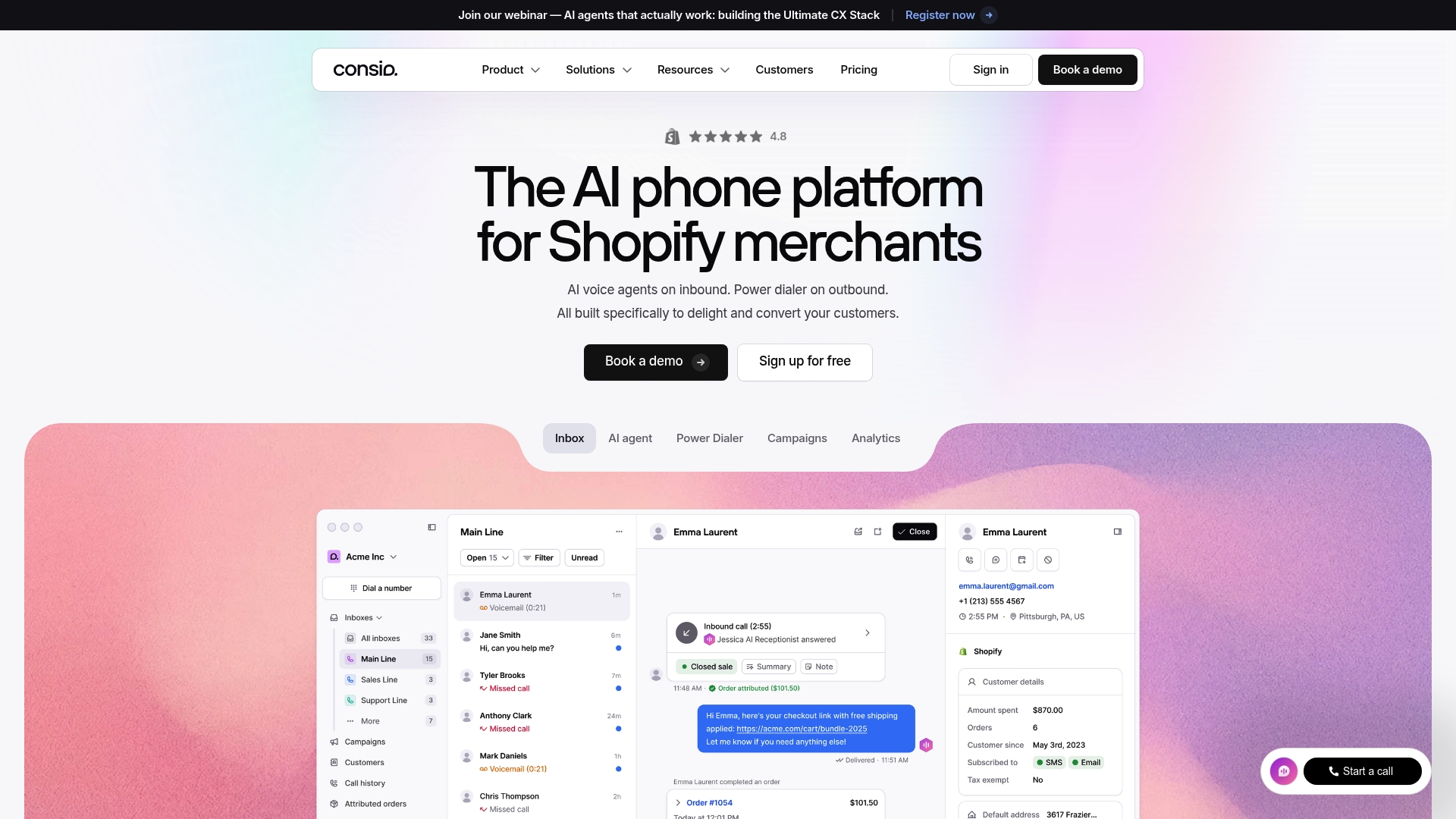
Usage-based pricing begins at $60 per month for 400 minutes, about $0.10 per minute, pairing voice automation with messaging and attribution tailored to Shopify merchants. The product emphasizes automated recovery campaigns and in-call order handling rather than manual support workflows.
Core Features
- AI voice agents for handling inbound calls and basic support intent recognition.
- Power dialer for outbound campaigns such as abandoned cart recovery and VIP re-engagement.
- Full Shopify integration that surfaces customer and order data during calls and lets the system trigger order actions.
- Automated SMS campaigns with reply handling and a revenue attribution dashboard for campaign measurement.
Key Differentiator
Consio AI combines native Shopify data access with voice automation so phone interactions can reference orders, update status, and attribute revenue without engineering glue work. That integration is the main operational advantage if you need calls that read and act on commerce context.
Pros
- Unlimited seats and agents in each plan remove per-user billing friction for growing support teams, which simplifies headcount planning.
- Full automation for calls, SMS, and order actions reduces repetitive manual steps and lets small teams handle higher volume without adding staff.
- The platform reports built-in revenue attribution, offering a direct view of which calls and messages drive dollars rather than guesswork.
- Vendor materials highlight connections to major marketing stacks, which helps link phone campaigns to email flows and segmentation.
- Usage-based billing aligns spend with activity, so quiet months cost less than heavy campaign periods.
Cons
- No third-party reviews or public user feedback were identified, which makes real-world reliability and support quality hard to verify.
- Heavy reliance on automation may frustrate customers who prefer human-to-human conversations for complex issues or high-value orders.
- Pricing and enterprise scalability details are not fully transparent; larger merchants will likely need a vendor conversation to confirm limits and SLAs.
Notable Integrations
Consio lists direct connections with Shopify and Klaviyo, enabling order lookups, customer data syncing, and campaign coordination between phone and email workflows. Those two integrations cover the common commerce and marketing stack for many Shopify merchants.
Who It's For
Ecommerce brands built on Shopify that want to convert phone and SMS interactions into measurable revenue without building custom call routing. Best for merchants running targeted recovery campaigns and those willing to trade some live-agent nuance for automated scale.
Real World Use Case
The vendor states multiple Shopify brands use Consio to automate call handling, recover abandoned carts, and provide 24/7 coverage using a mix of AI and human agents. That deployment model suits stores running frequent promotions and needing immediate follow up on cart abandonments.
Pricing
Usage-based pricing starts at $60 per month for 400 minutes. Additional charges apply for extra minutes, SMS volume, and extra phone numbers, so budget projections should include expected campaign minutes and outbound cadence.
Website: https://consio.ai
Comparative Analysis: Choosing the Best Fit for Your Needs
In-app Feedback and Support Tools Comparison
Deciding among tools for capturing in-app feedback and supporting users hinges on session replay and context attachment capabilities.
| Product | Core Feature | Key Differentiator | Best For | Pricing | Notable Limitation |
|---|---|---|---|---|---|
| Coevy | Feedback widget with session replay | Attaches logs and AI repro steps to every ticket | SaaS product managers and engineers | Not disclosed | Currently in private beta limiting stability |
| Konvo AI | AI-powered multichannel customer support | Learns from catalog data to autonomously resolve workflows | Ecommerce teams needing integrated AI | Not disclosed | Requires robust setup for catalog data |
| Hoola | Multichannel and actionable AI agents | Executes multi-step eCommerce operations autonomously | Ecommerce brands with mid-tier helpdesk needs | Not applicable | Reports of inconsistent billing and reliability |
| Konversation | Document-sync AI with Multi-channel inbox | Combines no-code automation with documentation tie-ins | SaaS teams needing cheap, quick automation | $49/month Starter | Limited large-scale validation and uncertain scalability |
| Consio AI | Voice and SMS campaigns with Shopify sync | Automated call and SMS handling with revenue attribution | Shopify merchants optimizing call handling | $60/month (400 min) | Heavy reliance on automation for nuanced interactions |
Discover a Smarter Way to Handle User Feedback and Support
When comparing covoy.io alternatives, one major pain point is the overwhelming challenge of capturing accurate bug reports tied to real user sessions. Many teams face delays because support lacks the exact context needed to reproduce issues faster. Coevy solves this by embedding an AI-powered widget that automatically bundles session replays, console logs, and smartly generated reproduction steps with every report.
Stop chasing vague user descriptions and reduce back-and-forth between support and engineering teams. Coevy’s codebase-aware AI goes beyond standard documentation by reading your actual code to provide precise debugging guidance. This approach helps software teams scale their support workflows while respecting privacy with GDPR compliance.
Explore Coevy and experience how integrating user feedback directly inside your app can transform your bug resolution process. Act now to cut investigation time and deliver fixes faster by trying Coevy’s unique feedback widget designed just for SaaS products.
Frequently Asked Questions
How does Coevy enhance support with in-app feedback?
Coevy enhances support by using an embedded feedback widget that collects bug reports, feature requests, and NPS feedback directly inside your web app. This feedback is accompanied by rich session context, including session replay and logs, which save engineers' investigation time. To get started effectively, integrating the Coevy widget into your app can streamline support workflows and enhance user experience.
What is the difference between Coevy and Konvo AI?
Konvo AI is known for automating up to 76% of customer interactions across multiple channels, which significantly enhances operational efficiency during peak seasons. Coevy, on the other hand, focuses on providing rich context around web app incidents, making it particularly useful for fostering collaboration between support and engineering teams. If your primary need is to streamline customer interactions while retaining detailed context for bug resolution, Coevy can be the right choice.
Can I use Hoola for complex transaction support?
Hoola is specifically designed to automate high-volume transactional support, handling order lookups and refunds effectively through AI agents. While it excels in eCommerce flows, Coevy's unique approach to layering automated reproduction steps and session data with user feedback is ideal for teams prioritizing context-driven debugging. Consider what your main support needs are when deciding between them.
What unique features does Coevy offer that aid in debugging?
Coevy offers a pre-triaged inbox where tickets arrive with attached session data and AI-generated reproduction steps. This means that engineers receive all relevant context with each ticket, simplifying the debugging process significantly. Teams looking to reduce the back-and-forth communication between support and engineering should consider implementing Coevy for its streamlined feature set.
How does Coevy handle user feedback collection?
Coevy captures user feedback through its feedback widget that also records console logs and network requests in real-time. This integrated approach ensures that all qualitative insights are tied to the same session data as bugs, enriching product decision-making. If your organization values comprehensive user feedback for continuous improvement, Coevy can serve as an effective tool.