Codebase documentation is the structured record of intent, architecture, and constraints that makes software understandable to both humans and machines. The debate around codebase documentation vs AI assistance misframes the real question. These are not competing methods. They are interdependent layers, and teams that treat them as substitutes pay for it in bugs, hallucinations, and support tickets. Tools like Cursor, Claude Code, and ChatGPT have made AI assistance a daily reality for developers, but AI tools for developers still depend on the quality of the documentation underneath them.
1. Codebase documentation vs AI assistance: what each actually does
Traditional codebase documentation serves as the single source of truth for a project's intent, constraints, and architecture. It covers READMEs, API contracts, inline code comments, JSDoc annotations, and specialized files like AGENTS.md. Each format answers a different question: READMEs explain what the project does, API contracts define expected behavior, and inline comments explain why a decision was made, not just what the code does.
AI assistance, by contrast, operates on pattern recognition across training data and whatever context you feed it at runtime. Tools like Cursor and Claude Code can write boilerplate, translate between languages, refactor functions, and explain unfamiliar code. What they cannot do is invent the intent behind a business rule that was never written down. That gap is where most AI errors originate.

Understanding the difference matters because the two tools solve different problems. Documentation preserves institutional knowledge across time and team changes. AI assistance accelerates execution in the present moment. Neither replaces the other.
2. How documentation drift silently breaks development workflows
Docs-as-code drift occurs when documentation and code are managed separately, causing them to fall out of sync over time. The practical cost is significant: documentation-related support tickets represent 40 to 60 percent of developer support load in API products. That number reflects hours lost to confusion that accurate docs would have prevented.
The root cause is almost always process, not intent. When documentation lives outside the code repository, it misses the natural update triggers that code changes create. A developer merges a pull request, the behavior changes, and the README still describes the old behavior. Three months later, a new team member or an AI assistant reads that README and produces incorrect output.
Anchoring documentation updates to the code lifecycle, meaning the same repository, the same pull request, and the same CI/CD pipeline, is the most reliable fix. Red Hat's Code-to-Docs approach demonstrates this at scale: their workflow analyzes code changes and proposes documentation updates for human approval, cutting update runtime from roughly 20 minutes to 4 minutes.
Pro Tip: Treat every pull request as a documentation event. Add a docs checklist item to your PR template so that no code change ships without a corresponding review of affected documentation.
3. What AI coding tools do well and where they consistently fail
AI coding assistants excel at a specific category of tasks: generating repetitive code structures, explaining unfamiliar patterns, translating logic between languages, and surfacing relevant examples from large codebases. 69% of developers recognize Cursor as a tool, and both Claude Code and Cursor each hold roughly 18% active usage among developers at work. Adoption is real and growing.
The failure modes are equally consistent. AI assistants hallucinate function names, call deprecated APIs, and make incorrect assumptions about system constraints when that information is not explicitly documented. This is not a model quality problem. It is a context problem. Undocumented intent creates what some engineers call "comprehension debt," where the AI produces code that passes tests but violates business rules that were never written down.
The most common example: a function has a side effect that matters to downstream processes. The code works. The tests pass. But the JSDoc comment is missing the constraint. An AI assistant refactoring that function has no way to know the constraint exists, so it removes the behavior. The bug surfaces in production, not in review.
Pro Tip: Use AI to audit your documentation gaps, not just to write code. Ask your AI assistant to identify functions in your codebase that lack documented constraints, side effects, or failure conditions. The output is a prioritized documentation backlog.
4. Creating AI-readable documentation surfaces
Standard human-oriented documentation and AI-readable documentation are not the same thing. AI-readable documentation surfaces like AGENTS.md encode behavior rules, architecture constraints, and preferred coding patterns in a format optimized for AI reasoning rather than human narrative. This distinction matters because AI tools parse these files differently than a developer would read a README.
An AGENTS.md file might specify which directories an AI agent should avoid modifying, which coding patterns the team prefers, and which APIs are deprecated. This gives the AI tool guardrails before it generates a single line of code. Teams that invest in these specialized surfaces report fewer correction cycles and more accurate first-pass suggestions.
The practical setup is straightforward. Create a root-level AGENTS.md file in your repository. Populate it with architecture decisions, naming conventions, and explicit constraints. Update it as part of the same PR process you use for code changes. This file costs little to maintain and pays back in reduced AI guesswork on every subsequent interaction.
5. Integrating docs and AI into a single feedback loop
The most productive teams treat documentation and AI assistance as a continuous feedback loop rather than separate tools. Better documentation produces better AI suggestions. Better AI suggestions surface documentation gaps that humans then fill. This cycle compounds over time, improving both the codebase and the AI's usefulness simultaneously.
Red Hat's human-in-the-loop workflow is the clearest production example of this approach. Their system proposes documentation changes based on code diffs, but a human approves every merge. This keeps AI speed without removing human judgment from the accuracy equation. The precomputed semantic folder indexes they use to narrow doc scope are a technical detail worth borrowing: by limiting which docs an AI call touches, they reduce both cost and error rate.
CI/CD integration is the structural piece that makes this sustainable. When documentation updates trigger as part of the build pipeline, they stop being a manual afterthought. Teams using this pattern report that documentation quality directly correlates with AI support accuracy, which is exactly what you would expect if you accept that AI tools are only as good as their context.
Here is how the three approaches compare across key workflow dimensions:
| Dimension | Traditional docs only | AI assistance only | Hybrid feedback loop |
|---|---|---|---|
| Intent preservation | High | Low | High |
| Speed of code generation | Low | High | High |
| Accuracy on edge cases | High (if current) | Low without context | High |
| Maintenance overhead | High | Low | Medium |
| Onboarding new developers | Strong | Inconsistent | Strong |
6. When to prioritize documentation over AI, and when to flip that
The choice between leaning on documentation versus AI assistance depends on project context, not personal preference. Five situations call for different approaches:
- Critical business logic with regulatory or compliance constraints. Write explicit documentation first. AI tools cannot infer legal requirements from code structure alone.
- Early-stage projects with no established patterns. Documentation is more valuable here because it forces architectural decisions to be made consciously rather than by AI default.
- Large distributed teams working across time zones. Documentation scales better than synchronous AI sessions. A well-maintained wiki or API contract answers questions at 2 a.m. without a prompt.
- Legacy codebases with minimal existing documentation. AI assistance is the faster path to initial comprehension, but every insight the AI surfaces should be written back into the codebase as documentation. For teams exploring codebase-aware AI support, this is where the investment pays off fastest.
- Rapid prototyping or exploratory development. AI assistance wins here. Speed matters more than precision, and the code may not survive long enough to need documentation.
The pattern across these scenarios is consistent. Documentation carries more weight when accuracy, longevity, and shared understanding are the priority. AI assistance carries more weight when speed and exploration are the priority. Most real projects need both at different stages.
Key takeaways
Documentation and AI assistance are most effective when they reinforce each other: documentation grounds AI accuracy, and AI accelerates documentation coverage.
| Point | Details |
|---|---|
| Documentation prevents AI errors | Undocumented intent causes hallucinations; explicit JSDoc and AGENTS.md files reduce incorrect AI output. |
| Drift is a process failure | Docs fall out of sync when managed separately from code; CI/CD integration fixes this structurally. |
| AI-readable surfaces are distinct | AGENTS.md files encode guardrails for AI tools, separate from human-oriented READMEs and API contracts. |
| Hybrid workflows outperform either alone | Red Hat's Code-to-Docs model shows that human-approved AI doc updates cut maintenance time by 80%. |
| Context determines the right balance | Compliance-heavy or distributed team projects need documentation first; prototyping favors AI assistance first. |
Why I think the "docs vs. AI" framing is the wrong fight
I have watched teams spend months debating whether to invest in documentation or just let their AI assistant handle knowledge transfer. The teams that chose AI-only almost always regret it within a year. The teams that doubled down on documentation without integrating AI tools left speed on the table.
The framing of documentation versus AI assistance is a false choice that distracts from the real problem: most codebases have neither good documentation nor well-configured AI tooling. The actual work is building both in parallel, which is harder to sell in a sprint planning meeting but far more honest about what it takes to maintain a codebase over time.
What I find most underappreciated is the role of documenting negative conditions. Developers document what code does. Almost nobody documents what it must not do, what side effects it has, or what assumptions it relies on. That is exactly the information AI tools need most, and exactly what is missing from the average codebase. Fixing that gap does more for AI accuracy than switching to a newer model.
The future I expect is not AI replacing documentation. It is AI making documentation cheaper to produce and easier to keep current, while humans remain responsible for the intent layer that no model can invent. Teams that build that workflow now will have a compounding advantage over teams still treating the two as alternatives.
— Dizzy
How Coevy connects documentation and AI assistance in one workflow
If your team is working through the tradeoffs between traditional documentation and AI-powered support, Coevy is built for exactly that transition.
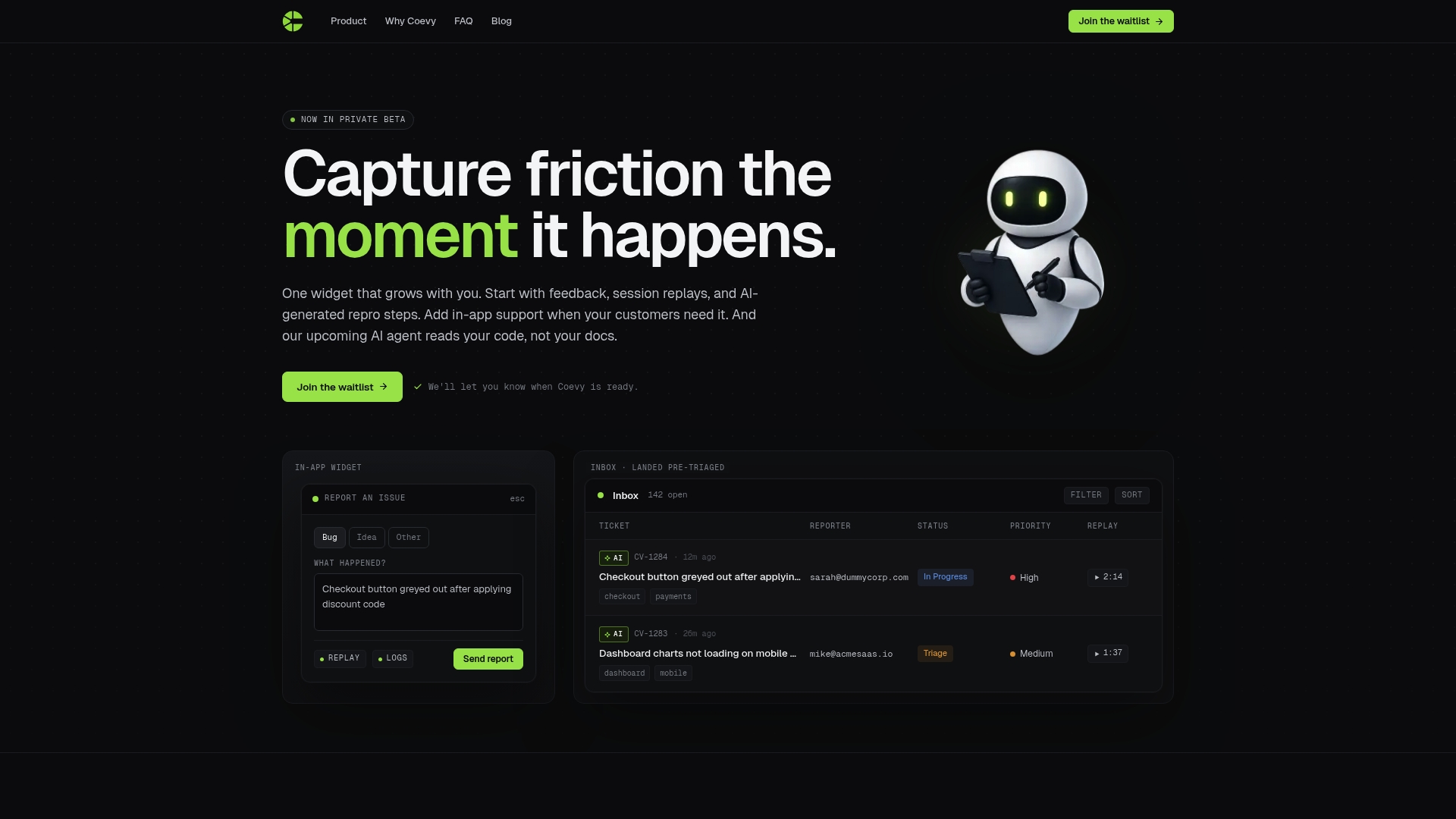
Coevy's platform reads your actual source code rather than relying on static documentation alone, which means its AI support answers are grounded in what your code actually does today. It captures user feedback, session replays, and bug reproduction steps directly inside your web app, attaching the contextual data that makes both human review and AI analysis more accurate. For teams that want source code integrated AI without rebuilding their support workflow from scratch, Coevy fits into existing pipelines without friction. Explore what Coevy can do for your team at coevy.com.
FAQ
What is the main difference between codebase documentation and AI assistance?
Codebase documentation preserves intent, constraints, and architecture as a permanent record. AI assistance accelerates code generation and comprehension in real time but depends on that documentation for accuracy.
Can AI tools replace traditional code documentation?
AI tools cannot replace documentation because they cannot invent undocumented business rules or constraints. Weak documentation causes AI assistants to hallucinate function names and call deprecated APIs.
What is an AGENTS.md file and why does it matter?
An AGENTS.md file is an AI-readable documentation surface that encodes architecture constraints, behavior rules, and coding preferences specifically for AI tool consumption. It gives AI assistants explicit guardrails before they generate code, reducing incorrect output.
How do teams keep documentation from drifting out of sync?
Anchoring documentation updates to the code lifecycle, meaning the same repository and pull request process, prevents drift. Red Hat's Code-to-Docs workflow automates this by proposing doc updates from code diffs with human approval before merge.
When should a team prioritize AI assistance over writing documentation?
AI assistance takes priority during rapid prototyping and exploratory development, where speed matters more than long-term accuracy. For compliance-heavy features or distributed teams, documentation should come first.