AI support tools are defined as software systems that use machine learning and natural language processing to handle customer queries, triage tickets, and surface product insights automatically. For SaaS founders, the ai support tools benefits extend far beyond cost savings: they enable 24/7 global coverage, intelligent churn detection, and feedback loops that human teams simply cannot match at scale. Platforms like Coevy, Intercom, and Zendesk AI have made these capabilities accessible at every company stage. The result is a new operational baseline where founders who adopt AI support early grow faster and retain customers longer than those who rely on manual processes.
1. AI support tools benefits SaaS founders most: slashing ticket costs
AI handles tier-1 support queries for under $0.15–$0.50 per chat, compared to roughly $6 per human-handled ticket. That gap compounds fast. At 5,000 tickets per month with a 55% deflection rate, monthly savings reach $15,600 and annual savings hit approximately $187,000. For a seed-stage startup, that is a full engineering hire.
The mechanism is straightforward. AI resolves password resets, billing questions, and how-to queries without any human involvement. Human agents then focus exclusively on escalations, edge cases, and high-value conversations. That division of labor is where the real efficiency gain lives.

Pro Tip: Avoid per-resolution pricing models when evaluating AI support tools. Flat-rate plans preserve your cost advantage as ticket volume grows, while per-resolution pricing scales linearly and erodes savings at exactly the moment your product gains traction.
Flat-rate AI support tools outperform per-resolution pricing at scale because your cost stays fixed regardless of volume. This is a structural advantage, not just a budget preference.
2. deflecting 60–75% of tickets without hiring anyone
Industry-standard SaaS support programs deflect 60–75% of tier-1 tickets using AI and self-service knowledge bases. Top-quartile programs cut cost per ticket below $12 as a direct result. That deflection rate is the single most important metric for a founder managing support alone or with a small team.
Self-service deflection works because most support questions repeat. A well-trained AI chatbot grounded in your documentation handles FAQs, onboarding steps, and account-state questions without human input. Smaller teams see 15–30% fully automated ticket resolution plus an additional 20% of tickets handled with AI assistance. That means roughly half your queue disappears before a human reads it.
The key word is "grounded." AI chatbots trained on your actual documentation prevent hallucination and give accurate answers. Generic large language models without documentation grounding will confidently give wrong answers, which damages trust faster than slow support ever could.
Pro Tip: Build your knowledge base before deploying any AI chatbot. The quality of your documentation directly determines the accuracy of your AI's responses. Garbage in, garbage out applies here more than anywhere else in SaaS.
3. 24/7 multilingual coverage without a regional team
Multilingual AI chatbots handle ten or more languages through API language switching from a single deployment. This eliminates the need for regional support hires and gives globally distributed users consistent quality responses at any hour. For a SaaS product with users across Europe, Latin America, and Southeast Asia, that is a meaningful operational shift.
24/7 global AI support is no longer a differentiator. It is an operational necessity for distributed SaaS products. Users in Tokyo and São Paulo expect the same response quality as users in New York. AI delivers that consistency without timezone constraints or staffing overhead.
Response time matters for retention. AI delivers first responses under 30 seconds versus hours for human-only teams. That speed directly correlates with customer satisfaction scores and reduces the frustration that drives churn.
"SaaS companies with AI-first support report 15–25% lower churn among customers who contact support, driven by faster, consistent, 24/7 quality responses." — SaaS Customer Support Playbook
The hybrid model works best in practice. AI handles the first response and resolves what it can. Complex or emotionally charged queries route to human agents with full context already attached. That handoff, done well, feels invisible to the customer.
4. smart ticket triage that finds revenue signals
Not every support ticket is a support ticket. AI tagging identifies buying signals and churn risks embedded in support conversations so your team can prioritize human follow-up on the conversations that matter most. A user asking about API rate limits may be evaluating an upgrade. A user asking how to export their data may be preparing to leave.
AI co-pilot tools improve human agent productivity by surfacing this context automatically. When a ticket arrives tagged as a potential expansion lead, your sales or customer success team can respond with the right message at the right time. That integration between support and your CRM or sales pipeline turns your support queue into a revenue signal feed.
The churn detection use case is equally valuable. Patterns in support language, like repeated billing questions, feature confusion, or requests for data exports, correlate with cancellation intent. AI that flags these patterns early gives your team a window to intervene before the customer decides to leave. You can read more about AI-powered ticket management to see how this triage logic works in practice.
5. choosing the right AI support tool for your stage
The right AI support tool depends on where you are in your growth curve. Solo founders, small teams, and scaling companies have different needs, and the wrong tool at the wrong stage wastes both money and time.
Here is a practical breakdown by stage:
- Solo founder (0–200 users): Handle support personally first. Founders who manage support personally until reaching 200 users build the pattern recognition needed to configure AI effectively later. Use this phase to document every repeated question.
- Small team (200–2,000 users): Deploy a documentation-grounded AI chatbot. Focus on deflection rate and accuracy. Tools like Coevy offer flat-rate pricing that keeps costs predictable as volume grows.
- Scaling company (2,000+ users): Add AI ticket triage, churn signal detection, and CRM integration. Platforms like Intercom AI and Zendesk AI offer these capabilities with enterprise-grade reliability.
| Tool | Best Fit | Pricing Model | Key Strength |
|---|---|---|---|
| Coevy | Solo founders and small teams | Flat-rate | Codebase-aware AI, session replays, feedback widget |
| Intercom AI | Mid-market SaaS | Per-seat plus usage | Workflow automation and CRM integration |
| Zendesk AI | Enterprise SaaS | Per-agent plus AI add-on | Ticket routing and analytics at scale |
Flat-rate pricing is the structural advantage for early-stage founders. A tool priced at $99 per month with unlimited conversations, like Coevy, costs the same whether you handle 500 or 5,000 tickets. Per-seat or per-resolution models punish growth, which is the opposite of what a scaling SaaS company needs.
Pro Tip: Before comparing platforms, define your top three support use cases. Deflection rate, churn detection, and multilingual coverage require different tool configurations. Buying a platform without a use-case priority list leads to underutilization and wasted spend.
For a deeper look at how small SaaS teams use AI agents at each growth stage, the patterns are more nuanced than most vendor comparisons suggest.
6. reducing churn through faster, consistent support quality
SaaS companies with AI-first support see 15–25% lower churn among customers who contact support. The mechanism is consistency. Human support quality varies by agent, shift, and workload. AI delivers the same response quality at 3 a.m. on a Sunday as it does at 9 a.m. on a Monday.
Consistency builds trust. When users know they will get a fast, accurate answer every time they reach out, they stop treating support interactions as a risk. That psychological shift reduces the friction that accelerates churn. The benefits of AI for founders in this area are measurable in retention metrics within the first 90 days of deployment.
Speed compounds this effect. A response in under 30 seconds versus a response in four hours changes the emotional context of the entire interaction. Users who get fast answers stay calmer, resolve issues faster, and form a more positive association with your product.
7. scaling support without scaling headcount
The traditional support model breaks at scale. Every new user cohort requires more agents, more training, and more management overhead. AI breaks that linear relationship. AI agents reshape SaaS support staffing by absorbing volume growth without proportional headcount increases.
This is the core scalability argument for why SaaS founders need scalable support tools built on AI. A team of two can support 10,000 users with the right AI layer in place. Without it, that same user base requires six to eight agents, a support manager, and a quality assurance process. The cost difference is not marginal. It is existential for a bootstrapped or early-stage company.
The scalability benefit also applies to product feedback. Coevy's integrated widget collects session replays and auto-tags feedback, giving founders a continuous stream of product intelligence without manual review. That feedback loop accelerates product decisions and reduces the time between identifying a problem and shipping a fix.
Key takeaways
AI support tools give SaaS founders the ability to handle high ticket volumes, reduce churn, and surface revenue signals without proportional increases in headcount or cost.
| Point | Details |
|---|---|
| Cost reduction is immediate | AI handles tier-1 queries for under $0.50 per chat versus $6 for human agents. |
| Deflection rate drives ROI | Programs deflecting 60–75% of tickets cut cost per ticket below $12. |
| Churn drops with faster responses | AI-first support correlates with 15–25% lower churn among support-contacting users. |
| Flat-rate pricing scales better | Fixed monthly pricing preserves savings as ticket volume grows, unlike per-resolution models. |
| Stage-appropriate adoption matters | Founders should handle support personally until 200 users before deploying AI automation. |
What i've learned from watching founders get this wrong
I have watched dozens of SaaS founders deploy AI support tools too early, too late, or with the wrong configuration. The pattern is consistent and avoidable.
The founders who get the most out of AI support are the ones who spent time in the queue first. They know which questions repeat, which answers require nuance, and which tickets signal a deeper product problem. That knowledge makes their AI configuration accurate from day one. The founders who skip that phase end up with an AI that deflects the wrong tickets and frustrates the users they most need to retain.
The other mistake I see constantly is treating AI support as a cost-cutting exercise rather than a growth tool. The churn signal detection and buying intent tagging capabilities are where the real leverage lives. A founder who uses AI to identify expansion opportunities in the support queue is playing a different game than one who just wants to reduce ticket volume.
My honest recommendation: do not buy a platform because it has the most features. Buy the one that fits your current stage and has a clear upgrade path. Coevy is built specifically for this progression, from a solo founder handling 50 tickets a week to a team managing thousands. The codebase-aware AI is genuinely different from documentation-only tools. It reads your actual source code, which means it gives accurate answers about your specific product rather than generic responses based on training data.
Start with the knowledge base. Get the deflection rate above 60%. Then layer in triage and churn detection. That sequence works. Reversing it does not.
— Dizzy
How Coevy helps SaaS founders scale support from day one
If you are a SaaS founder managing support alone or with a small team, Coevy is built for exactly where you are right now.
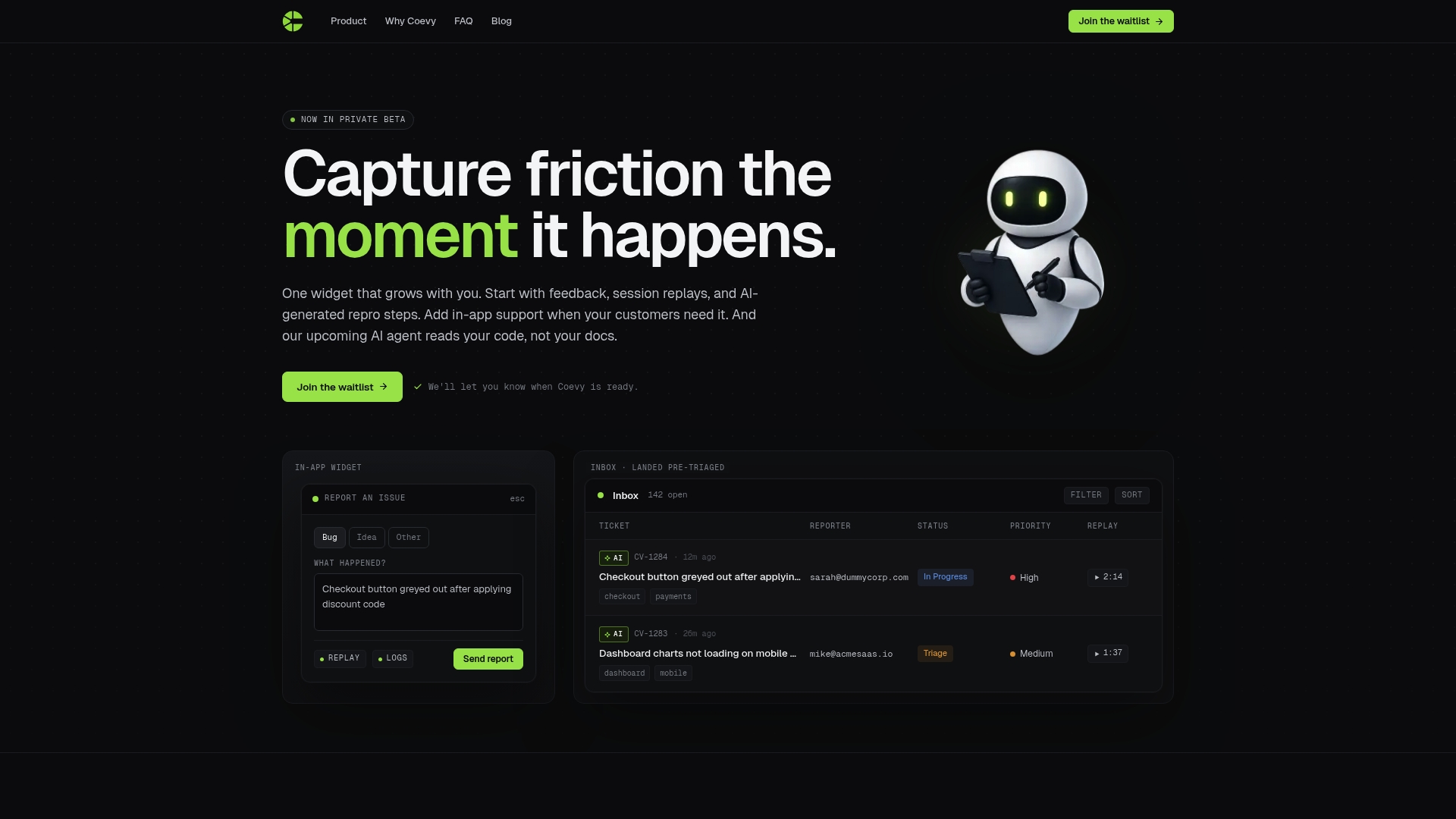
Coevy's flat-rate pricing means your support costs stay predictable as your user base grows. The integrated widget collects user feedback, session replays, and AI-generated bug reproduction steps directly inside your web app. The upcoming codebase-aware AI agent reads your actual source code to give users precise answers, not generic responses. GDPR compliance, field masking, and IP anonymization are built in. You can start with Coevy and have AI-powered support running before your next sprint ends.
FAQ
What are the main AI support tools benefits for SaaS founders?
AI support tools reduce ticket costs by 60–80%, deflect 60–75% of tier-1 queries automatically, and provide 24/7 multilingual coverage without additional headcount. They also surface churn signals and buying intent from support conversations.
When should a SaaS founder start using AI support tools?
Founders should handle support personally until reaching approximately 200 users to build pattern recognition, then deploy AI to automate repetitive queries and scale coverage efficiently.
How does AI support reduce SaaS churn?
SaaS companies with AI-first support report 15–25% lower churn among customers who contact support, driven by response times under 30 seconds and consistent answer quality regardless of time or volume.
What pricing model works best for early-stage SaaS teams?
Flat-rate pricing models preserve cost advantages as ticket volume scales. Per-resolution pricing increases linearly with growth and erodes the savings that make AI support economically attractive in the first place.
How does Coevy differ from tools like intercom or zendesk AI?
Coevy's upcoming AI agent reads actual application source code rather than relying solely on documentation, which produces more accurate answers for product-specific questions. It also combines feedback collection, session replays, and support in a single widget designed for early-stage and scaling SaaS teams.