AI-powered ticket management is defined as the use of machine learning, natural language processing, and agentic AI to automate the intake, triage, routing, and resolution of customer support tickets. Platforms like Zendesk, Moveworks, and Rezolve.ai have moved well beyond static rule sets, applying probabilistic models that read ticket intent, detect sentiment, and score urgency before a human ever sees the request. The result is faster first response, fewer misroutes, and support teams that spend their time on problems that actually require human judgment. For software team leaders managing growing user bases, this shift is not optional. It is the architecture that makes scalable support possible.
What is AI-powered ticket management and how does it work?
AI-powered ticket management runs on a multi-step pipeline that separates intent extraction, urgency scoring, and routing into distinct, tunable stages. When a ticket arrives, an NLP model parses the text, identifies the core request, detects the language, and reads emotional tone. That output feeds a classification layer that assigns a category, a priority score, and a suggested queue. The entire process takes milliseconds and produces structured signals that a rule-based system could never generate from raw free-form text.
The concept that separates modern AI systems from legacy automation is confidence gating. Confidence gating enables AI to automate assignments when the model is highly confident, surface a suggested action for agent review when moderately confident, and defer entirely to a human when the ticket is ambiguous. This three-tier decision layer means the system never silently misroutes a ticket. It chooses the safest effective next step based on what it actually knows.

Zendesk describes intelligent triage as probabilistic, with configurable confidence controls that teams can tune per use case, including routing, deflection, and trend reporting. That tunability matters because no two support queues look the same. A SaaS product handling billing disputes needs different thresholds than a DevOps team triaging infrastructure alerts.
Agentic AI takes the process further. Rather than stopping at routing, agentic AI can autonomously resolve tickets by reasoning across enterprise systems, executing workflows, and only creating a formal ticket record when human intervention is genuinely required. The ticket becomes an audit artifact rather than the primary work item. This is the architectural shift that defines 2026-era AI ticketing solutions.
Key components in the pipeline include:
- NLP parsing: Extracts intent, entities, and sentiment from unstructured ticket text
- Classification and priority scoring: Maps parsed data to categories and urgency levels
- Confidence gating: Decides whether to automate, suggest, or escalate
- Queue routing: Assigns the ticket to the correct team or agent based on classification output
- Agentic resolution: Executes multi-step fixes autonomously when permissions and context allow
Pro Tip: Start by mapping your three highest-volume ticket categories before deploying any AI model. Clean category definitions produce cleaner training signals, and cleaner signals produce higher confidence scores from day one.
What are the key benefits of AI ticketing solutions for support teams?

The most direct benefit of automated ticket management is the elimination of repetitive decision steps that consume agent time without adding value. When an AI model handles initial triage, agents receive tickets that are already categorized, prioritized, and routed. That means the first human touchpoint is a qualified response, not a sorting exercise.
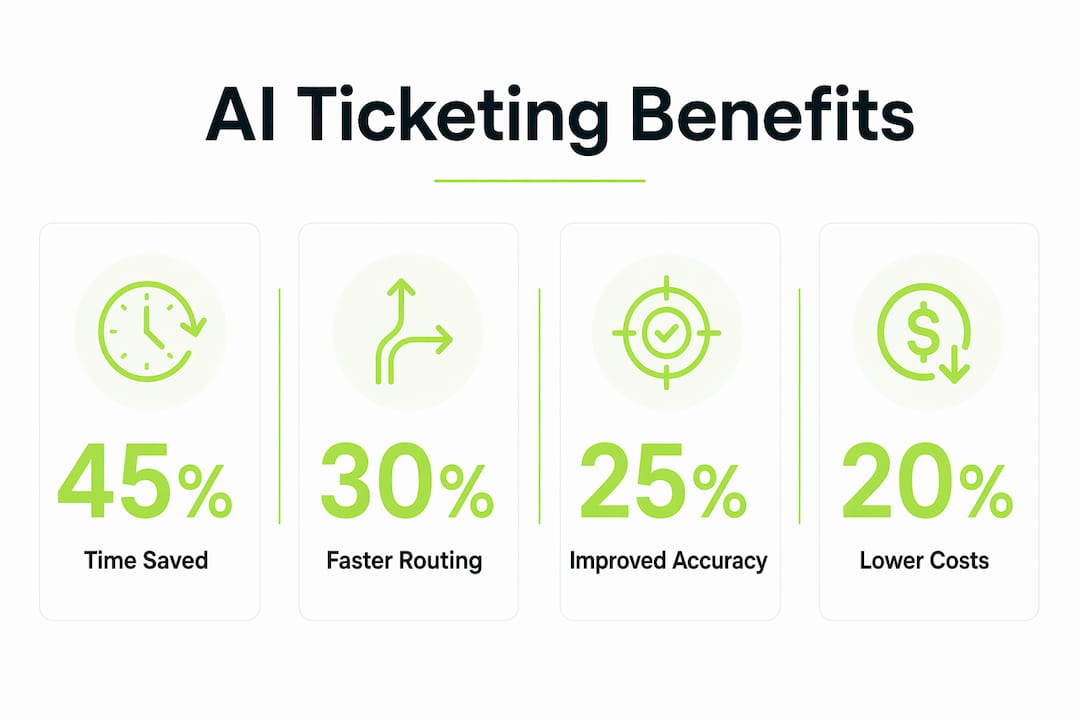
The numbers behind this shift are significant. AI ticketing systems can achieve up to 85% ticket deflection on automatable categories and a 30 to 50 percent reduction in mean time to resolution. A 30 to 50 percent MTTR reduction translates directly into fewer escalations, lower churn risk, and support teams that can handle volume growth without proportional headcount increases.
The benefits compound across the operation:
- Reduced manual triage workload: Agents stop spending time on classification and start spending time on resolution.
- Faster first response times: AI handles intake instantly, so the clock on first response starts much earlier in the workflow.
- Improved routing accuracy: AI classification with confidence thresholds handles ambiguous requests that static rules consistently misroute.
- Scalability without headcount growth: Volume spikes during product launches or outages do not require emergency staffing.
- Better analytics: AI enhances operational views by extracting structured signals from ticket data, giving managers trend visibility that raw ticket counts never provided.
For software teams specifically, the analytics benefit deserves attention. When every ticket carries machine-generated intent and sentiment labels, you can spot product friction patterns in real time. That data feeds product roadmaps, not just support queues. Coevy's approach to AI auto-tagging reflects exactly this principle: structured ticket signals become a product intelligence layer, not just an operational convenience.
How do AI ticket management systems differ from traditional ITSM tools?
Traditional IT service management platforms are fundamentally tracking systems. They store tickets, apply static routing rules, and surface dashboards. The intelligence in a traditional ITSM setup lives in the rule configuration, which means every new ticket type requires a human to write a new rule. That model breaks down at scale and fails entirely when ticket language is ambiguous or unexpected.
AI-driven support systems operate on a different architecture. Traditional rule-based routing lacks the flexibility to handle ambiguous or novel requests, while AI classification with confidence gating adapts to language variation without manual rule updates. The practical difference is that an AI system gets better as ticket volume grows, while a rule-based system gets more brittle.
| Dimension | Traditional ITSM | AI-powered ticketing |
|---|---|---|
| Routing logic | Static rules written by admins | NLP classification with confidence scoring |
| Handling ambiguity | Fails or defaults to a catch-all queue | Confidence gating routes or escalates appropriately |
| Ticket role | Primary work item tracked through stages | Audit artifact created when human action is needed |
| Intake channels | Typically email or web form | Multimodal: chat, email, voice, in-app with shared context |
| Improvement over time | Requires manual rule updates | Model improves with feedback and volume |
| Analytics output | Volume and status counts | Structured intent, sentiment, and trend signals |
The most consequential difference is the role of the ticket itself. In a traditional ITSM tool, the ticket is the work. In an agentic AI system, the ticket shifts to an audit trail for actions the AI has already taken or attempted. That inversion changes how support managers measure performance and how engineers interact with the queue.
The best implementations do not choose between AI and deterministic rules. Combining deterministic rules for audit-sensitive routing with AI classification for interpretation tasks reduces failure points across the entire workflow. Compliance-sensitive categories get hard rules. Everything else gets the model.
What practical steps should teams take to implement AI ticket management?
Implementation succeeds or fails based on the quality of the foundation, not the sophistication of the model. Before configuring any AI ticketing solution, audit your existing ticket data. Clean category labels, consistent tagging, and resolved ticket histories are the training material the model will learn from. Garbage in, garbage in.
A phased deployment approach reduces risk significantly. Phased deployment with shadow mode and confidence tuning lets teams validate AI routing decisions against human decisions before any automation goes live. In shadow mode, the AI classifies and routes tickets in parallel with human agents. The team reviews discrepancies, adjusts confidence thresholds, and builds trust in the model before handing it real authority.
Practical steps for a successful rollout:
- Audit existing ticket data: Identify your top ten ticket categories and verify that historical labels are consistent and accurate.
- Define confidence threshold policies: Decide at what confidence score the AI automates, suggests, or escalates for each category.
- Run shadow mode for two to four weeks: Compare AI routing decisions to agent decisions and log every override.
- Integrate with existing platforms: Connect your AI ticketing layer to your ITSM, Slack, or communication stack before go-live.
- Assign threshold ownership to operational teams: Confidence threshold adjustments owned by operational teams accelerate trust and reduce delays caused by waiting on vendor support.
- Build a continuous feedback loop: Route agent overrides back into model training to improve accuracy over time.
Pro Tip: Treat your first 90 days as a calibration period, not a performance period. The goal is accurate thresholds, not maximum automation. Teams that rush to full automation in week one spend months fixing misroutes.
For SaaS teams, integrating AI ticketing with in-app feedback collection compounds the value. When session context, reproduction steps, and user behavior data attach automatically to each ticket, the AI model has richer signals to classify against. Coevy's guide on AI-first customer support covers how this end-to-end approach works in practice for growing SaaS products.
What are common challenges when adopting AI ticketing systems?
The most common failure mode in AI ticket management is not technical. It is organizational. Support teams that have built workflows around manual triage resist handing classification authority to a model they do not yet trust. Change management requires showing agents the confidence scores, explaining the gating logic, and giving them visible override controls from day one.
Technical challenges cluster around three areas:
- Ambiguous tickets: Free-form text from users is often incomplete, emotionally charged, or written in multiple languages. Fallback routing policies must be defined before go-live, not after the first misroute.
- Integration complexity: Connecting an AI triage layer to legacy ITSM platforms, identity systems, and communication tools requires API work that vendors often underestimate in their sales materials. Budget time for this.
- Governance and auditability: Automated decisions in regulated industries need traceable logs. Agentic AI resolution systems require aligned permissions, RBAC, and knowledge base grounding to avoid silent failures and maintain auditability.
Over-reliance on AI for sensitive or high-risk cases is a governance risk that deserves its own policy. Careful governance with confidence thresholds and human-in-the-loop controls is the design principle that keeps speed from outrunning accuracy. Any ticket category involving account security, financial transactions, or legal exposure should have a hard human-review rule regardless of model confidence.
Key takeaways
AI-powered ticket management delivers measurable efficiency gains only when confidence gating, phased deployment, and strong governance are built into the system from the start.
| Point | Details |
|---|---|
| Core mechanism | NLP parsing, confidence gating, and priority scoring replace manual triage decisions. |
| Quantified ROI | Up to 85% deflection on automatable categories and 30 to 50% MTTR reduction are achievable with agentic AI architectures. |
| AI vs. traditional ITSM | AI systems treat tickets as audit artifacts; traditional tools treat them as the primary work item. |
| Implementation priority | Shadow mode deployment and operational ownership of confidence thresholds reduce rollout risk. |
| Governance requirement | Human-in-the-loop controls and RBAC are non-negotiable for sensitive ticket categories. |
Where AI ticket management is actually headed
The conversation about AI in support has spent too long focused on deflection rates. Deflection is a cost metric. The more interesting question is what happens to the support function when AI handles 80 percent of intake autonomously.
What I have seen, working across SaaS support teams, is that the teams who get the most from AI ticketing are not the ones who automate the most. They are the ones who use the structured signals AI generates to make better product decisions. Sentiment trends by feature area, intent clusters that predict churn, urgency spikes that correlate with deployment events. That data exists in your ticket queue right now. AI just makes it readable.
The hybrid model, where AI handles intake and triage while humans own resolution for complex cases, is not a transitional state. It is the target architecture. AI agents are already reshaping staffing models in SaaS support, and the teams that treat this as a workforce reduction exercise miss the point entirely. The goal is a smaller team working on harder problems with better information.
Agentic AI will continue expanding its resolution footprint through 2026 and beyond. But the teams that will lead are the ones who build governance frameworks now, before the models get more capable. Confidence thresholds, override logging, and human review policies are not bureaucratic overhead. They are the controls that let you move fast without breaking trust.
— Dizzy
How Coevy handles AI-powered ticket management for SaaS teams
Coevy is built for software teams who need ticket management that grows with their product, not against it.
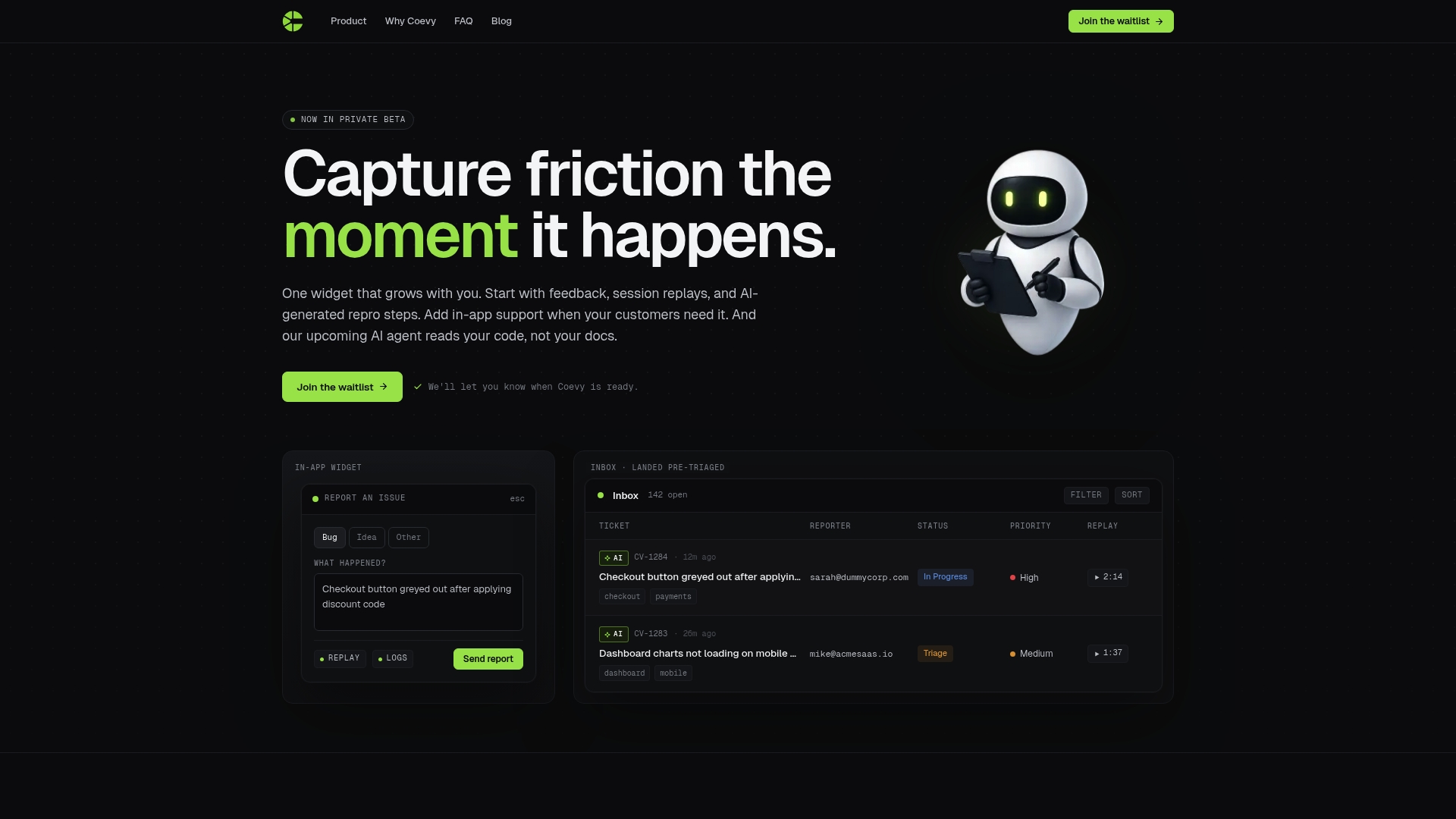
Coevy's AI-powered features include auto-tagging, priority scoring, and a codebase-aware AI agent that reads your actual source code to deliver precise answers, not generic documentation responses. Every ticket arrives with session replay data, reproduction steps, and contextual signals already attached, giving the AI richer classification inputs from the first interaction. The result is faster first response, fewer back-and-forth exchanges, and a support queue that generates product intelligence alongside resolved tickets. If you are evaluating AI ticketing solutions for your team, see how Coevy works and start capturing support friction the moment it happens.
FAQ
What is AI-powered ticket triage?
AI-powered ticket triage is the automated process of analyzing incoming support tickets to detect intent, language, and sentiment, then routing each ticket to the correct queue or agent. Zendesk describes this as probabilistic, with confidence controls that handle ambiguous cases without misrouting.
How does confidence gating work in AI ticketing?
Confidence gating sets thresholds that determine whether the AI automates a routing decision, suggests an action for agent review, or defers entirely to a human. Moveworks uses this approach to balance speed and accuracy across ticket categories with varying levels of complexity.
What is the difference between AI ticketing and traditional ITSM?
Traditional ITSM uses static rules to route tickets and treats the ticket as the primary work item. AI ticketing systems use NLP classification and agentic AI to handle intake and resolution autonomously, with the ticket serving as an audit record rather than the work itself.
How long does it take to implement an AI ticket management system?
A phased deployment starting with shadow mode typically requires two to four weeks of calibration before automation goes live. Elementum AI recommends running suggest-only modes with override logging to build model accuracy and team trust before full deployment.
What are the biggest risks of AI ticket management?
The primary risks are over-automation of sensitive ticket categories, integration complexity with legacy platforms, and insufficient governance controls. Agentic AI systems require aligned permissions, role-based access controls, and human-in-the-loop policies to maintain auditability and prevent silent failures.