AI-driven retention is defined as the use of predictive models, behavioral monitoring, and automated workflows to identify at-risk users and trigger personalized interventions before they cancel. The role of AI in SaaS user retention has shifted from a competitive advantage to a baseline expectation. SaaS companies using AI-driven retention systems report 25–40% churn reduction within six months of adoption. That number reflects a fundamental change in how product teams think about loyalty. Instead of reacting to cancellations, AI lets you predict them weeks in advance and act with precision.
How does AI predict and prevent SaaS churn?
AI identifies churn risk by tracking behavioral signals that humans cannot monitor at scale. Login frequency, feature usage decay, support ticket volume, and session depth all feed into a predictive health score that updates in real time. The result is a living picture of every user's engagement level, not a monthly snapshot.
The accuracy of these models is what separates AI from traditional methods. AI models predict at-risk users with 85–90% accuracy, 60–90 days before cancellation. That window gives your customer success team enough time to intervene with a targeted offer, a training session, or a product change.

Traditional churn analysis relies on lagging indicators: a user cancels, you look back and ask why. AI flips that sequence entirely.
| Method | Signal Type | Prediction Window | Accuracy |
|---|---|---|---|
| Traditional reporting | Lagging (cancellation data) | 0–7 days | Low |
| Manual health scores | Mixed (usage snapshots) | 14–30 days | Moderate |
| AI predictive models | Leading (behavioral streams) | 60–90 days | 85–90% |
| AI decisioning systems | Dynamic (multi-variable loops) | Continuous | Highest |
AI-native SaaS products face an additional layer of complexity. In those environments, agent-output quality decay signals user disengagement 14–21 days before traditional usage metrics drop. If users are heavily editing AI-generated content, that manual correction rate is a leading churn indicator your standard analytics dashboard will miss entirely.
Key behavioral signals AI monitors in real time:
- Login frequency and session duration trends
- Feature adoption rate and depth of usage
- Support ticket volume and sentiment
- Manual editing of AI-generated outputs
- Time-to-value milestones missed in onboarding
What AI retention features do SaaS teams actually use?
The most effective AI retention features target two critical moments: the activation cliff in the first 90 days and the ROI realization cliff around months 9–12. Building in-product AI Q&A and usage-based alerting costs $20,000–$35,000 and takes 6–9 weeks for pre-Series A SaaS firms. That investment pays back quickly when you consider the compounding effect of even a small GRR improvement.
Here are the top AI retention tactics SaaS teams deploy in 2026:
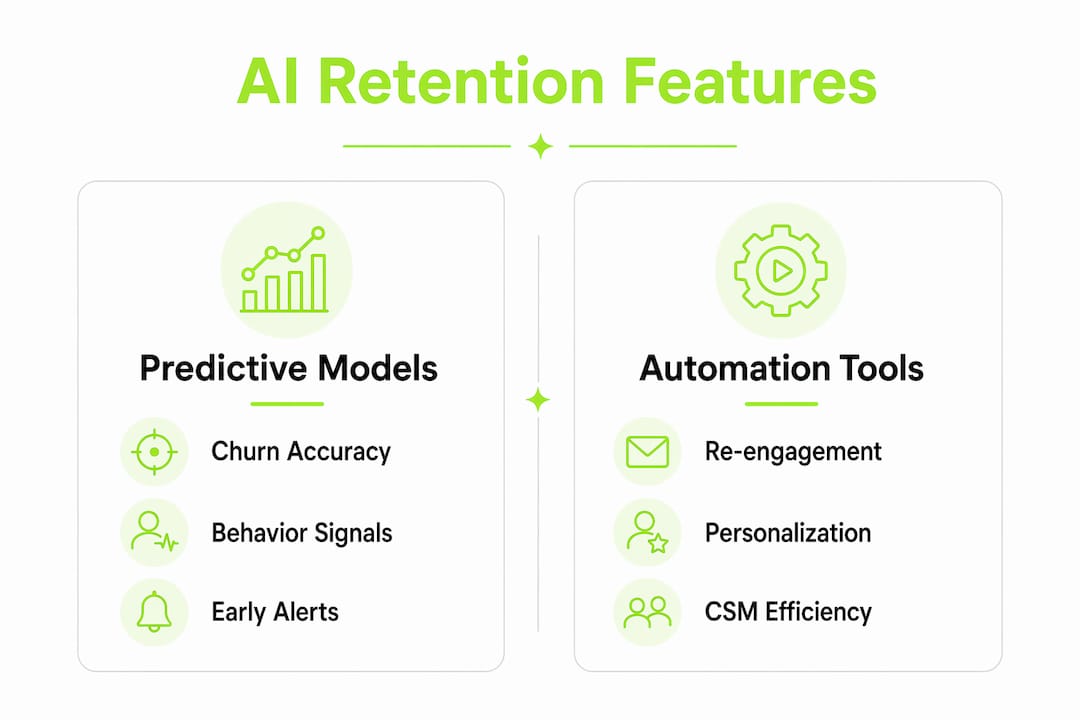
- Predictive health scoring. Assign every account a real-time risk score based on behavioral signals. Route high-risk accounts to CSMs automatically.
- Role-based onboarding flows. Adaptive checklists that adjust based on user role, company size, and feature adoption pace.
- In-product AI Q&A. Answer user questions inside the product without requiring a support ticket, reducing friction at the activation cliff.
- Automated re-engagement sequences. Trigger email, in-app, or SMS workflows the moment a risk flag fires, not on a weekly batch schedule.
- AI-assisted CSM prioritization. Surface the accounts most likely to churn or expand, so CSMs spend time where it matters most.
The CSM efficiency gain from AI is significant. AI-assisted CSMs manage 2x higher ARR books compared to traditional models, handling $2M–$3M ARR versus the historical $1M benchmark. AI handles data processing and routine check-ins, freeing CSMs for strategic relationship work.
Pro Tip: Before building custom re-engagement workflows, map your user journey to identify exactly where engagement drops. Most SaaS products have one or two specific feature adoption failures that account for the majority of early churn. Fix those first with targeted in-product guidance, then layer in automated sequences.
Advanced platforms use what Braze calls AI decisioning, which optimizes offer type, message content, and send timing simultaneously using dynamic feedback loops. This moves retention from static segmentation to continuous optimization. The difference in outcomes is measurable within 30 days of deployment.
What are the biggest pitfalls in AI retention deployment?
AI is not a shortcut. Without clean data and product-market fit, AI amplifies noise rather than improving retention. A model trained on messy CRM data will confidently predict the wrong users at risk. The confidence is the problem, because teams act on those predictions.
Common deployment pitfalls SaaS teams encounter:
- Weak product-market fit. AI cannot retain users who never found value in the product. Fix the core value proposition before investing in retention automation.
- Dirty or incomplete data. Behavioral signals need consistent event tracking across your product. Gaps in telemetry produce unreliable health scores.
- Building proprietary ML too early. Under $1M ARR, manual health scores often outperform ML models because data volume is too low for statistical reliability.
- AI hallucinations in customer-facing interactions. AI systems can generate inaccurate responses that damage trust. Human-in-the-loop workflows with critic agents validate AI outputs before they reach customers.
- Over-automating CSM touchpoints. Users notice when outreach feels scripted. Automation should trigger human conversations, not replace them.
Pro Tip: Integrate your existing CRM and product telemetry into an off-the-shelf AI tool before building anything custom. Tools like Gainsight, Mixpanel, or Amplitude already have retention-focused AI layers. Start there, validate your signals, and only build proprietary models once you have enough clean data to justify the cost.
The scale threshold matters. ML models outperform manual scoring once you have sufficient event volume and account history. Below that threshold, a well-maintained spreadsheet health score beats a poorly trained model every time. Know where you are on that curve before committing budget to custom AI development.
How should SaaS teams prioritize AI retention investments?
Start with the activation cliff. The first 90 days determine whether a user ever reaches the ROI realization milestone. AI-driven onboarding that adapts to user behavior in real time reduces early churn more than any other single investment. For context, a 5-point GRR improvement on a $10M ARR base equals $500,000 saved annually, and that compounds with growth.
| AI Retention Feature | Estimated Cost | Timeline | Primary Impact |
|---|---|---|---|
| In-product AI Q&A | $20,000–$35,000 | 6–9 weeks | Activation cliff |
| Predictive health scoring | $15,000–$25,000 | 4–8 weeks | Early churn detection |
| Automated re-engagement | $10,000–$20,000 | 3–6 weeks | Mid-cycle retention |
| AI-assisted CSM tools | $25,000–$50,000 | 8–12 weeks | ARR expansion |
Balance automation with human engagement at every stage. AI should surface the right accounts and trigger the right workflows. A CSM should still own the relationship conversation. The teams that get this balance wrong either over-automate and feel impersonal or under-automate and burn out their CS team on low-value tasks.
Measure GRR improvement, not just churn rate. Gross Revenue Retention captures both cancellations and downgrades, giving you a cleaner picture of retention program impact. Pair that with time-to-value metrics in the first 90 days and you have a complete picture of where AI is working and where it is not.
For SaaS teams looking to understand how AI scales with product growth, AI support scaling strategies offer a practical framework for matching AI investment to product stage.
Key takeaways
AI-driven retention works because it converts behavioral data into predictive interventions before users decide to leave, compressing the gap between risk signal and human response to near zero.
| Point | Details |
|---|---|
| Churn prediction accuracy | AI models predict at-risk users with 85–90% accuracy up to 90 days before cancellation. |
| GRR financial impact | A 5-point GRR improvement on $10M ARR saves $500,000 annually, compounding over time. |
| CSM efficiency gain | AI-assisted CSMs manage 2x more ARR by automating data tasks and focusing on strategic work. |
| Data quality is non-negotiable | AI amplifies noise without clean telemetry and clear objectives, making data hygiene a prerequisite. |
| Start with off-the-shelf tools | Integrate existing CRM and telemetry into proven AI platforms before building custom ML models. |
Where most teams get the AI retention equation wrong
I have watched SaaS teams buy into AI retention tools expecting the software to fix a leaky bucket. It does not work that way. AI is a force multiplier. If your onboarding is broken or your core feature delivers value inconsistently, AI will predict churn with impressive accuracy and then watch it happen anyway because the intervention playbook has nothing real to offer.
The teams that see 30%+ churn reduction from AI are the ones that already had a working retention motion. They knew which features drove activation. They had CSMs who understood the customer journey. AI gave those teams scale and speed, not direction.
The other thing I would push back on is the obsession with building proprietary models. Most SaaS founders I talk to want a custom ML system before they have 500 accounts with consistent event tracking. That is backwards. Start with Gainsight or a similar platform, instrument your product properly, and let the data tell you what signals actually matter. You will learn more in three months of real data than in six months of model building.
The emerging metric I find genuinely interesting is agent-output quality decay in AI-native products. If your product generates AI content and users are editing it heavily, that editing rate is a churn signal your standard dashboard will never surface. That is the kind of leading indicator that separates teams doing real AI retention work from teams running automated email sequences and calling it AI.
— Dizzy
How Coevy helps SaaS teams capture retention signals earlier
Retention starts with knowing where users hit friction before they give up and leave. Coevy captures that friction in real time, embedding session replays, user feedback, and AI-generated bug reproduction steps directly inside your web app.
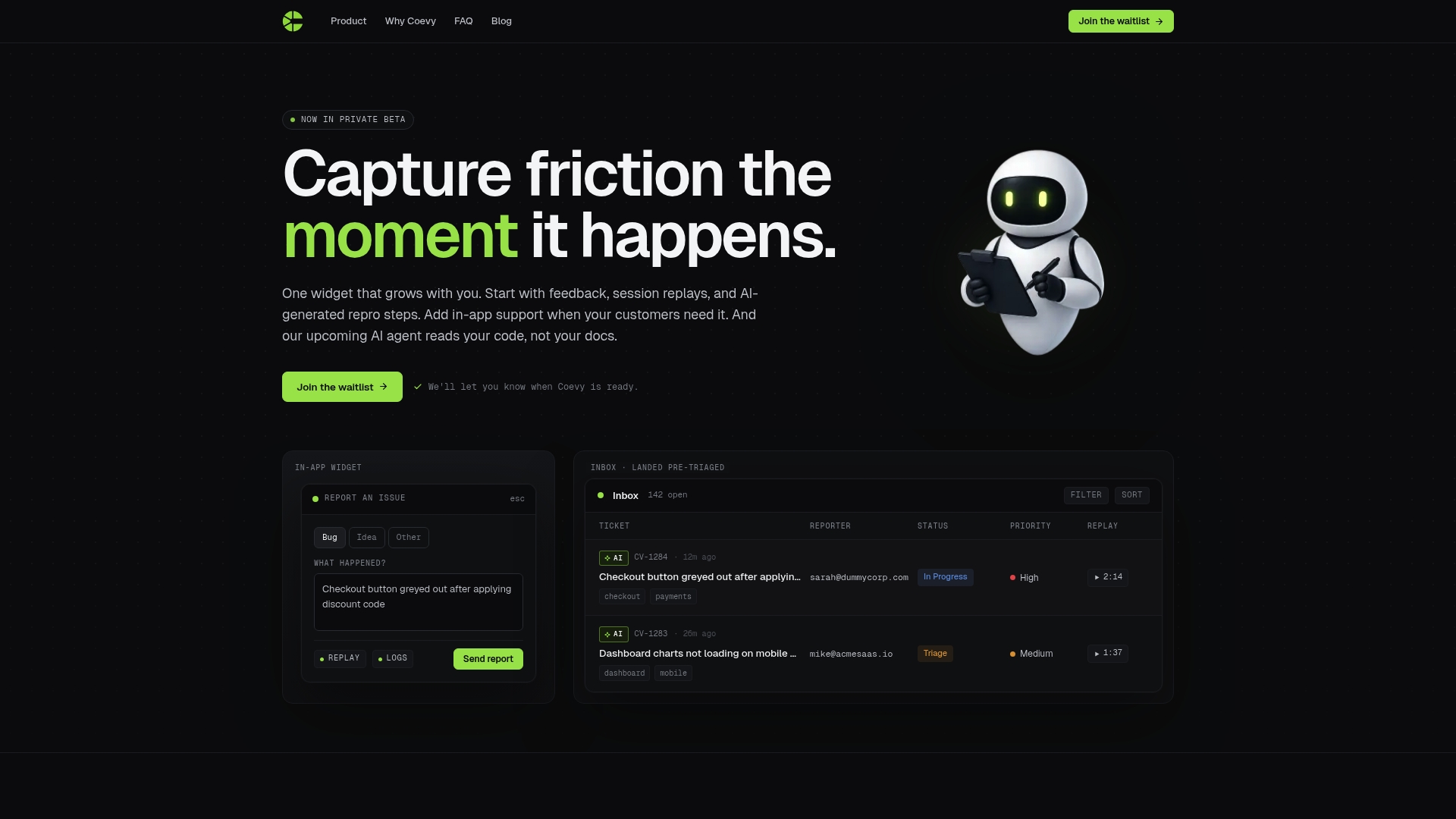
When a user struggles with a feature, Coevy surfaces the signal immediately with full context attached. Your team sees exactly what happened, without the back-and-forth that delays resolution. For SaaS teams building out their AI retention stack, Coevy's real-time friction detection gives you the behavioral data quality that predictive models require to work accurately. Explore Coevy to see how it fits into your retention workflow.
FAQ
What is the role of AI in SaaS user retention?
AI in SaaS user retention is the use of predictive models and automated workflows to identify at-risk users and trigger personalized interventions before cancellation. SaaS companies using these systems report 25–40% churn reduction within six months.
How accurate are AI churn prediction models?
AI models identify at-risk users with 85–90% accuracy, 60–90 days before cancellation, using signals like login frequency and feature usage decay.
When should a SaaS team build a custom AI retention model?
Build custom ML models only after you have clean, consistent event data at meaningful account volume. Under $1M ARR, manual health scores typically outperform ML models due to data limitations.
How does AI improve customer success manager efficiency?
AI-assisted CSMs manage $2M–$3M ARR books compared to the traditional $1M benchmark by automating data processing and routine tasks, freeing time for strategic account work.
What is the biggest risk in ai-driven retention programs?
The biggest risk is deploying AI on top of poor data or weak product-market fit. Without clean telemetry and clear objectives, AI amplifies noise and produces confident but inaccurate churn predictions.