When your backlog hits triple digits and engineers are triaging bug reports written in five different styles, reading every ticket in full becomes a real cost. That cost is exactly what AI-generated issue summary tools are designed to cut. Understanding what is AI-generated issue summary explained means isn't just a technical curiosity. For software teams, it's the difference between a support queue that resolves in hours and one that stalls for days. This guide breaks down how AI summaries work, where they genuinely help, and where they can quietly mislead you.
Table of Contents
- Key takeaways
- What is AI-generated issue summary explained
- Benefits of AI issue summaries in dev workflows
- Challenges and limitations you need to know
- Extractive vs. abstractive summarization
- Best practices for integrating AI summaries
- My take on where AI summaries actually fit
- See AI-powered issue capture in action with Coevy
- FAQ
Key takeaways
| Point | Details |
|---|---|
| AI summarization speeds up triage | AI-powered review tools compress multi-day manual reviews into minutes, directly benefiting bug queue management. |
| Two distinct methods exist | Extractive summarization quotes source text; abstractive summarization generates new sentences. Each fits different use cases. |
| Input quality determines output quality | Descriptive field names and structured data formats are what make AI summaries precise rather than vague. |
| Human review is non-negotiable | AI models can hallucinate or drop critical context. A human-in-the-loop step protects resolution accuracy. |
| Usefulness beats perfection | The goal of any AI summary is faster, more informed decisions, not textually flawless output. |
What is AI-generated issue summary explained
An AI-generated issue summary is a machine-produced condensation of a bug report, support ticket, or technical issue thread into a short, readable description. The AI reads the source content and outputs a shorter version that captures the core problem, relevant context, and sometimes a suggested next step. For software teams handling hundreds of tickets, understanding AI-generated content at this level is directly practical.
The technology behind this relies on natural language processing (NLP) and machine learning models, most commonly large language models (LLMs) like GPT-4 or similar generative architectures. These models are trained on enormous text datasets and learn to recognize what information in a piece of text is most relevant to a given question or task.
Two primary approaches drive how AI summarization works:
- Extractive summarization: The model scans the source text and pulls out sentences or phrases verbatim. Nothing is rewritten. The summary is a curated selection from the original.
- Abstractive summarization: The model generates entirely new sentences that paraphrase and synthesize the source material. This produces more readable output but introduces the possibility of subtle inaccuracies.
- Hybrid approaches: Many production tools combine both methods, using extractive passes to identify key content and abstractive passes to make the result fluent and concise.
When applied to a bug report, this means the AI might pull the error message directly (extractive) and then generate a one-sentence explanation of likely user impact (abstractive).
Pro Tip: When evaluating an AI summarization tool for your team, ask specifically whether it uses extractive, abstractive, or hybrid processing. The answer tells you a lot about how much you can trust the output without verification.
Benefits of AI issue summaries in dev workflows
The most obvious benefit is speed. AI-powered review tools reduce what would take manual reviewers days down to minutes. For a software support team processing 200 tickets a day, that compression directly affects how fast engineers get to the actual fix.
Beyond raw speed, here is how AI summaries create practical value across a typical development workflow:
- Automatic categorization: AI models can read a bug report and tag it by component, severity, or type without a human touching it. This means tickets land in the right queue from the moment they're submitted.
- Clearer communication across roles: A five-paragraph technical bug report might mean nothing to a product manager. An AI-generated two-sentence summary makes the issue legible across the team without losing the technical detail in the original ticket.
- Faster prioritization: When an AI summary highlights that three separate tickets all describe the same authentication failure, a team lead can bump that cluster to the top of the queue immediately. AI summaries help support agents scan and prioritize tickets far faster than reading full reports.
- Suggested resolutions: More advanced implementations, like those using codebase-aware models, can attach a likely fix or a relevant code reference directly to the summary. This cuts the time between "ticket opened" and "engineer has context."
The downstream effect on team collaboration is real. When everyone reads the same concise summary of a critical issue, discussions move faster and duplicate work drops. Generative AI can run multiple times per object to refine summaries until they hit the quality threshold your workflow needs.
Pro Tip: Don't evaluate your AI summary tool only on how fast it runs. Judge it on whether the output actually helps your team make faster decisions. Summaries should be judged on usefulness, not textual elegance.

Challenges and limitations you need to know
AI summaries are not a clean solution. They come with a category of failure that is particularly dangerous in software contexts: confident-sounding output that is factually wrong.
The most documented risk is hallucination. Generative AI models can produce information that sounds plausible but is simply incorrect. In a medical or legal context, this is catastrophic. In a bug report context, it can send an engineer down the wrong diagnostic path for hours.
Additional limitations worth taking seriously:
- Context loss: AI summaries frequently omit nuance, especially the environmental details that make a bug reproducible. An engineer reading only the summary might miss that the issue only occurs on Safari on iOS 17.
- Faithfulness gaps: The summary may accurately capture the tone of a ticket while misrepresenting its actual content. Faithfulness verification has emerged as the core bottleneck in production AI summarization systems, because fluency and accuracy are not the same thing.
- Garbage in, garbage out: If your bug reports are inconsistently formatted, missing key fields, or written in shorthand, the AI will produce vague or misleading summaries. The model is only as good as the data it processes.
- Overreliance risk: Teams that stop reading original tickets entirely, and trust only AI output, lose the ability to catch what the model missed. This is how small, critical bugs quietly slip through.
"Faster summarization is not always better summarization if the details that matter most are the ones that get dropped."
This risk profile doesn't mean you should avoid AI summaries. It means you should build workflows that treat them as a first pass, not a final answer.
Extractive vs. abstractive summarization
Understanding the difference between these two methods helps you pick the right tool and set the right expectations.

| Feature | Extractive | Abstractive |
|---|---|---|
| How it works | Pulls sentences verbatim from source text | Generates new sentences that paraphrase the source |
| Accuracy risk | Low. Output traces directly to source | Higher. Model may introduce inaccuracies |
| Readability | Can feel disjointed or overly literal | More natural and fluid |
| Compliance fit | Strong. Every word is sourced | Weaker. Claims may be harder to verify |
| Best use case | Audit trails, legal records, regulated workflows | Quick triage, team communication, Slack digests |
Extractive summarization is safer for compliance because every word in the output can be traced back to the original source. Abstractive summarization produces more readable output, but introduces the possibility that a paraphrase changes the meaning of the original claim.
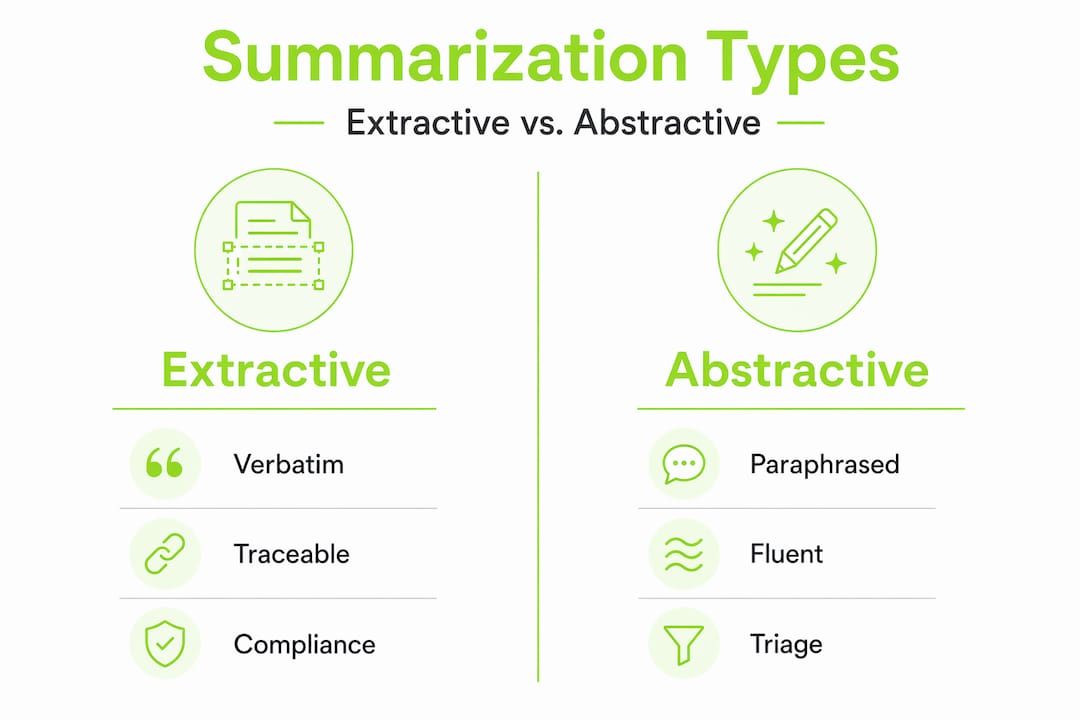
For most software development teams, abstractive summaries work well for daily triage and team communication. When you're documenting a bug that will drive a breaking change or a post-mortem, extractive or hybrid approaches give you a defensible audit trail.
Best practices for integrating AI summaries
Getting genuine value from AI issue summaries takes more than switching on a feature. Here is what actually works in practice.
Structure your input data first. Descriptive field names and consistent formats directly improve AI summary quality. If your bug report template has a field called "notes" that contains everything from stack traces to user complaints to internal Slack links, the AI will produce unfocused summaries. Label fields specifically: "steps to reproduce," "observed behavior," "expected behavior," "environment."
- Build a human-in-the-loop review step for any ticket that will trigger an automated action, like closing a ticket or escalating a severity level.
- Use dry-run modes before committing AI outputs to your issue tracker. Dry-run practices reduce API abuse and prevent duplicate issue creation from misconfigured automation.
- Set measurable success criteria. Track whether time-to-first-response improves, whether misrouted tickets decrease, and whether engineers report fewer "I didn't have enough context" moments.
- Treat AI summary failure as a data quality signal. If summaries for a specific component are consistently poor, that usually means the reports coming from that area are under-structured.
Integrating AI support into lean teams works best when the team defines what "good enough" looks like before deploying the tool rather than after.
Pro Tip: Assign one engineer per sprint to audit a random sample of AI-generated summaries against their source tickets. Ten minutes of spot-checking per week is enough to catch systematic errors before they become systematic problems.
Teams that do this well report meaningful efficiency gains. The best AI summarization systems combine fluent output with proof of accuracy, because fluency alone builds false confidence.
My take on where AI summaries actually fit
I've watched teams adopt AI summarization tools with genuine enthusiasm and then quietly scale back six months later. Not because the technology failed, but because their expectations were miscalibrated from the start.
What I've learned watching this pattern is that AI-generated summaries work exceptionally well as a first filter. They are phenomenal at turning noise into signal when your backlog is large and your team's reading time is limited. I've seen a well-configured summarization layer cut ticket triage time by more than half on teams handling 150-plus tickets per week.
But I've also seen what happens when teams stop reading original reports entirely. A hallucination in a summary about a database timeout gets triaged as a front-end issue. Two weeks later, the root cause is still there. The summary wasn't wrong in a dramatic way. It was wrong in a quiet, subtle way. That's the kind of failure nobody writes post-mortems about, which is exactly why it keeps happening.
My honest recommendation: use AI summaries aggressively for triage and communication, and cautiously for anything that drives automated action. The teams I've seen get the most value treat the AI as a capable first reader, not a decision-maker. They've also invested in source code ingestion for AI accuracy, which dramatically reduces the hallucination rate in summaries tied to specific code paths.
The future of AI summarization in software development is genuinely exciting. But the teams winning right now are the ones who stay skeptical enough to keep it honest.
— Dizzy
See AI-powered issue capture in action with Coevy
If your team is still manually reading every bug report before routing it, you're absorbing a cost that compounds fast as your product scales.
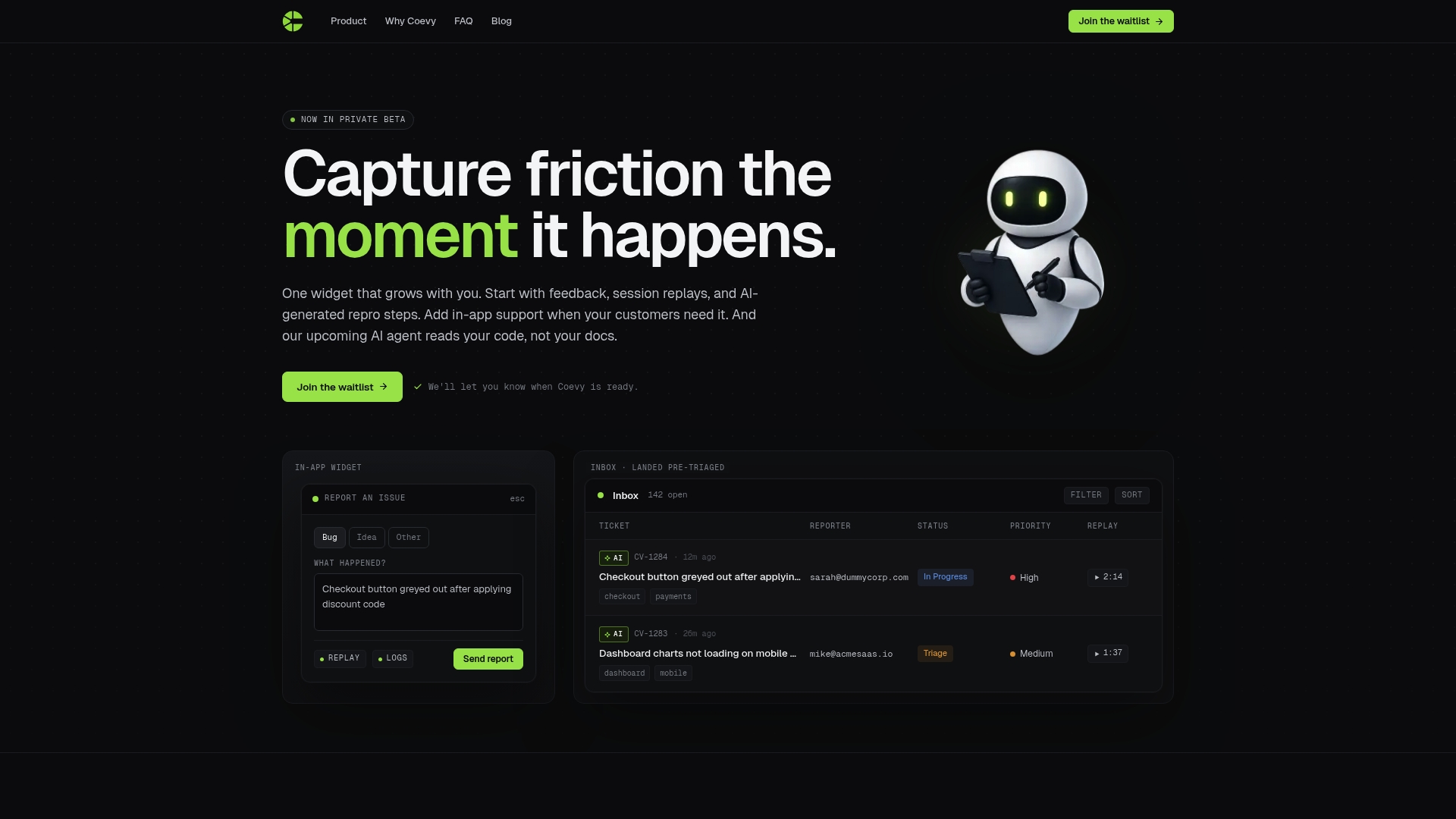
Coevy was built specifically for software teams who need AI to do more than search a knowledge base. The platform captures user feedback, session replays, and bug reproduction steps directly inside your web app, then attaches contextual session data automatically so your engineers get a complete picture without asking follow-up questions. Coevy's AI-powered features include auto-tagging, issue prioritization, and a codebase-aware AI agent that reads your actual source code rather than generic documentation. The result is summaries and triage recommendations that are grounded in what your app actually does. If that sounds like the upgrade your support workflow needs, start with Coevy.
FAQ
What is an AI-generated issue summary?
An AI-generated issue summary is a machine-produced condensation of a bug report or support ticket into a short description covering the core problem, key context, and sometimes a recommended next step. It uses NLP and large language models to produce this output automatically.
How does AI summarization work for bug reports?
AI summarization processes the text of a bug report using either extractive methods (pulling verbatim sentences) or abstractive methods (generating new paraphrased sentences). Extractive methods are safer for compliance while abstractive methods produce more readable output.
What are the main benefits of AI issue summaries for dev teams?
AI summaries speed up triage, improve cross-team communication, and enable automatic categorization of tickets. AI-powered tools reduce manual review from days to minutes, freeing engineers to focus on fixes rather than reading.
Can AI-generated summaries be wrong?
Yes. Generative AI models can hallucinate information that sounds accurate but is incorrect. AI summaries can also omit critical context like environment-specific details, which is why human review remains part of any reliable workflow.
What input data produces the best AI summaries?
Well-structured bug reports with specific, labeled fields produce significantly better summaries than freeform text. Descriptive field names and consistent formatting give the AI cleaner material to work with, which directly improves output precision.