Picking the wrong support tool as a startup does not just cost you money. It costs you time, customer trust, and engineering cycles you cannot get back. In 2026, the affordable saas support tools 2026 category has gotten genuinely crowded, and that is good news for founders on tight budgets. The bad news is that sticker price and actual cost are almost never the same number. This guide cuts through the noise with a curated list, real pricing data, and a decision framework built specifically for early-stage teams who need support that scales without the enterprise bill.
Table of Contents
- Key takeaways
- Essential criteria for evaluating affordable SaaS support tools
- Top affordable SaaS support tools in 2026
- 1. Deskwoot
- 2. Zendesk
- 3. Intercom
- 4. Hive Support
- 5. Coevy
- 6. Free-tier and open-source alternatives
- 7. AI chatbot tools as standalone support layers
- Comparison of featured tools by cost, AI features, and scalability
- Best use cases and recommendations by startup stage
- My honest take on the cost and functionality tradeoff
- Coevy fits where other support tools stop
- FAQ
Key takeaways
| Point | Details |
|---|---|
| Total cost beats sticker price | Always calculate seat fees, AI add-ons, and overage charges before committing to any plan. |
| AI pricing models vary wildly | Per-resolution AI billing can balloon costs faster than per-seat or flat-rate AI inclusion. |
| Consolidate early | Starting with one platform that covers feedback, ticketing, and AI support prevents costly tool sprawl later. |
| Self-hosting is a real option | WordPress-based help desks remove monthly SaaS fees entirely but require technical upkeep. |
| Free tiers are a starting point | Functional SaaS support stacks are achievable for $30 to $150 monthly with smart tier selection. |
Essential criteria for evaluating affordable SaaS support tools
Before you compare any tools, you need a consistent scoring lens. Most startup founders skip this step and end up evaluating tools based on demo quality rather than real-world fit.
Cost structure is where most surprises live. A tool priced at $49 per seat per month looks reasonable until you add the AI feature tier, the extra 500-ticket overage, and the required annual commitment. Always map out three scenarios: current usage, 3x growth, and peak load. If the cost curve turns vertical under any of those scenarios, the tool is not affordable. It is just cheap today.

AI-native support capabilities matter more in 2026 than they did two years ago. Tools built before AI became a default support expectation often bolt on AI as a separate charge. That distinction matters when AI usage fees dominate total cost at scale.
Here is what else to evaluate before you sign anything:
- Integration depth: Does the tool connect natively to your existing stack (Slack, GitHub, Stripe, CRMs)? A tool that requires a Zapier workaround for every integration will cost you hours every week.
- Data security and sovereignty: Where does customer data live? EU-based startups especially need to check GDPR compliance, field masking, and IP anonymization settings before onboarding.
- Scalability and vendor reliability: Avoid tools from vendors with no public roadmap or thin funding. Lifetime deal tools can be tempting, but for core support infrastructure prioritize vendor stability over a one-time price.
- Onboarding overhead: Some tools require weeks of configuration before they handle a single ticket. If you are a team of three, that is a real cost.
Pro Tip: Add a subscription tracking tool to your stack immediately. Paying for expired free trials or unused seat licenses is a surprisingly common drain. Unused SaaS tools quietly consume budget that could fund better tools.
Top affordable SaaS support tools in 2026
Here is a curated list of the best budget SaaS tools 2026 has to offer for support teams, with honest notes on where each one shines and where it falls short.
1. Deskwoot
Deskwoot positions itself as the most cost-transparent option in the affordable customer service tools category. The AI bot is included in every paid plan without extra seat surcharges. For a four-agent team, total monthly cost runs approximately $146 including AI overages. That flat-rate AI inclusion is the single biggest pricing differentiator in this segment. For budget-conscious teams hitting a few hundred support requests per month, Deskwoot is hard to beat on pure cost.
2. Zendesk
Zendesk carries real brand recognition and a deep feature set, but it is unambiguously a premium product. At $115 per agent per month for Suite Professional, plus a $50 AI add-on per agent, four seats costs roughly $660 per month. That is not affordable for most early-stage teams. Zendesk makes sense if you have enterprise clients who expect it by name, or if you are already at Series B and support complexity genuinely demands the workflow depth it offers.
3. Intercom
Intercom's AI chatbot "Fin" is technically impressive, but the pricing model is the most dangerous one in this comparison. Seats start at $39, which looks approachable. The catch is that Fin charges $0.99 per resolution. At moderate conversation volume with 50% AI deflection, total monthly costs can reach $1,330 for a small team. If your support volume spikes, your bill spikes with it. That unpredictability is the opposite of what bootstrapped founders need.
4. Hive Support
Hive Support takes a fundamentally different approach. It runs as a WordPress plugin, meaning no ongoing SaaS fees and local data storage inside your own infrastructure. For startups where data sovereignty is non-negotiable, or where recurring SaaS spend is genuinely unsustainable, this is worth serious consideration. The tradeoff is real: you own the maintenance burden, security patching, and uptime responsibility. It is a strong option if you have even one developer who can manage a WordPress environment comfortably.
5. Coevy
Coevy is purpose-built for software teams who need feedback collection, session replays, and AI-assisted bug reproduction inside a single widget. Rather than replacing a help desk, it fills a gap that most traditional support tools miss entirely: capturing friction at the exact moment it happens, with contextual session data attached automatically. Its GDPR-compliant architecture includes field masking and IP anonymization by default. For AI-first customer support workflows, Coevy's codebase-aware AI offers something genuinely different from documentation-reliant bots.
6. Free-tier and open-source alternatives
Several tools in the support space offer free tiers that cover a surprising amount of functionality. The best value tools in competitive SaaS categories now cover roughly 80% of premium functionality at no cost. Crisp, Tidio, and Freshdesk all offer free plans worth testing before you commit to any paid tier. Open-source ticket management tools are another angle, especially for teams comfortable with self-hosting. The ceiling on free tools is real, but it is high enough to support several hundred users before you hit it.
7. AI chatbot tools as standalone support layers
For very early-stage products with minimal support volume, a standalone AI chatbot can handle the majority of tier-one questions at near-zero cost. These tools work best when paired with a lightweight ticket system rather than used in isolation. The balance between automation and human escalation is what separates a cost-effective AI support layer from one that frustrates users. See how AI chatbots work for small products if you are exploring this route.
Comparison of featured tools by cost, AI features, and scalability
The table below gives you a SaaS support tools comparison across the dimensions that matter most for startup budget planning.
| Tool | Monthly cost (4 seats) | AI pricing model | Best for |
|---|---|---|---|
| Deskwoot | ~$146 | Flat-rate, included | Small teams wanting cost predictability |
| Zendesk | ~$660 | Per-seat add-on | Enterprise-expectation accounts |
| Intercom | ~$1,330 | Per-resolution ($0.99) | Teams with low, stable AI volume |
| Hive Support | One-time license | None (self-hosted) | Data sovereignty, no SaaS fees |
| Coevy | Contact for pricing | Codebase-aware AI | SaaS teams needing feedback and bug context |
| Free-tier tools | $0 to ~$50 | Limited or add-on | Pre-revenue and very early-stage teams |
The most important column is AI pricing model. Tools that charge per resolution are genuinely unpredictable at scale. A marketing campaign that drives 2,000 new signups and a flood of support requests could triple your Intercom bill without any change to your base plan. Deskwoot's flat-rate AI inclusion removes that variable entirely, which is why it dominates the cost-effective SaaS solutions conversation in 2026 for small teams.
Pro Tip: Run a 90-day cost projection before committing to any paid tier. Take your current monthly ticket volume, multiply by three, and calculate what each tool would charge at that load. The number that looks reasonable today often looks very different at moderate scale.
Vendor limitations matter too. Zendesk's depth is also its liability for early teams: the configuration overhead is substantial. Intercom's conversation design is excellent, but you need predictable support volume to budget reliably. Hive Support is powerful precisely because it removes SaaS fees, but requires technical maintenance that some teams simply cannot afford in hours, even if they can afford it in dollars.
Best use cases and recommendations by startup stage
Choosing the right tool depends less on features and more on where you are in your growth trajectory. Here is a stage-by-stage guide to making the right call.
Solo founders and pre-revenue teams: Start with a free tier from Crisp, Tidio, or Freshdesk. Pair it with Coevy's feedback widget to capture in-app friction without building a full support operation. You do not need a ticket system yet. You need to understand what is breaking.
Early-stage teams (2 to 10 people): Deskwoot is the standout choice here. The flat-rate AI pricing means you can experiment with AI deflection without worrying about bill shock. Selecting an integrated platform early prevents the tool sprawl that drains budgets at this stage.
Growing startups with 500 to 2,000 monthly support requests: This is where the SaaS support tools comparison becomes critical. At this volume, per-resolution AI pricing becomes genuinely expensive. Flat-rate AI tools or Coevy's integrated approach will outperform on total cost. Evaluate how AI support scales before locking into a per-resolution contract.
Teams with data sovereignty requirements: If you are in healthcare, fintech, or any regulated sector, Hive Support's self-hosted model or Coevy's GDPR-compliant architecture with field masking should be at the top of your evaluation. The technical overhead is real but often legally necessary.
Teams consolidating an existing tool stack: If you are already paying for three or four separate tools, run a consolidation audit. Businesses waste 30% of software budgets on underutilized tools. An all-in-one platform that handles feedback, ticketing, and AI support in one place will almost always win on total cost even if its per-seat price looks higher.
Teams approaching paid tier transitions: Move to a paid tier when free limits are causing support degradation, not before. The moment free-tier constraints start affecting response time or ticket visibility, that is your signal. Waiting too long creates user churn from poor support experiences that costs more than the plan upgrade would have.
My honest take on the cost and functionality tradeoff
I've spent a lot of time looking at support tool pricing, and the thing that surprises most founders is not that enterprise tools are expensive. It is that the tools marketed as affordable often carry the most unpredictable cost structures.
Intercom is the clearest example. The per-resolution AI model made sense when AI deflection was a novelty. In 2026, when AI is expected to handle the majority of tier-one queries, that model turns a core feature into a scaling tax. I've seen early-stage teams accidentally spend more on Intercom's AI fees in a single month than their entire previous support budget.
What actually works is starting lean and treating your first tool as a learning exercise, not a permanent commitment. Pick something with a flat-rate AI model or a free tier that covers your current volume. Use the first six months to understand your actual support patterns, not your projected ones. Then upgrade from a position of data, not ambition.
The shift I find genuinely interesting in 2026 is that AI-powered pricing models are forcing the whole market to re-examine what "affordable" actually means. A tool that was cheap in 2022 pricing logic may be expensive in 2026 usage patterns. The best budget SaaS tools 2026 has to offer are the ones that priced AI as a feature, not an add-on. That distinction is now the most important thing you can check before signing.
— Dizzy
Coevy fits where other support tools stop
If you are building a SaaS product and your support stack does not capture what users actually experienced before they reported an issue, you are guessing at root causes. Coevy fixes that gap.
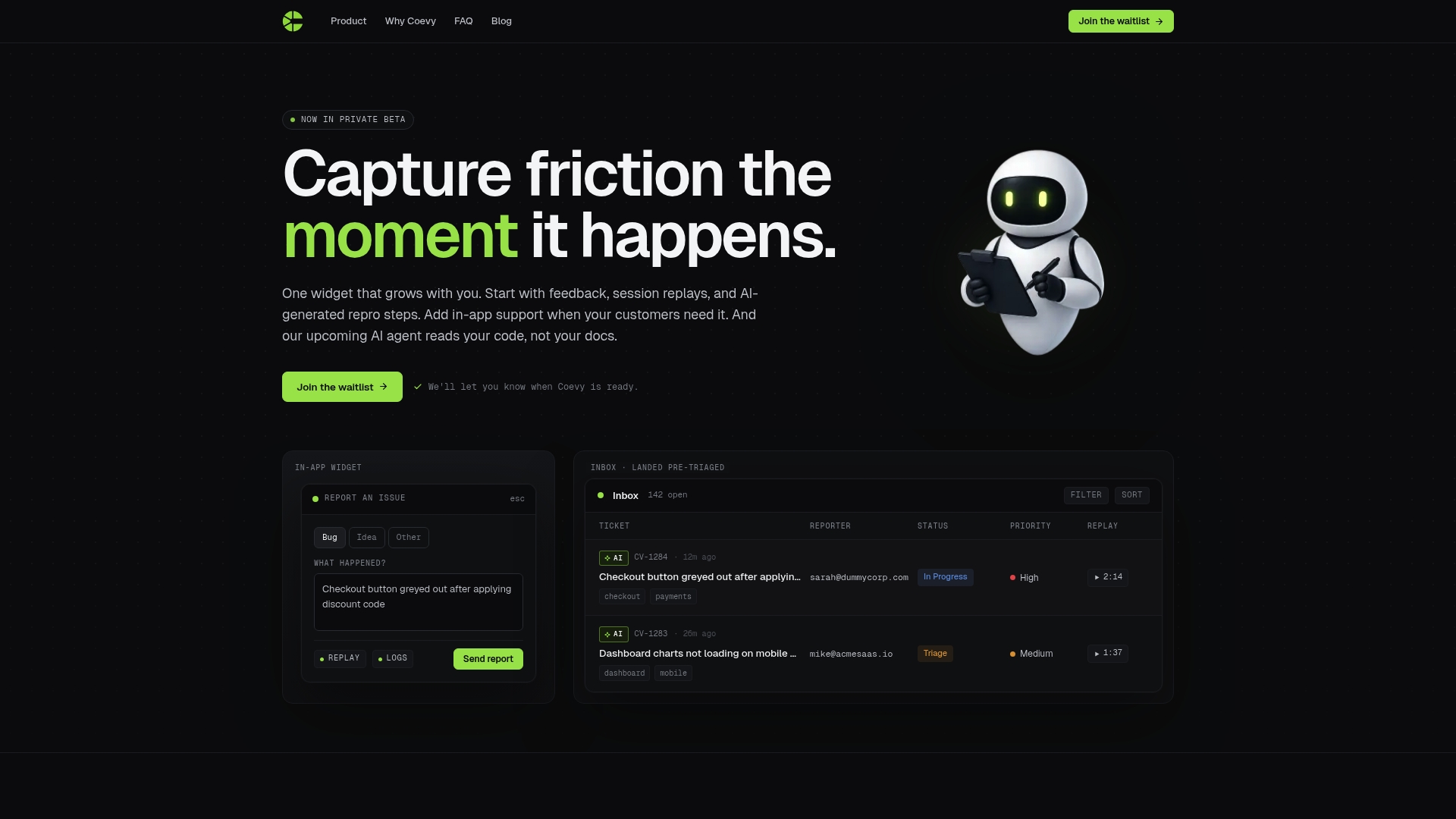
Coevy's in-app widget attaches session replays, auto-tagged bug reports, and AI-generated reproduction steps directly to every ticket. No back-and-forth. No "can you describe what happened?" The AI reads your actual codebase rather than generic documentation, which means answers are precise rather than plausible. It is GDPR-compliant by default, with field masking and IP anonymization built in. For teams comparing in-app feedback tools and trying to consolidate their support stack, Coevy sits comfortably in a budget-conscious architecture. Explore Coevy to see how it fits your current support workflow.
FAQ
What is the most affordable SaaS support tool in 2026?
Deskwoot offers the most predictable total cost for small teams, with AI included at approximately $146 per month for four agents. Free-tier tools like Crisp and Freshdesk are viable for pre-revenue teams.
How do I avoid surprise costs with AI support tools?
Always calculate the total cost at 3x your current support volume before committing. Per-resolution AI pricing models, like Intercom's $0.99 per resolution fee, can become the largest line item faster than most founders expect.
Is self-hosted help desk software worth it for startups?
Self-hosted tools like Hive Support eliminate recurring SaaS fees and keep data local, but require technical maintenance. They are worth it when data sovereignty is a legal or compliance requirement, not just a preference.
When should a startup move from a free to a paid support tier?
Move when free-tier constraints are causing measurable support quality issues, such as missed tickets or slow response times. Waiting too long creates customer churn that costs more than the paid plan would have.
How does Coevy differ from traditional help desk tools?
Coevy captures in-app friction with session replays and auto-tagged bug context at the moment issues occur, reducing the back-and-forth that traditional ticket tools require. Its AI reads actual source code rather than documentation for more accurate support responses.